Court Marriage in Pakistan: Documents, Procedure & Legal Validity 2026
SEO Title: Court Marriage in Pakistan: Documents, Procedure & Legal Validity
Meta Description: Complete guide to court marriage in Pakistan 2026. Learn required documents, step-by-step procedure, legal validity, free consent rules, Union Council registration, and rights of adult couples. Expert help from Justify.pk.
Introduction
Many couples in Pakistan choose a “court marriage” when they want a legally recognised marriage based on free consent, especially if families oppose the match or when a quick, documented process is needed.
In practical terms, a court marriage usually means a properly solemnised Nikah for Muslim couples that is registered with the Union Council and entered in NADRA records, often facilitated through a lawyer or licensed Nikah Registrar.
For certain non-Muslim or interfaith couples, procedures under the Special Marriage Act 1872 may apply.
This guide explains the documents required, standard procedure, legal validity, and important rights and protections for adult couples across Pakistan, including Lahore, Karachi, and Islamabad.
What Is a Court Marriage in Pakistan?
There is no single law titled “Court Marriage Act.” The term commonly refers to a legally recognised marriage completed according to the applicable personal law and registration requirements.
- A Nikah performed with the free consent of both adult parties.
- Proper documentation, including free-will or free-consent affidavits where required.
- Presence of the required witnesses.
- Registration with the relevant Union Council under the Muslim Family Laws Ordinance, 1961 for Muslim marriages.
- Subsequent issuance of the NADRA Marriage Registration Certificate.
For non-Muslims or specific interfaith situations, the Special Marriage Act 1872 may provide a civil marriage procedure involving notice to a Marriage Registrar and the applicable objection period.
A properly solemnised and registered marriage creates important legal rights and can be used for inheritance, maintenance, immigration, family records, and other legal proceedings.
Legal Requirements for Court Marriage
- Age: Both parties must meet the applicable legal minimum age. The exact rule should be confirmed according to the relevant provincial law.
- Free Consent: Both parties must enter the marriage voluntarily and without force, coercion, or undue pressure.
- Capacity: The parties must have the legal capacity to marry and must not fall within prohibited degrees of relationship.
- Previous Marriage: If previously married, appropriate divorce, khula, or death documentation may be required.
- Witnesses: Muslim Nikah generally requires the required adult witnesses according to applicable law and practice.
Adult persons who freely consent to marriage have important legal protections. Family disagreement by itself does not remove an adult’s legal capacity to marry.
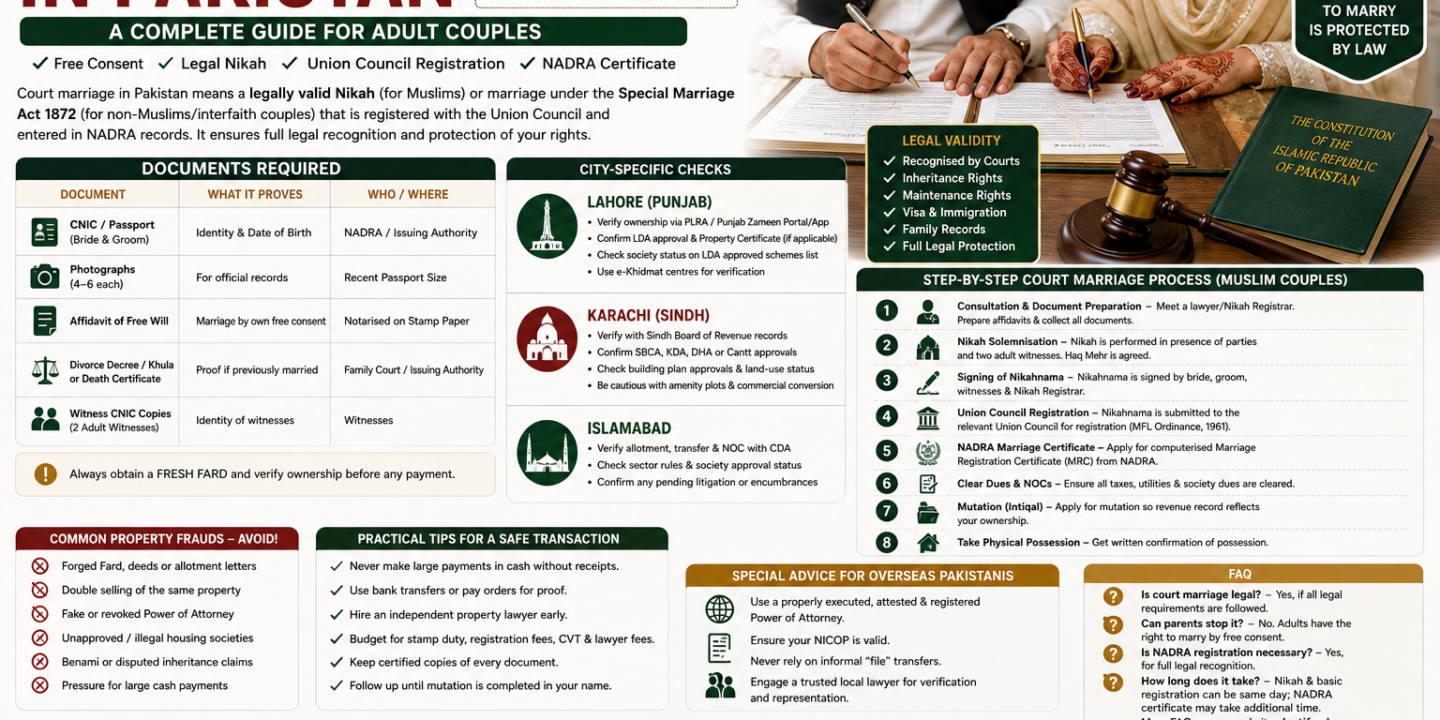
Documents Required for Court Marriage
For Bride and Groom
- Original CNIC, or applicable passport/NICOP for overseas Pakistanis.
- Recent passport-size photographs, usually 4–6 each.
- Free-will or free-consent affidavit where required.
- Divorce certificate, khula decree, or death certificate of a previous spouse, where applicable.
For Witnesses
- CNIC copies of the required adult witnesses.
The Union Council or Nikah Registrar may request additional documents, such as proof of age, residence, or other supporting records. Requirements can vary depending on the city, province, and circumstances.
Step-by-Step Court Marriage Procedure in Pakistan
-
Consultation and Document Preparation:
Consult a lawyer or licensed Nikah Registrar and prepare the required documents and affidavits. -
Nikah Solemnisation:
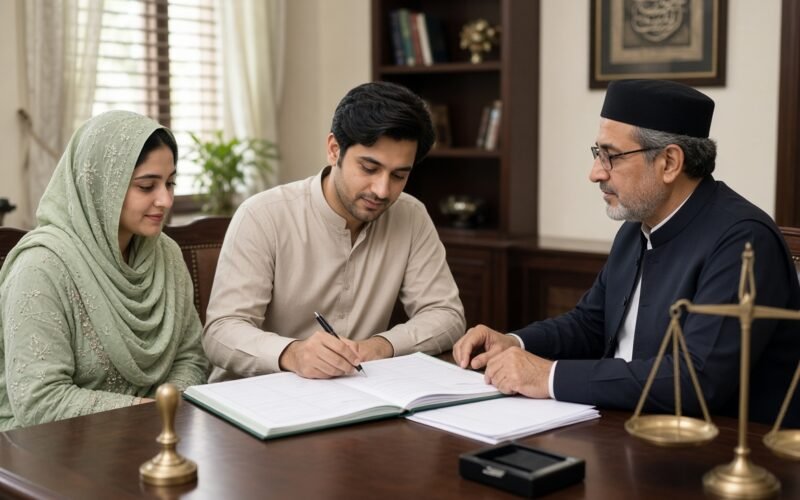
The Nikah is performed in the presence of the parties and required witnesses. Offer and acceptance take place and Haq Mehr is agreed. -
Signing of Nikahnama:
The bride, groom, witnesses, and Nikah Registrar complete and sign the Nikahnama. -
Union Council Registration:
The completed Nikahnama is submitted to the relevant Union Council for registration under the applicable law. -
NADRA Marriage Registration Certificate:
After registration, the parties may obtain the computerised NADRA Marriage Registration Certificate as official documentary proof of the marriage.
The Nikah and basic registration process may be completed quickly when documents are complete, although issuance of the NADRA certificate can take additional time. Special Marriage Act cases may involve a formal notice and applicable objection period.
Legal Validity of Court Marriage
A marriage properly solemnised according to the applicable legal and personal-law requirements and correctly registered has legal consequences and creates rights and obligations between the spouses.
- Creates legal spousal rights and obligations.
- Supports inheritance claims where applicable.
- Can support visa, passport, and immigration applications.
- Provides official family-record documentation.
- Can be relied upon in court and before government authorities.
- Provides stronger documentary protection when free consent and registration are properly established.
Important Legal Protections and Practical Tips
- Free consent is fundamental to a valid marriage.
- Keep copies of the signed Nikahnama and registration documents.
- Complete Union Council registration promptly.
- Obtain the NADRA Marriage Registration Certificate where applicable.
- For interfaith marriages, obtain advice regarding the applicable personal law and procedure.
- If there is a genuine threat of violence or unlawful interference, seek legal protection promptly.
- Do not rely on unlicensed intermediaries for important legal documentation.
City-Specific Considerations
Lahore
Couples in Lahore should ensure that their Nikah is conducted by an authorised Nikah Registrar and that the marriage is properly registered with the relevant Union Council.
Karachi
Couples in Karachi should verify the applicable Sindh registration requirements and ensure that all documents submitted to the relevant Union Council are complete and accurate.
Islamabad
Couples in Islamabad should confirm the registration requirements applicable to their locality and maintain certified copies of their Nikahnama and marriage registration documents.
Special Considerations for Overseas Pakistanis
Overseas Pakistanis may require additional identity documents such as NICOP or passport. If a marriage is being arranged or documented while one party is abroad, additional authentication or Power of Attorney requirements may apply depending on the transaction.
- Keep NICOP and passport information current.
- Use properly executed and authenticated documents.
- Verify requirements with the relevant Pakistani Mission where necessary.
- Keep certified copies of marriage documents.
Common Problems to Avoid
- Using incomplete or incorrect CNIC information.
- Failing to properly register the Nikahnama.
- Using false or forged documents.
- Not obtaining copies of signed marriage documents.
- Ignoring applicable age requirements.
- Relying on verbal promises instead of proper documentation.
- Using an unauthorised person to perform or register the Nikah.
Internal Link
Read also:
Child Marriage Laws in Pakistan – Recent Reforms & Penalties
Frequently Asked Questions
1. Is court marriage legal in Pakistan?
Yes. When the applicable legal requirements are satisfied, including free consent, required formalities, witnesses where applicable, and proper registration, the marriage is legally recognised.
2. Can parents stop an adult couple from marrying?
Adult persons have legal protections to marry according to their free choice, subject to the applicable law. Family disagreement alone does not automatically invalidate a marriage.
3. What is the minimum age for court marriage?
The applicable minimum age depends on the relevant law and jurisdiction. Couples should confirm the current provincial or territorial rule before proceeding.
4. Do we need a lawyer for court marriage?
A lawyer is not necessarily required in every case, but professional legal assistance is strongly recommended where documentation, family opposition, interfaith issues, overseas documents, or legal risks are involved.
5. Is NADRA registration necessary?
Proper Union Council registration is important for official recognition and documentation. A NADRA Marriage Registration Certificate provides widely used documentary evidence of the marriage.
6. Can interfaith couples have a court marriage?
Interfaith marriage can involve complex questions of personal law and applicable legislation. The exact legal route depends on the religions and circumstances of the parties, so specific legal advice should be obtained.
7. How long does court marriage take?
The Nikah and basic registration may be completed quickly when all documents are ready. Issuance of official registration certificates can take additional time.
Conclusion
Court marriage in Pakistan provides a legally recognised route for eligible adult couples who wish to marry through free consent and proper documentation. Completing the required formalities, including the Nikahnama, witnesses, Union Council registration, and applicable NADRA documentation, helps protect the legal rights of both spouses.
Understanding the documents, procedure, registration requirements, and applicable personal law before proceeding can help couples avoid unnecessary legal complications.
Need Legal Assistance?
Planning a court marriage in Lahore, Karachi, Islamabad, or anywhere in Pakistan? Need help with documents, free-will affidavits, Nikah registration, or NADRA formalities?
Contact the experienced family law team at Justify.pk for confidential, professional guidance and legal support.
Written by the Legal Team at Justify.pk | August 30, 2026