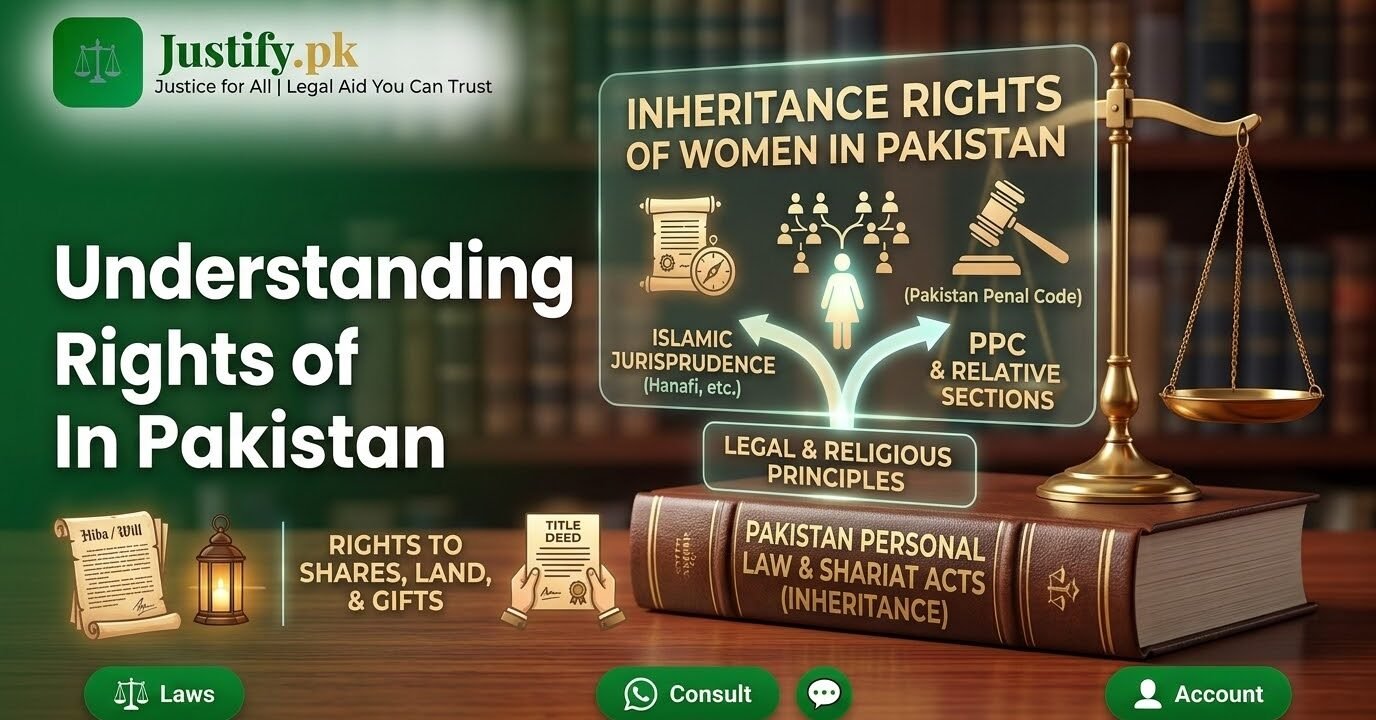
Under Pakistani law, the inheritance rights of women sit at the intersection of Islamic jurisprudence, constitutional guarantees and statutory protections. Both Islamic law and Pakistan’s legal system ensure that female relatives receive a fixed share of property on the death of an ancestor, yet socio-cultural practices often lead to women being unlawfully deprived of their share.
Understanding the legal mechanisms, criminal safeguards and remedies available is essential for protecting female heirs across Pakistan.
1. The Islamic Legal Framework (Shariat)
Inheritance matters for Muslim citizens in Pakistan are governed by Muslim personal law, applied through the West Pakistan Muslim Personal Law (Shariat) Application Act, 1962. Under Islamic law, inheritance shares are fixed Quranic rights (fara’id) that vest in the legal heirs on the death of the property owner:
- Daughters: A single daughter inherits 1/2 of the estate if there are no sons. Two or more daughters with no sons collectively share 2/3. When sons are present, a daughter receives half of the share of a son.
- Widow: A widow receives 1/8 of her deceased husband’s estate if there are surviving children, or 1/4 if there are none.
- Mother: A mother receives 1/6 of her deceased child’s estate if the deceased left children or two or more siblings; otherwise she generally receives 1/3, subject to applicable exceptions.
2. Criminal Safeguards Under the Pakistan Penal Code (PPC)
To stop relatives from coercing female heirs into giving up their property, the legislature introduced a specific criminal offence:
Section 498-A PPC (prohibition of depriving a woman from inheriting property): whoever by deceitful or illegal means deprives any woman from inheriting any movable or immovable property at the time of opening of succession is punishable with imprisonment of either description for a term which may extend to ten years but shall not be less than five years, or with a fine of one million rupees, or both.
3. Summary Remedies Through the Ombudsperson
Because civil litigation can take years, special laws now give women a faster forum to enforce their property and inheritance rights:
- Islamabad Capital Territory: the Enforcement of Women’s Property Rights Act, 2020 allows a woman to complain to the Federal Ombudsperson for Protection against Harassment.
- Punjab: the Punjab Enforcement of Women’s Property Rights Act, 2021 provides a similar remedy before the Provincial Ombudsperson.
- Khyber Pakhtunkhwa: the Khyber Pakhtunkhwa Enforcement of Women’s Property Rights Act, 2019 provides a similar remedy before the Provincial Ombudsperson.
Under these laws the ombudsperson can order an inquiry, typically through the Deputy Commissioner, and where the claim is established, direct that the woman be given possession of her property. Where no such special law applies, women can still use civil proceedings and the criminal remedy under Section 498-A PPC.
4. Judicial Stance of the Superior Courts
The superior courts of Pakistan take a strict view of forced or fraudulent relinquishment of inheritance:
- Heavy burden of proof on the beneficiary: claims that a female heir voluntarily gave up or gifted (hiba) her share to male relatives are examined with great caution. The courts have repeatedly held that the person relying on such a transfer must prove that it was voluntary, informed and made with independent advice.
- Title vests on death: succession opens immediately on the death of the property owner. No deed or court declaration is needed to “create” a woman’s share; it vests by operation of law.
Conclusion
Women’s inheritance in Pakistan is a protected, non-negotiable legal right. Female heirs whose shares have been denied or unlawfully transferred can seek remedies through the ombudsperson where a women’s property rights law applies, file civil proceedings for declaration and partition, or lodge a criminal complaint under Section 498-A PPC against those responsible.
Legal Disclaimer: This article provides general legal information and is not a substitute for advice from a qualified advocate.
Join Justify.pk on WhatsAppGet new legal news, jobs, scholarships and law updates on WhatsApp — free.
Join Channel