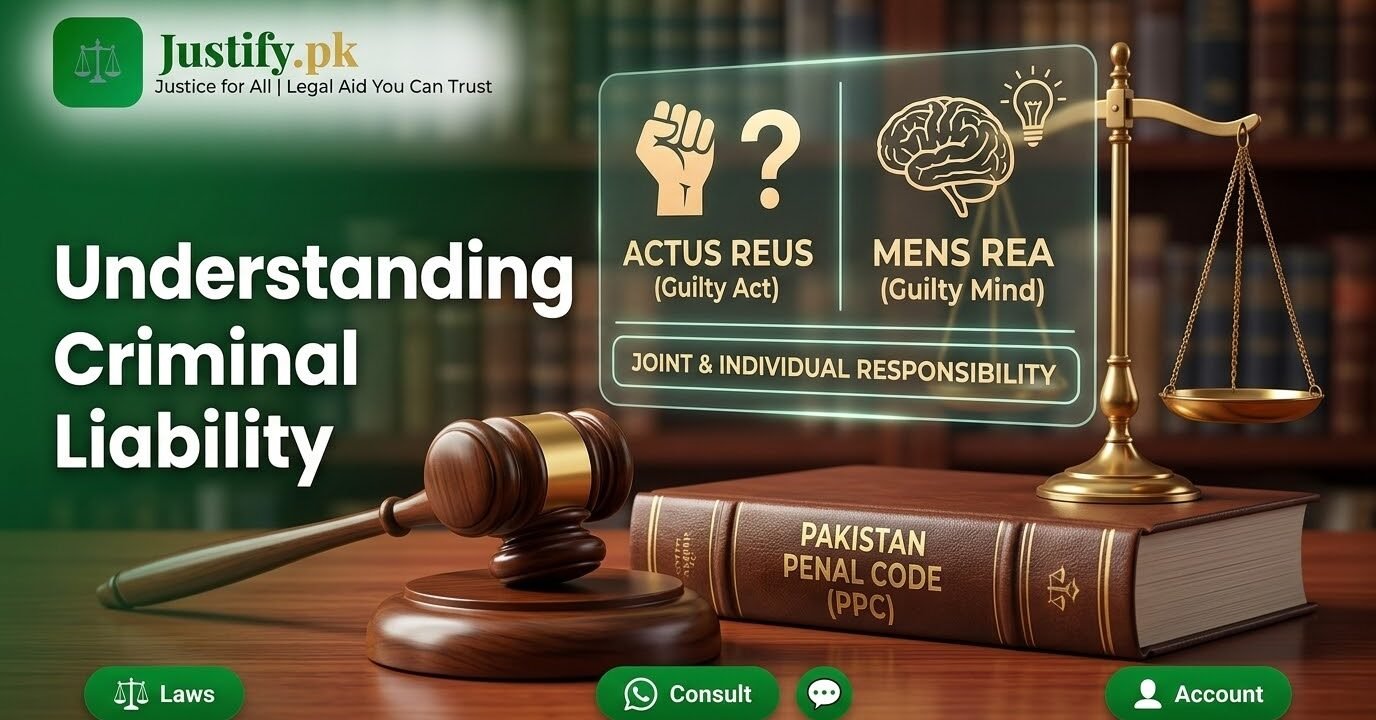
Criminal liability is the core legal principle that determines whether an individual or entity can be held legally accountable for a crime and subjected to statutory punishment. In Pakistani jurisprudence—governed primarily by the Pakistan Penal Code (PPC), 1860, and the Code of Criminal Procedure (CrPC), 1898—establishing criminal liability requires proving specific legal elements beyond a reasonable doubt.
Understanding how criminal liability is defined, established, and categorized is fundamental to navigating the criminal justice system.
The Fundamental Elements of Criminal Liability
Under classic legal philosophy, an act alone does not make a person guilty unless their mind is also guilty (actus non facit reum nisi mens sit rea). Consequently, establishing criminal liability generally requires two indispensable elements:
Actus Reus (The Guilty Act): The physical element of a crime. This includes the overt physical act, omission, or state of affairs prohibited by law. For instance, in theft, the physical taking of property constitutes the actus reus.
Mens Rea (The Guilty Mind): The mental state or intention accompanying the physical act. Depending on the offense, mens rea can take various forms:
Intention: A deliberate purpose to bring about a specific harmful result.
Knowledge: Awareness that a particular outcome is almost certain to follow from an act.
Recklessness/Negligence: Disregarding a substantial risk or failing to exercise standard reasonable care (e.g., rash driving under Section 279 PPC).
Strict Liability Offenses: The Exception to Mens Rea
While mens rea is a general requirement, statutory law contains specific exceptions where criminal liability attaches without proving a guilty mind. These are known as Strict Liability Offenses.
In strict liability cases, performing the prohibited actus reus is sufficient for a conviction. Common examples in Pakistan include:
Food adulteration laws
Environmental pollution regulations
Specific traffic and public health violations
Types and Modes of Criminal Liability
Criminal liability is not restricted solely to the person who directly executes a crime. The law recognizes several modes of liability:
Direct/Individual Liability: Attaches to the principal offender who personally commits the criminal act.
Joint/Constructive Liability: Applies when multiple individuals act in concert. Under provisions like Section 34 PPC (Common Intention) or Section 149 PPC (Unlawful Assembly), participants can be held equally liable for acts committed by others in furtherance of a shared goal.
Vicarious Liability: Generally rare in criminal law, vicarious liability holds one person responsible for the acts of another (e.g., an employer’s liability under specific regulatory statutes).
Abetment and Conspiracy: Under Section 107 and Section 120A/120B PPC, encouraging, instigating, or conspiring with others to commit a crime generates independent criminal liability, even if the abettor was not physically present during the crime’s execution.
Standard of Proof and Defenses
In all criminal proceedings in Pakistan, the burden of proving criminal liability rests entirely on the prosecution. The standard of proof is exceptionally high: guilt must be established beyond a reasonable doubt.
If the prosecution meets this burden, the defense may plead statutory exceptions outlined in Chapter IV of the PPC (General Exceptions). These defenses—such as private defense (self-defense), insanity, infancy, or necessity—can negate or reduce criminal liability.
Join Justify.pk on WhatsAppGet new legal news, jobs, scholarships and law updates on WhatsApp — free.
Join Channel