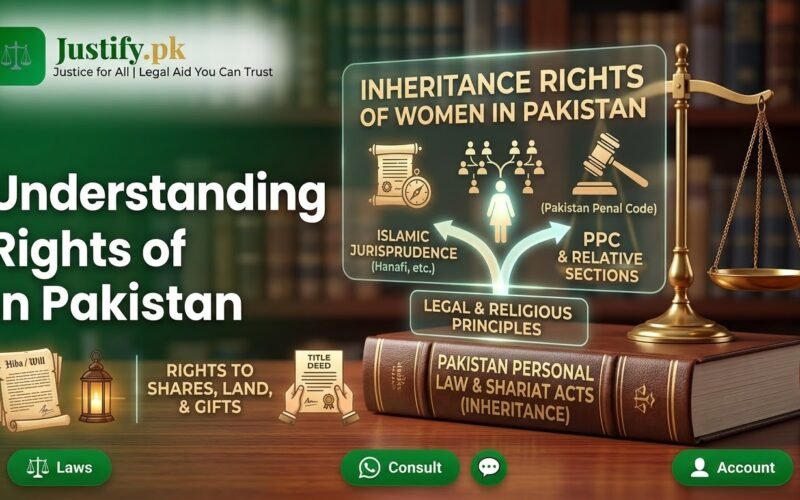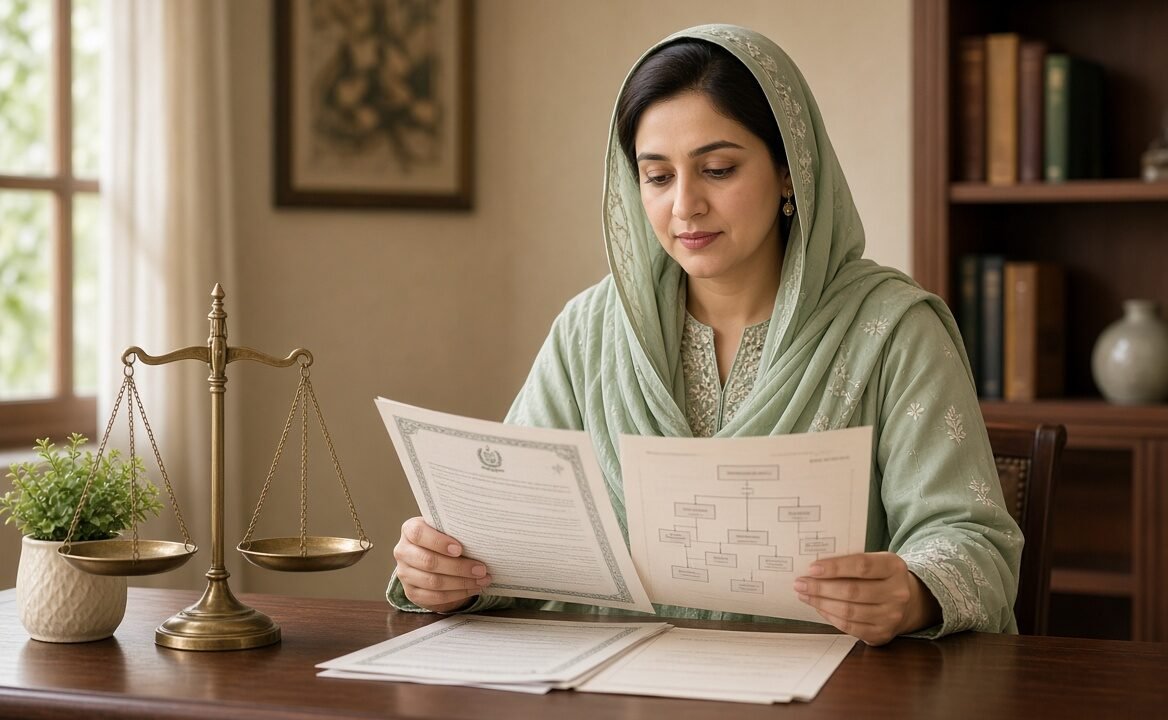
Under Pakistani law, the inheritance rights of women and daughters are mandatory and legally protected through Islamic principles and applicable Pakistani laws. These rights cannot lawfully be taken away merely through family pressure, custom, or an unlawful arrangement.
Legal Framework for Women’s Inheritance Rights
The West Pakistan Muslim Personal Law (Shariat) Application Act, 1962 provides for the application of Muslim personal law to matters including inheritance. The Constitution of Pakistan and judicial decisions also protect the legal rights of women to inherit property.
Pakistani courts have repeatedly emphasized that a woman cannot simply be deprived of her lawful inheritance share because of family custom, social pressure, or an informal family arrangement.
Key Inheritance Shares for Women
Under Sunni Hanafi principles, which are followed by a large majority of Pakistani Muslims, the exact share depends on the surviving heirs.
| Heir | Share | When it applies |
|---|---|---|
| Wife (Widow) | 1/8 or 1/4 | 1/8 if the deceased husband left children; 1/4 if he left no children |
| One Daughter | 1/2 | When there is no son |
| Two or More Daughters | 2/3 collectively | When there is no son; shared equally between the daughters |
| Daughter(s) with Son(s) | Residuary share | Each son receives twice the share of each daughter |
| Mother | 1/6 or 1/3 | 1/6 if the deceased left children or two or more siblings; otherwise generally 1/3, subject to applicable exceptions |
Exact inheritance shares can vary depending on the complete combination of surviving heirs. A qualified legal practitioner should calculate the estate before distribution.
Important Rules About Women’s Inheritance
- When sons and daughters inherit together, the general Quranic rule is that a son receives twice the share of a daughter.
- If there is more than one widow, the widow’s collective share is divided equally among the surviving wives.
- Fixed inheritance shares cannot simply be removed through an informal family agreement.
- A woman does not lose her inheritance merely because she is married.
- A daughter cannot be deprived of her lawful inheritance merely because she lives with her husband or outside her parental home.
Protection Against Deprivation of Inheritance
Any attempt to deprive a woman of her lawful inheritance through fraud, coercion, deception or unlawful means may be challenged before the competent authorities or courts.
Courts may carefully examine documents such as alleged gifts (hiba), relinquishment deeds, family settlements and compromises where there is an allegation that a woman’s lawful inheritance was unlawfully taken away.
Section 498-A Pakistan Penal Code
Section 498-A of the Pakistan Penal Code makes it an offence to deprive a woman of her inheritance through deceitful or illegal means. Depending on the facts of the case, criminal as well as civil remedies may be available.
A person whose inheritance has been denied should obtain professional legal advice to determine the appropriate remedy and forum.
How to Claim Your Inheritance Share
- Obtain the Death Certificate: Obtain official proof of the deceased’s death.
- Obtain the Family Registration Certificate (FRC): Obtain relevant family information from NADRA.
- Collect Property Records: Obtain the relevant Fard, Record of Rights and other property documents.
- Identify the Legal Heirs: Determine all surviving heirs before calculating the inheritance shares.
- Obtain Succession Documentation: Depending on the nature of the assets, a succession certificate or other appropriate succession documentation may be required.
- Apply for Inheritance Mutation: For land and other immovable property, the relevant inheritance mutation should be completed in the revenue record.
- Seek Legal Remedy: If another heir refuses to recognize the lawful share, appropriate declaratory, partition or other proceedings may be initiated before the competent court.
Inheritance of Agricultural Land
Women and daughters can have inheritance rights in agricultural land. The applicable Muslim personal law principles govern the distribution of the estate among eligible heirs, subject to the relevant statutory framework and facts of the case.
Practical Tips for Women
- Do not sign a relinquishment or gift document without understanding its legal effect.
- Do not sign documents under family pressure or coercion.
- Keep copies of property and inheritance documents.
- Obtain updated revenue records relating to inherited property.
- Keep evidence of any threats, pressure, fraud or unlawful transfer.
- Seek legal advice promptly if your inheritance is being withheld.
Orphaned Grandchildren and Inheritance
Section 4 of the Muslim Family Laws Ordinance, 1961 contains a specific rule concerning the children of a predeceased son or daughter. The application of this provision depends on the family structure and the circumstances of the deceased.
Frequently Asked Questions
Can brothers exclude sisters from inheritance?
No. A brother cannot lawfully deprive a sister of her legal inheritance share merely because of family custom or personal preference. A woman may challenge an unlawful deprivation through the appropriate legal process.
Does a daughter lose her inheritance after marriage?
No. Marriage does not by itself cancel a daughter’s inheritance rights from her deceased parent.
Do women have inheritance rights in agricultural land?
Yes. Women can inherit agricultural land according to the applicable Muslim personal law and statutory framework.
Can a will completely exclude a daughter from inheritance?
A will cannot simply be used to override the mandatory inheritance rights of legal heirs. The legal effect of a will depends on the applicable Muslim personal law, the nature of the bequest and the consent of the relevant heirs.
What should a woman do if her family refuses to give her inheritance?
She should collect the relevant family and property records and consult a qualified advocate. Depending on the circumstances, civil, revenue and potentially criminal remedies may be available.
Need Help Claiming Your Inheritance Share?
If you or a female family member is being denied a lawful inheritance share, Justify.pk can provide guidance regarding succession documentation, inheritance mutation, legal notices, partition proceedings and other available legal remedies.
Contact Justify.pk: 0300-0779014
Legal Disclaimer: This article provides general legal information and is not a substitute for advice from a qualified advocate. The exact inheritance share depends on the complete list of surviving heirs, the applicable school of Muslim law and the nature of the assets. Legal procedures may also vary depending on the jurisdiction and circumstances.
Join Justify.pk on WhatsAppGet new legal news, jobs, scholarships and law updates on WhatsApp — free.
Join Channel