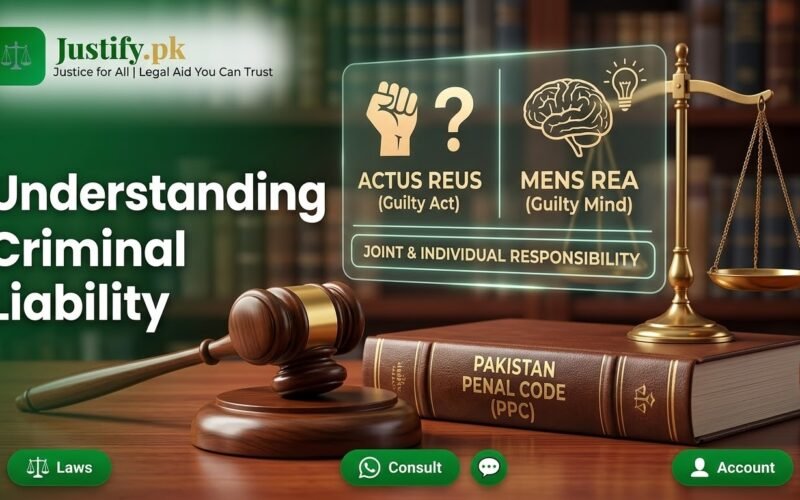
When multiple individuals are involved in committing an offense, establishing individual guilt requires a precise examination of their mental state (mens rea). In criminal law, a common area of confusion arises when distinguishing between acts committed under a shared design versus acts committed with merely similar intention. While both involve similar mental states targeting the same individual or outcome, the legal ramifications are fundamentally different.
What is Similar Intention?
Similar Intention refers to a situation where two or more persons independently form a similar mental design, objective, or intention to commit a criminal act against the same victim or at the same time, without any pre-arranged plan, mutual arrangement, or meeting of minds.
Unlike common intention (governed by Section 34 of the Pakistan Penal Code), where co-accused act in furtherance of a shared scheme, similar intention involves individual minds operating side by side independently.
Key Characteristics of Similar Intention
To categorize an act as being driven by similar intention rather than common intention, courts evaluate the following elements:
Independent Formation of Mind: Each participant conceives their intent on their own, driven by personal motives, grudges, or spontaneous decisions.
Absence of Pre-Arranged Plan (Pre-Concert): There is no meeting of minds prior to or during the occurrence. Neither party acts on behalf of or in reliance upon the other.
Simultaneous Action: The criminal acts of the participants occur at or near the same time, creating an appearance of joint action even though no agreement exists.
Legal Consequence: Individual vs. Constructive Liability
The distinction between common intention and similar intention carries critical consequences in criminal prosecutions:
No Constructive Liability: Section 34 PPC imposes joint or “constructive” liability, holding every participant equally responsible for the ultimate result of the crime, regardless of who inflicted the fatal injury. Under similar intention, Section 34 PPC does not apply.
Strict Individual Liability: Under similar intention, each accused is held criminally liable strictly for their own specific act and the actual injury caused.
For example, if two individuals independently shoot at a victim at the same time without prior concert, and one bullet strikes a non-vital limb while the other causes death, the shooter who inflicted the fatal wound is charged with murder, while the other is charged only for the specific injury or attempt attributable to them.
Judicial Approach and Burden of Proof
Pakistani superior courts have consistently ruled that common intention cannot be lightly presumed merely from the presence of multiple accused persons at a crime scene. Where the prosecution fails to establish a prior meeting of minds or a shared plan, the court will treat the intention as merely similar or independent.
In such cases, the burden rests on the prosecution to prove the exact role and specific injury caused by each individual accused to sustain a conviction.
Join Justify.pk on WhatsAppGet new legal news, jobs, scholarships and law updates on WhatsApp — free.
Join Channel