By Justify.pk Editorial Team | Based on the legal training research of Mirza Abdur Rehman, Deputy Director Legal, Anti-Narcotics Force (ANF) | Reviewed by Zeshan Haider Advocate | WhatsApp: 0300-0779014
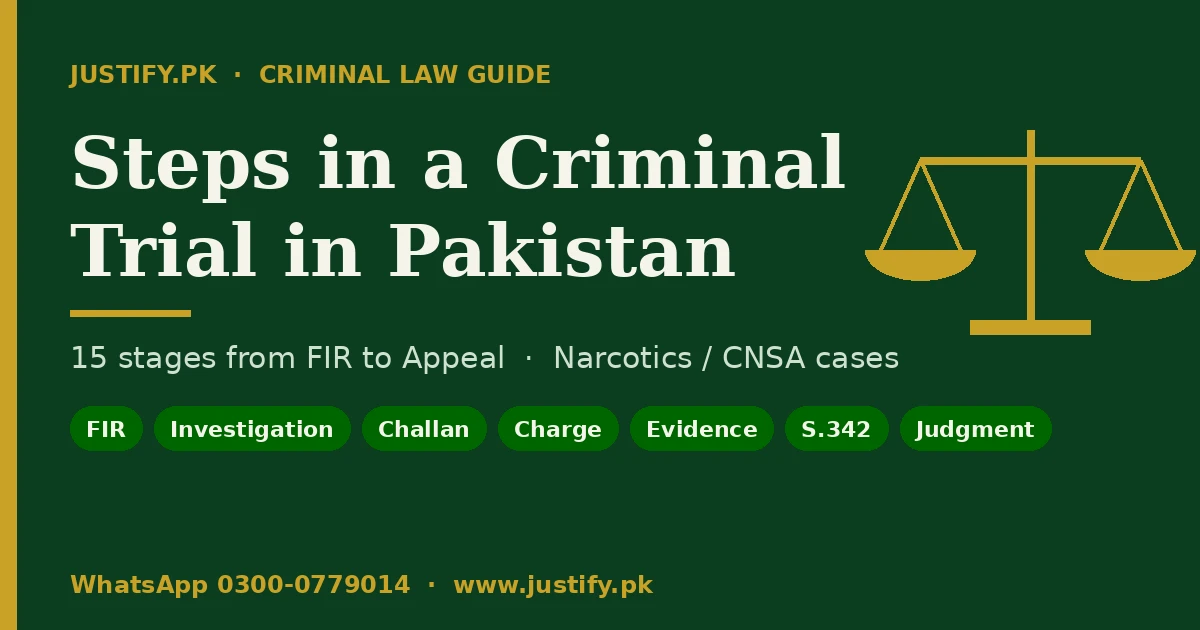
If you, a family member or a client has been named in an FIR, the first question is always: what happens next? A criminal trial in Pakistan is not a single hearing. It is a chain of legally distinct stages under the Code of Criminal Procedure, 1898 (CrPC), the Qanun-e-Shahadat Order, 1984 (QSO) and, in drug cases, the Control of Narcotic Substances Act, 1997 (CNSA). A defect at any stage can change the result. This guide walks through all 15 stages of a criminal trial, from FIR to appeal, and explains the special evidentiary rules that decide most narcotics cases.
Watch: ANF فوجداری مقدمے کے مراحل (Video in Urdu)
Need help with an FIR, bail or trial right now? Talk to a verified advocate through Justify.pk.
WhatsApp / Call: 0300-0779014 | Request a free consultation
Quick Answer: The 15 Stages at a Glance
- Commission of offence and FIR (s.154 CrPC)
- Investigation (ss.156–173 CrPC)
- Arrest and remand (Article 10, ss.61 and 167 CrPC)
- Challan / police report (s.173 CrPC)
- Cognizance by the court
- Appearance, bail and supply of copies (ss.241-A, 265-C CrPC; s.51 CNSA)
- Framing of charge (ss.221–240, 265-D CrPC)
- Prosecution evidence
- Cross-examination
- Statement of accused under s.342 CrPC
- Defence evidence
- Final arguments
- Judgment (s.366 onwards CrPC)
- Sentencing
- Appeal, revision and other remedies (CrPC; s.48 CNSA)
The Constitutional Foundation of a Fair Trial
Every stage operates inside the Constitution of Pakistan, 1973. The key guarantees are:
| Article | What it protects |
|---|---|
| Article 4 | Right to be dealt with in accordance with law |
| Article 9 | Security of person, life and liberty |
| Article 10 | Safeguards on arrest and detention |
| Article 10A | Right to a fair trial and due process |
| Article 13 | Protection against double punishment and self-incrimination |
| Article 14 | Dignity of man |
| Article 25 | Equality before law |
A prosecution must pass two tests: the offence must be proved by legally admissible evidence, and that evidence must have been collected and presented lawfully. Failing either can defeat an otherwise strong case.
The Main Laws Involved
- CrPC 1898 — the procedural code for FIR, investigation, remand, charge, trial and judgment.
- Qanun-e-Shahadat Order 1984 — the law of evidence, including Article 164 on evidence from modern devices.
- CNSA 1997 — the special regime for narcotics: s.29 (presumption), s.36 (Government Analyst reports), s.47 (CrPC applies subject to CNSA), s.48 (appeals) and s.51 (bail restrictions).
- ANF Act 1997 — the institutional framework of the Anti-Narcotics Force.
- Control of Narcotic Substances (Government Analysts) Rules 2001 — testing and reporting, especially Rule 6.
Stage-by-Stage Explanation
1. FIR Registration (Section 154 CrPC)
Information about a cognizable offence is recorded as a First Information Report. The FIR sets the criminal law in motion, but it is not proof of guilt. Courts examine the time of reporting, unexplained delay and whether the accused was named. In narcotics cases, recovery often happens before the FIR, so the sequence of events must be documented carefully. If an FIR is false, see our guide on quashment of FIR under 561-A CrPC.
2. Investigation (Sections 156–173 CrPC)
The investigating officer (IO) inspects the scene, records witness statements under s.161, prepares recovery memos and site plans, sends samples for forensic testing and maintains the case diary under s.172. Investigation must be impartial — the IO’s job is to find the truth, not only incriminating material.
3. Arrest and Remand
Article 10 of the Constitution and s.61 CrPC require an arrested person to be produced before a Magistrate within the prescribed time (24 hours, excluding travel time). Under s.167 CrPC the Magistrate may grant physical remand (police custody) or judicial remand (jail custody). Illegal detention is a frequent ground of defence challenge.
4. Challan (Section 173 CrPC)
After investigation, the police submit the final report with details of the accused, witness statements, recovery documents and forensic reports. The challan is the prosecution’s blueprint; gaps here usually surface later as acquittals.
5. Cognizance
The court formally takes notice of the offence and checks its jurisdiction. Narcotics cases are tried by Special Courts under the CNSA, so jurisdiction must be verified at this stage.
6. Appearance, Bail and Copies
The accused appears and is supplied copies of the police report and statements (ss.241-A and 265-C CrPC) so that a defence can be prepared. Bail is governed by the CrPC and, in narcotics cases, by the restrictions in s.51 CNSA, which courts interpret in line with constitutional principles. Read more on pre-arrest bail in Pakistan.
7. Framing of Charge
The charge must state the offence, its essential particulars and the statutory provision, and must be clearly communicated (ss.221–240 and 265-D CrPC). It can be altered under s.227. An error in the charge does not automatically invalidate the trial; the question is whether it caused prejudice to the accused.
8. Prosecution Evidence
The prosecution must prove its case beyond reasonable doubt through oral evidence (complainant, recovery witnesses, IO), documentary evidence (FIR, recovery memo, site plan, forensic report) and expert evidence. In drug cases it must prove the identity of the substance, the accused’s connection to it and the integrity of the forensic process.
9. Cross-Examination
The defence tests the witnesses for contradictions, omissions, delays, custody defects and bias. Courts distinguish minor discrepancies from material contradictions. Official witnesses are competent, but their evidence is weighed on its own merit like any other.
10. Statement of the Accused (Section 342 CrPC)
The court must put every incriminating circumstance to the accused, who answers without oath. Silence alone does not prove guilt, and a conviction based on circumstances never put to the accused is generally unsustainable.
11. Defence Evidence
The accused may lead oral, documentary or expert evidence. In narcotics cases, typical defences concern who controlled the vehicle or premises, the circumstances of recovery, the reliability of sampling and the absence of conscious possession.
12. Final Arguments
The prosecution addresses the ingredients of the offence, evidence, statutory presumptions and precedents. The defence addresses missing elements, contradictions, procedural defects and reasonable doubt.
13. Judgment
The court records reasoned findings and either convicts or acquits. The benefit of doubt goes to the accused — a fundamental safeguard against wrongful conviction.
14. Sentencing
Punishment must stay within statutory limits and reflect gravity, quantity and category of substance, previous record and mitigating or aggravating factors. In CNSA cases accurate weighment is critical.
15. Appeal and Revision
A conviction or acquittal can be challenged under the CrPC and, for narcotics cases, s.48 CNSA. Appellate courts examine questions of law, appreciation of evidence and procedural irregularities. Constitutional jurisdiction is available where its requirements are met — see writ petitions under Article 199.
Is your case at one of these stages? Justify.pk connects you with a verified advocate in your city.
WhatsApp 0300-0779014 | Free consultation
Special Evidence Rules in Narcotics (CNSA/ANF) Cases
The Evidence Chain
Recovery → Identification → Sampling → Sealing → Safe custody → Transmission → Laboratory examination → Production in court. A material break in any link can destroy the prosecution’s foundation.
Chain of Custody
The prosecution must show that the material tested in the laboratory is the same material recovered from the accused, without substitution or tampering. The usual links are: recovery officer → IO → custodian / malkhana → person transporting the sample → laboratory → Government Analyst. Every transfer must be documented. A broken chain of custody is one of the most common grounds of acquittal in narcotics cases.
Government Analyst Report (Section 36 CNSA and Rule 6)
The report must identify the sample, record the tests applied and their results, and follow the required protocols. The Supreme Court in Imam Bakhsh (2018 SCMR 2039) and Khair-ul-Bashar (2019 SCMR 930) emphasised compliance with Rule 6 and the contents of the report.
Conscious Possession and the Section 29 Presumption
Section 29 CNSA creates a presumption, but it does not remove the prosecution’s initial burden. The prosecution must first prove the foundational facts — recovery from the accused and his possession, knowledge or control. Only then does the presumption operate.
Video Recording and Article 164 QSO
CCTV, photographs and mobile recordings of recovery improve transparency and reduce disputes. In Zahid Sarfaraz Gill (2024 SCMR 934) the Supreme Court stressed the value of modern techniques in recording recovery. Such evidence must still be authentic, relevant and reliable.
Key Supreme Court Precedents
| Case | Principle |
|---|---|
| Imam Bakhsh (2018 SCMR 2039) | Rule 6 of the Government Analysts Rules — mandatory requirements |
| Ikramullah (2015 SCMR 1002) | Safe custody and transmission of samples |
| Khair-ul-Bashar (2019 SCMR 930) | Contents and reliability of analyst reports |
| Zahid Sarfaraz Gill (2024 SCMR 934) | Modern techniques for recording recovery |
| Shahadat Ali (2024 PCrLJ 385) | Evaluation of evidence and standard of proof |
Always read the full judgment before relying on a citation in court.
Common Myths vs. the Correct Law
| Myth | Correct position |
|---|---|
| An FIR proves guilt | An FIR only starts the process; guilt is proved by evidence |
| Recovery guarantees conviction | Recovery must be proved through admissible evidence |
| The analyst report alone is enough | It must comply with the Rules and be read with other evidence |
| Any irregularity means acquittal | The effect depends on the nature of the defect and prejudice |
| Section 29 CNSA removes the prosecution’s burden | Foundational facts must still be proved |
| Official witnesses cannot be believed | They are competent and judged on merit |
| The accused’s silence proves guilt | The prosecution must prove the charge |
Practical Checklist for Accused Persons and Families
- Get a certified copy of the FIR and note its date and time.
- Check whether the accused was produced before a Magistrate on time.
- Apply for copies of the challan and statements once the case reaches court.
- Ask your advocate to check the recovery memo, weighment, sealing and the dates of sample dispatch.
- Check whether the Government Analyst report complies with Rule 6.
- Consider bail at the earliest proper stage.
- Keep track of every hearing date — absence can lead to cancellation of bail.
Frequently Asked Questions
What are the stages of a criminal trial in Pakistan?
FIR, investigation, arrest and remand, challan, cognizance, bail and copies, charge, prosecution evidence, cross-examination, statement under s.342 CrPC, defence evidence, final arguments, judgment, sentencing and appeal.
Is an FIR proof of guilt?
No. An FIR only sets the criminal process in motion. Guilt must be proved in court by admissible evidence beyond reasonable doubt.
What is a section 342 CrPC statement?
It is the court’s examination of the accused, without oath, in which every incriminating circumstance in the evidence is put to the accused for explanation.
Why are many narcotics cases acquitted?
Common reasons are a broken chain of custody, delayed or undocumented sample dispatch, an analyst report not complying with Rule 6, failure to prove conscious possession, and material contradictions between witnesses.
Does section 29 CNSA mean the accused must prove innocence?
No. The presumption works only after the prosecution proves the foundational facts, such as recovery from the accused’s possession or control.
Where does an appeal lie in a CNSA case?
Appeals are governed by section 48 CNSA read with the CrPC; the forum depends on the court that decided the case. An advocate can advise on limitation and forum.
Facing a criminal or narcotics case? Don’t wait until the next hearing.
Justify.pk connects clients across Pakistan with verified criminal-law advocates for FIRs, bail, trial and appeal.
WhatsApp / Call: 0300-0779014 | Request a free consultation | More criminal law guides
Legal disclaimer: This article is general information on Pakistani law for educational purposes and is not legal advice. It draws on professional legal training material; views are not an official statement of any government department. Statutes and judgments change — verify the current text and consult a qualified advocate.
Join Justify.pk on WhatsAppGet new legal news, jobs, scholarships and law updates on WhatsApp — free.
Join Channel
Leave a Reply