“`html
Writ Petitions in High Court: When & How to File (Article 199)
SEO Title: Writ Petitions in High Court: When & How to File (Article 199)
Meta Description: Complete guide to filing writ petitions in High Courts of Pakistan under Article 199. Learn when to file, types of writs (habeas corpus, mandamus, certiorari), procedure, and key requirements. Expert help from Justify.pk.
Introduction
When a public authority acts unlawfully, exceeds its powers, or violates fundamental rights, citizens in Pakistan can seek constitutional relief through a writ petition under Article 199 of the Constitution. This extraordinary jurisdiction of the High Courts is an important legal remedy to challenge illegal state action, secure release from unlawful detention, or enforce public duties.
This practical guide explains when a writ petition is appropriate, the main types of writs, the key conditions for maintainability, and the basic steps to file one in the High Courts of Lahore, Karachi, Islamabad, Peshawar, or Quetta.
What Is a Writ Petition under Article 199?
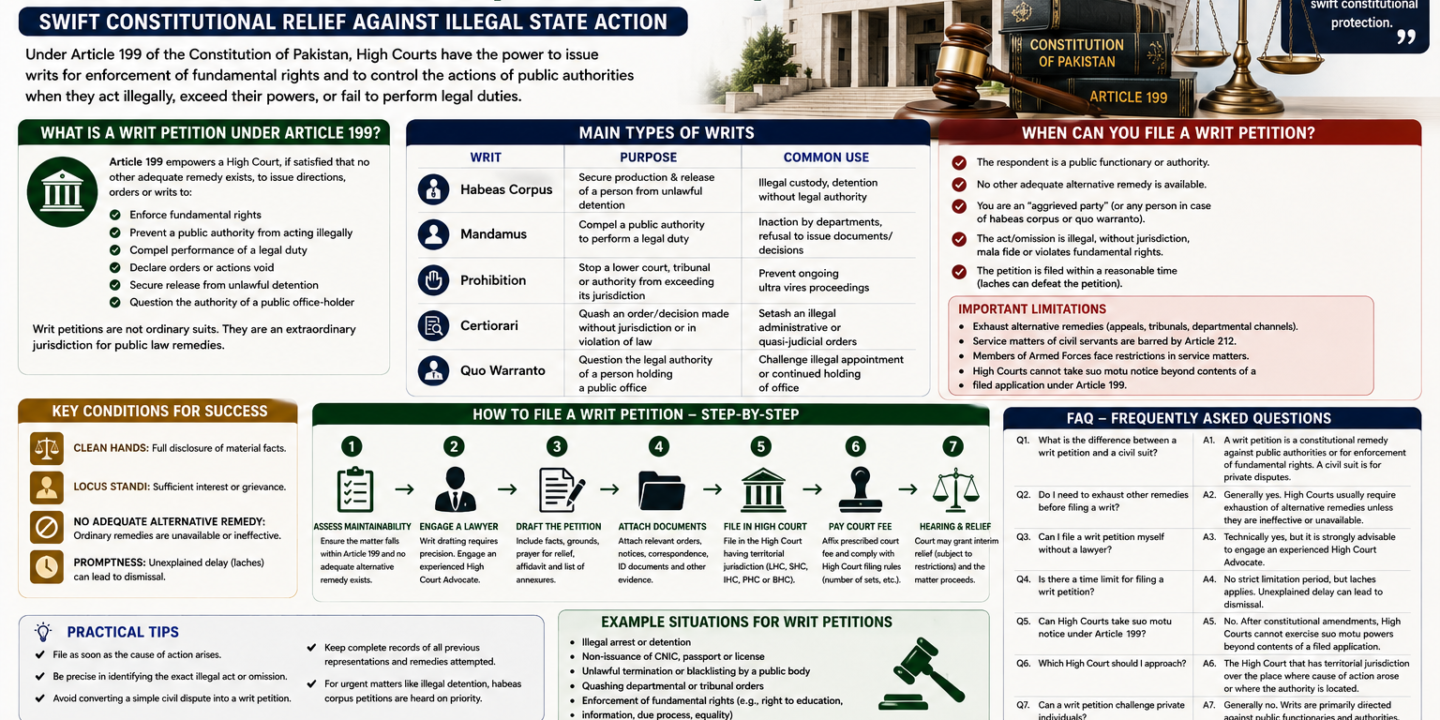
Article 199 empowers a High Court, where the constitutional requirements are satisfied and no other adequate remedy is provided by law, to issue directions and orders against public authorities. It may also provide relief concerning unlawful detention, public offices, illegal official actions, and enforcement of fundamental rights.
Writ petitions, also called constitutional petitions, are not ordinary civil suits. They are primarily used for matters involving public authorities or enforcement of constitutional rights where ordinary legal remedies are inadequate or unavailable.
Main Types of Writs
| Writ | Purpose | Common Use |
|---|---|---|
| Habeas Corpus | Secure production and release of a person from unlawful detention | Illegal custody or detention without legal authority |
| Mandamus | Compel a public authority to perform a legal duty | Government inaction or refusal to issue documents or decisions |
| Prohibition | Stop a lower court, tribunal, or authority from exceeding its jurisdiction | Prevent ongoing ultra vires proceedings |
| Certiorari | Quash an order or decision made without jurisdiction or in violation of law | Set aside illegal administrative or quasi-judicial orders |
| Quo Warranto | Question the legal authority of a person holding a public office | Challenge an illegal appointment or continued holding of office |
When Can You File a Writ Petition?
A writ petition is generally maintainable when:
- The respondent is a public authority or a person performing functions connected with the affairs of the Federation, a Province, or a local authority, subject to Article 199.
- There is no other adequate alternative remedy available under ordinary law.
- The petitioner is an aggrieved party, except where the nature of the writ permits a broader standing.
- The action or omission is illegal, without jurisdiction, mala fide, or violates fundamental rights.
- The petition is filed within a reasonable time, because unexplained delay or laches may affect maintainability.
Important Limitations
- High Courts generally expect petitioners to exhaust adequate alternative remedies such as appeals, tribunals, or departmental channels.
- Service matters of civil servants are often subject to the jurisdiction of Service Tribunals under Article 212.
- Members of the Armed Forces face constitutional restrictions in certain service-related matters.
- The scope of constitutional jurisdiction must remain within the limits prescribed by Article 199 and the Constitution.
Key Conditions for Success
1. Clean Hands
The petitioner should approach the court honestly, disclose material facts, and avoid concealment of relevant information.
2. Locus Standi
The petitioner must ordinarily demonstrate a sufficient legal interest or grievance in the matter.
3. No Adequate Alternative Remedy
Where an effective statutory remedy is available, the High Court may decline to exercise its constitutional jurisdiction unless there are exceptional circumstances.
4. Promptness
A petition should be filed without unnecessary delay. Unexplained delay can result in dismissal on the ground of laches.
How to File a Writ Petition – Step-by-Step
Step 1: Assess Maintainability
Determine whether the matter falls within Article 199 and whether an adequate alternative legal remedy is available.
Step 2: Engage a Competent Lawyer
Writ drafting requires legal precision. It is strongly advisable to engage an experienced Advocate of the High Court.
Step 3: Draft the Petition
A constitutional petition generally contains:
- Name and title of the High Court
- Names and particulars of the petitioner and respondents
- Facts stated in chronological order
- Legal grounds of challenge
- Specific prayer or relief requested
- Supporting affidavit
- List of annexures and supporting documents
Step 4: Attach Supporting Documents
Attach relevant orders, notices, correspondence, identity documents, official communications, and other evidence supporting the petition.
Step 5: File in the Appropriate High Court
The petition should ordinarily be filed before the High Court having territorial jurisdiction over the relevant cause of action or public authority, subject to the applicable constitutional and procedural rules.
The principal High Courts include:
- Lahore High Court
- Sindh High Court
- Islamabad High Court
- Peshawar High Court
- Balochistan High Court
Step 6: Pay Court Fee and Complete Formalities
Pay the prescribed court fee and comply with the relevant High Court filing requirements, including indexing, documents, copies, and other procedural formalities.
Step 7: Hearing and Interim Relief
The High Court may grant interim relief, including a stay or protective order, where legally appropriate. The case may then proceed through notices, replies, arguments, and final hearing.
Practical Tips
- File the petition as soon as the cause of action arises.
- Clearly identify the exact illegal act, decision, or omission being challenged.
- Do not convert an ordinary private civil dispute into a constitutional petition without a proper public-law element.
- Keep complete records of previous representations and remedies attempted.
- In urgent illegal-detention matters, seek immediate legal assistance regarding appropriate habeas corpus relief.
- Ensure all material facts are disclosed to the court.
Common Situations Where a Writ May Be Considered
- Unlawful detention
- Illegal government action
- Failure of a public authority to perform a statutory duty
- Exercise of powers without jurisdiction
- Challenge to an unlawful administrative order
- Violation of fundamental rights by a public authority
- Challenge to an unlawful appointment to a public office
Frequently Asked Questions
1. What is the difference between a writ petition and a normal civil suit?
A writ petition is an extraordinary constitutional remedy primarily concerning public authorities and constitutional rights. A civil suit is an ordinary legal proceeding generally used for private civil disputes.
2. Do I need to exhaust other remedies before filing a writ?
Generally, yes. High Courts usually expect adequate alternative remedies to be exhausted first, unless the alternative remedy is ineffective, unavailable, or exceptional circumstances justify constitutional intervention.
3. Can I file a writ petition myself without a lawyer?
Although a person may be able to appear personally in appropriate circumstances, engaging an experienced High Court advocate is strongly recommended because constitutional petitions involve technical legal and procedural requirements.
4. Is there a fixed time limit for filing a writ petition?
There is generally no ordinary limitation period in the same manner as a conventional civil claim, but the principle of laches applies. Unexplained delay may result in dismissal.
5. Can High Courts take suo motu notice under Article 199?
The scope of High Court constitutional jurisdiction is governed by Article 199 and the Constitution. Recent constitutional changes have placed limits on the exercise of powers beyond the contents of a filed application.
6. Which High Court should I approach?
Normally, the High Court having territorial jurisdiction over the relevant cause of action or public authority should be approached, subject to the applicable constitutional and procedural rules.
7. Can a writ petition challenge private individuals?
Generally, writ jurisdiction is directed against public authorities and public functions. Purely private disputes are ordinarily dealt with through appropriate civil or other statutory remedies.
Conclusion
Writ petitions under Article 199 of the Constitution of Pakistan remain an important constitutional safeguard against unlawful state action, violations of fundamental rights, and decisions made without lawful authority.
Success depends on proper maintainability, clean hands, timely filing, accurate documentation, and precise legal drafting. Understanding when a writ petition is the appropriate remedy — and when another legal forum should be used — is essential for protecting your rights effectively.
Need Legal Help?
Facing illegal government action, unlawful detention, denial of fundamental rights, or another public-law issue in Pakistan?
Contact the experienced constitutional law team at Justify.pk for professional legal advice and representation in writ petitions before the High Courts of Pakistan.
Justify.pk — Law | Justice | Rights
“`