By Justify.pk Editorial Team | Reviewed by Zeshan Haider Advocate
Lecture Series: Legal Definitions and Differences
- Part 1: Summons, Warrant, Qatl, Penalty and Fine
- Part 2: FIR, Bail, Remand, Challan and Criminal Procedure (you are here)
- Part 3: Evidence, Confession, Admission and Burden of Proof
- Part 4: Suit, Decree, Order, Res Judicata and Injunction
- Part 5: Nikah, Mahr, Talaq, Khula and Iddat
- Part 6: Title, Mutation, Fard, Registry and Pre-emption
- Part 7: Fundamental Rights, Writs and Jurisdiction
Welcome back to our lecture series on legal definitions. In Part 1 we studied summons, warrant, qatl, penalty and fine. Today we walk through a criminal case from its first step to its last, beginning with the difference between FIR and complaint, then pre-arrest and post-arrest bail, remand, the police report, the trial, and the remedies that follow. Each stage has its own vocabulary, and each of these criminal procedure terms has a precise meaning in the Code of Criminal Procedure, 1898 (CrPC).
As before, key terms get the full treatment (dictionary meaning, legal meaning, section and case law); the rest get a short legal definition with the section you need.
Key Points at a Glance
- An FIR (ابتدائی اطلاعاتی رپورٹ) is information to the police about a cognizable offence (s. 154); a complaint (استغاثہ) is an allegation made directly to a magistrate (s. 200).
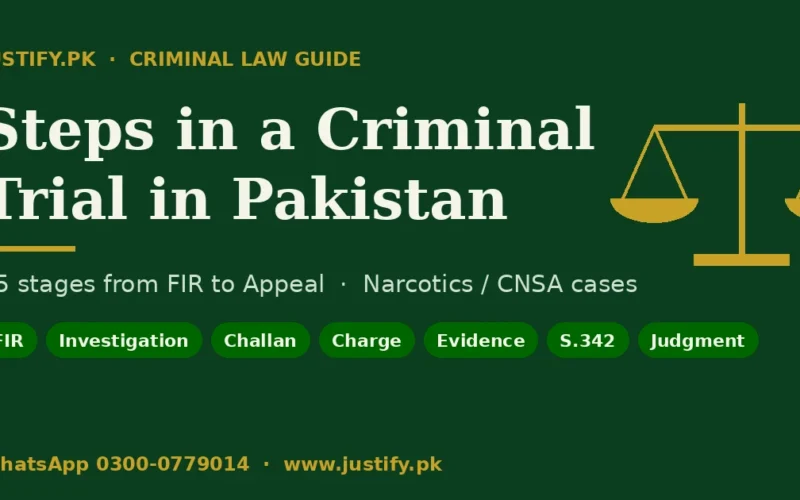
- Investigation is done by police; inquiry by a magistrate or court before trial; trial is the judicial determination of guilt.
- Post-arrest bail is under s. 497 (non-bailable) or s. 496 (bailable); pre-arrest bail is under s. 498 and requires a showing of mala fide or ulterior motive.
- Physical remand (جسمانی ریمانڈ) keeps the accused with the police; judicial remand (جوڈیشل ریمانڈ) sends him to jail. Police custody cannot exceed 15 days in total (s. 167).
- The challan (چالان) is the police report under s. 173 that sends the case to court.
- A Justice of Peace under s. 22-A acts quasi-judicially; the High Court’s power to quash lies under s. 561-A.
- Appeal reopens facts and law; revision corrects jurisdictional or legal error.
'/><text%20x='600'%20y='58'%20text-anchor='middle'%20font-size='30'%20font-weight='700'%20fill='rgb(38,38,38)'>Stages%20of%20a%20Criminal%20Case%20in%20Pakistan</text><g%20font-size='20'%20text-anchor='middle'><rect%20x='40'%20y='110'%20width='200'%20height='120'%20rx='14'%20fill='rgb(47,90,93)'/><text%20x='140'%20y='160'%20fill='white'%20font-weight='700'%20font-size='24'>FIR%20/%20Complaint</text><text%20x='140'%20y='195'%20fill='rgb(232,220,196)'>s.%20154%20/%20s.%20200</text><rect%20x='270'%20y='110'%20width='200'%20height='120'%20rx='14'%20fill='rgb(47,90,93)'/><text%20x='370'%20y='160'%20fill='white'%20font-weight='700'%20font-size='24'>Investigation</text><text%20x='370'%20y='195'%20fill='rgb(232,220,196)'>Remand%20s.%20167</text><rect%20x='500'%20y='110'%20width='200'%20height='120'%20rx='14'%20fill='rgb(47,90,93)'/><text%20x='600'%20y='160'%20fill='white'%20font-weight='700'%20font-size='24'>Challan</text><text%20x='600'%20y='195'%20fill='rgb(232,220,196)'>s.%20173</text><rect%20x='730'%20y='110'%20width='200'%20height='120'%20rx='14'%20fill='rgb(47,90,93)'/><text%20x='830'%20y='160'%20fill='white'%20font-weight='700'%20font-size='24'>Charge</text><text%20x='830'%20y='195'%20fill='rgb(232,220,196)'>s.%20221%20onwards</text><rect%20x='960'%20y='110'%20width='200'%20height='120'%20rx='14'%20fill='rgb(47,90,93)'/><text%20x='1060'%20y='160'%20fill='white'%20font-weight='700'%20font-size='24'>Trial</text><text%20x='1060'%20y='195'%20fill='rgb(232,220,196)'>Evidence,%20arguments</text></g><g%20fill='rgb(201,154,63)'><polygon%20points='256,170%20244,160%20244,180'/><polygon%20points='486,170%20474,160%20474,180'/><polygon%20points='716,170%20704,160%20704,180'/><polygon%20points='946,170%20934,160%20934,180'/></g><line%20x1='1060'%20y1='232'%20x2='1060'%20y2='290'%20stroke='rgb(201,154,63)'%20stroke-width='6'/><g%20font-size='20'%20text-anchor='middle'><rect%20x='730'%20y='300'%20width='430'%20height='100'%20rx='14'%20fill='rgb(181,67,47)'/><text%20x='945'%20y='343'%20fill='white'%20font-weight='700'%20font-size='24'>Judgment</text><text%20x='945'%20y='377'%20fill='white'>Conviction%20or%20Acquittal%20(249-A%20/%20265-K)</text><rect%20x='240'%20y='300'%20width='430'%20height='100'%20rx='14'%20fill='white'%20stroke='rgb(205,190,158)'%20stroke-width='3'/><text%20x='455'%20y='343'%20fill='rgb(38,38,38)'%20font-weight='700'%20font-size='24'>Remedies</text><text%20x='455'%20y='377'%20fill='rgb(110,98,80)'>Appeal%20%C2%B7%20Revision%20%C2%B7%20561-A</text></g><polygon%20points='686,350%20700,340%20700,360'%20fill='rgb(201,154,63)'/><line%20x1='700'%20y1='350'%20x2='728'%20y2='350'%20stroke='rgb(201,154,63)'%20stroke-width='6'/><rect%20x='40'%20y='300'%20width='170'%20height='100'%20rx='14'%20fill='white'%20stroke='rgb(205,190,158)'%20stroke-width='3'/><text%20x='125'%20y='343'%20text-anchor='middle'%20font-size='22'%20font-weight='700'%20fill='rgb(38,38,38)'>Bail</text><text%20x='125'%20y='377'%20text-anchor='middle'%20font-size='18'%20fill='rgb(110,98,80)'>ss.%20496%E2%80%93498</text><text%20x='600'%20y='470'%20text-anchor='middle'%20font-size='24'%20font-style='italic'%20fill='rgb(47,90,93)'>Bail%20can%20be%20sought%20at%20any%20stage,%20even%20before%20arrest%20(s.%20498).</text><text%20x='600'%20y='535'%20text-anchor='middle'%20font-size='18'%20fill='rgb(110,98,80)'>justify.pk%20%C2%B7%20Legal%20Definitions%20Part%202</text></svg>%E2%80%9D%20alt=%E2%80%9DStages%20of%20a%20criminal%20case%20in%20Pakistan:%20FIR%20or%20complaint,%20investigation%20and%20remand%20under%20section%20167,%20challan%20under%20section%20173,%20charge,%20trial,%20judgment,%20bail%20and%20appeal%E2%80%9D%20width=%E2%80%9D1200%E2%80%B3%20height=%E2%80%9D560%E2%80%B3%20loading=%E2%80%9Dlazy%E2%80%9D%20style=%E2%80%9Dwidth:100%;height:auto%E2%80%9D/><figcaption>From%20FIR%20to%20appeal:%20the%20stages%20of%20a%20criminal%20case%20and%20the%20CrPC%20section%20for%20each.</figcaption></figure>%0A%0A<h2>Stage%201:%20Difference%20Between%20FIR%20and%20Complaint</h2>%0A%0A<h3>1.%20FIR%20(First%20Information%20Report)</h3>%0A<p><strong>Dictionary%20meaning:</strong>%20literally,%20the%20first%20report%20of%20information%20about%20an%20event.</p>%0A<p><strong>Legal%20meaning:</strong>%20Under%20<strong>Section%20154%20CrPC</strong>,%20every%20information%20relating%20to%20the%20commission%20of%20a%20<em>cognizable</em>%20offence%20given%20to%20the%20officer%20in%20charge%20of%20a%20police%20station%20must%20be%20reduced%20into%20writing,%20read%20over%20to%20the%20informant,%20signed%20by%20him%20and%20entered%20in%20the%20prescribed%20book.%20The%20FIR%20sets%20the%20criminal%20law%20in%20motion;%20it%20is%20not%20itself%20evidence%20of%20the%20facts%20it%20states,%20but%20it%20can%20be%20used%20to%20corroborate%20or%20contradict%20its%20maker.</p>%0A%0A<h3>2.%20Complaint</h3>%0A<p><strong>Legal%20meaning:</strong>%20Section%204(1)(h)%20defines%20a%20complaint%20as%20an%20allegation%20made%20orally%20or%20in%20writing%20to%20a%20<strong>magistrate</strong>,%20with%20a%20view%20to%20his%20taking%20action,%20that%20some%20person%20has%20committed%20an%20offence;%20a%20police%20report%20is%20not%20a%20complaint.%20The%20magistrate%20examines%20the%20complainant%20on%20oath%20under%20<strong>Section%20200</strong>%20and%20may%20hold%20an%20inquiry%20under%20<strong>Section%20202</strong>%20before%20summoning%20the%20accused.</p>%0A%0A<table>%0A<thead><tr><th>Point</th><th>FIR</th><th>Private%20complaint</th></tr></thead>%0A<tbody>%0A<tr><td>Made%20to</td><td>Police%20(SHO)</td><td>Magistrate%20or%20court</td></tr>%0A<tr><td>Offence</td><td>Cognizable%20only</td><td>Cognizable%20or%20non-cognizable</td></tr>%0A<tr><td>Section</td><td>s.%20154</td><td>ss.%20200%E2%80%93204</td></tr>%0A<tr><td>Who%20investigates</td><td>Police</td><td>Court%20inquiry;%20police%20only%20if%20the%20court%20directs</td></tr>%0A<tr><td>Who%20prosecutes</td><td>State,%20through%20the%20prosecutor</td><td>Complainant,%20through%20his%20counsel</td></tr>%0A</tbody>%0A</table>%0A%0A<h3>3.%20Justice%20of%20Peace%20(s.%2022-A)</h3>%0A<p>When%20the%20police%20refuse%20to%20register%20an%20FIR,%20the%20aggrieved%20person%20may%20apply%20to%20the%20<strong>ex-officio%20Justice%20of%20Peace</strong>%20(the%20Sessions%20Judge%20or%20a%20nominated%20Additional%20Sessions%20Judge)%20under%20<strong>Section%2022-A(6)</strong>.%20In%20<strong><em>Younus%20Abbas%20v.%20Additional%20Sessions%20Judge,%20Chakwal</em>,%20PLD%202016%20SC%20581</strong>,%20a%20larger%20bench%20of%20the%20Supreme%20Court%20held%20that%20these%20functions%20are%20<strong>quasi-judicial</strong>,%20not%20merely%20administrative,%20and%20must%20be%20exercised%20with%20judicial%20discretion%20rather%20than%20mechanically.</p>%0A%0A<h3>4.%20Cognizance</h3>%0A<p>Taking%20cognizance%20means%20the%20court%20applying%20its%20mind%20to%20the%20case%20for%20the%20purpose%20of%20proceeding%20against%20the%20accused.%20A%20magistrate%20takes%20cognizance%20under%20<strong>Section%20190</strong>%20on%20a%20complaint,%20a%20police%20report,%20or%20information%20from%20any%20other%20person;%20a%20Court%20of%20Session%20takes%20cognizance%20on%20a%20case%20sent%20to%20it%20(s.%20193).</p>%0A%0A<h2>Stage%202:%20Investigation,%20Arrest%20and%20Custody</h2>%0A%0A<h3>5.%20Investigation,%20Inquiry%20and%20Trial</h3>%0A<table>%0A<thead><tr><th>Term</th><th>Definition</th><th>Conducted%20by</th></tr></thead>%0A<tbody>%0A<tr><td><strong>Investigation</strong>%20(%D8%AA%D9%81%D8%AA%DB%8C%D8%B4)</td><td>All%20proceedings%20under%20the%20Code%20for%20the%20collection%20of%20evidence%20(s.%204(1)(l))</td><td>Police%20officer%20or%20person%20authorised%20by%20a%20magistrate</td></tr>%0A<tr><td><strong>Inquiry</strong>%20(%D8%A7%D9%86%DA%A9%D9%88%D8%A7%D8%A6%D8%B1%DB%8C)</td><td>Every%20inquiry,%20other%20than%20a%20trial,%20conducted%20by%20a%20magistrate%20or%20court%20(s.%204(1)(k))</td><td>Magistrate%20or%20court</td></tr>%0A<tr><td><strong>Trial</strong>%20(%D9%B9%D8%B1%D8%A7%D8%A6%D9%84)</td><td>Judicial%20examination%20of%20the%20charge,%20ending%20in%20conviction%20or%20acquittal</td><td>Court</td></tr>%0A</tbody>%0A</table>%0A%0A<h3>6.%20Accused%20and%20Suspect</h3>%0A<p>A%20<strong>suspect</strong>%20is%20a%20person%20whose%20involvement%20is%20under%20examination;%20an%20<strong>accused</strong>%20is%20one%20against%20whom%20an%20accusation%20has%20been%20formally%20made,%20by%20being%20named%20in%20an%20FIR%20or%20complaint,%20or%20sent%20up%20in%20a%20challan.%20The%20distinction%20matters%20for%20the%20content%20of%20a%20police%20notice%20(see%20Part%201).</p>%0A%0A<h3>7.%20Remand:%20Physical%20and%20Judicial</h3>%0A<p><strong>Legal%20meaning:</strong>%20When%20investigation%20cannot%20be%20completed%20within%2024%20hours,%20the%20accused%20must%20be%20produced%20before%20a%20magistrate,%20who%20may%20authorise%20his%20detention%20under%20<strong>Section%20167%20CrPC</strong>.</p>%0A<ul>%0A<li><strong>Physical%20remand</strong>%20(police%20custody):%20the%20accused%20stays%20with%20the%20police%20for%20investigation.%20The%20total%20period%20cannot%20exceed%20<strong>15%20days</strong>,%20and%20the%20magistrate%20must%20record%20reasons.</li>%0A<li><strong>Judicial%20remand</strong>%20(judicial%20custody):%20the%20accused%20is%20sent%20to%20jail,%20where%20the%20police%20cannot%20interrogate%20him%20without%20permission.</li>%0A</ul>%0A<p>Remand%20is%20an%20exception%20to%20liberty;%20it%20is%20not%20granted%20for%20the%20asking.</p>%0A%0A<h3>8.%20Proclaimed%20Offender</h3>%0A<p>A%20person%20who%20absconds%20to%20avoid%20arrest%20and%20against%20whom%20a%20proclamation%20is%20issued%20under%20<strong>Section%2087</strong>,%20with%20possible%20attachment%20of%20property%20under%20<strong>Section%2088</strong>.%20Absconding%20is%20a%20serious%20obstacle%20to%20bail.</p>%0A%0A<h2>Stage%203:%20Pre-Arrest%20and%20Post-Arrest%20Bail%20(%D8%B6%D9%85%D8%A7%D9%86%D8%AA)</h2>%0A%0A<h3>9.%20Bail</h3>%0A<p><strong>Dictionary%20meaning:</strong>%20security%20given%20for%20the%20release%20of%20a%20person,%20with%20the%20promise%20that%20he%20will%20appear%20when%20required.</p>%0A<p><strong>Legal%20meaning:</strong>%20release%20from%20custody%20on%20a%20bond,%20with%20or%20without%20sureties,%20on%20condition%20of%20appearance.%20The%20CrPC%20divides%20it%20as%20follows:</p>%0A<table>%0A<thead><tr><th>Kind%20of%20bail</th><th>Section</th><th>Nature</th></tr></thead>%0A<tbody>%0A<tr><td>Bail%20in%20bailable%20offences</td><td>s.%20496</td><td>A%20right%20of%20the%20accused</td></tr>%0A<tr><td>Bail%20after%20arrest%20in%20non-bailable%20offences</td><td>s.%20497</td><td>Discretion%20of%20the%20court</td></tr>%0A<tr><td>Pre-arrest%20(protective)%20bail</td><td>s.%20498</td><td>Extraordinary%20relief%20before%20arrest</td></tr>%0A<tr><td>Cancellation%20of%20bail</td><td>ss.%20497(5),%20498</td><td>Withdrawing%20bail%20already%20granted</td></tr>%0A</tbody>%0A</table>%0A%0A<h3>10.%20Prohibitory%20clause%20and%20%E2%80%9Cfurther%20inquiry%E2%80%9D</h3>%0A<p>Under%20Section%20497(1),%20bail%20shall%20not%20be%20granted%20in%20an%20offence%20punishable%20with%20death,%20life%20imprisonment%20or%20ten%20years%E2%80%99%20imprisonment%20where%20there%20are%20reasonable%20grounds%20to%20believe%20the%20accused%20is%20guilty.%20This%20is%20the%20<strong>prohibitory%20clause</strong>.%20Where%20the%20offence%20falls%20<em>outside</em>%20it,%20the%20Supreme%20Court%20has%20repeatedly%20held%20that%20bail%20is%20the%20rule%20and%20refusal%20the%20exception:%20<strong><em>Tariq%20Bashir%20v.%20The%20State</em>,%20PLD%201995%20SC%2034</strong>,%20and%20<strong><em>Muhammad%20Tanveer%20v.%20The%20State</em>,%20PLD%202017%20SC%20733</strong>.%20Where%20the%20evidence%20leaves%20the%20guilt%20open%20to%20doubt,%20the%20case%20is%20one%20of%20<strong>further%20inquiry</strong>%20under%20Section%20497(2).</p>%0A%0A<h3>11.%20Pre-arrest%20bail</h3>%0A<p>Pre-arrest%20bail%20protects%20a%20person%20from%20arrest%20that%20is%20sought%20for%20an%20improper%20purpose.%20In%20<strong><em>Rana%20Muhammad%20Arshad%20v.%20Muhammad%20Rafique</em>,%20PLD%202009%20SC%20427</strong>,%20the%20Supreme%20Court%20explained%20that%20it%20is%20an%20extraordinary%20relief,%20and%20that%20the%20accused%20must%20show%20that%20his%20arrest%20is%20intended%20for%20an%20ulterior%20motive,%20such%20as%20humiliation%20or%20harassment,%20in%20addition%20to%20a%20case%20on%20merits.</p>%0A%0A<h3>12.%20Surety%20and%20Bond</h3>%0A<p>A%20<strong>bond</strong>%20(%D9%85%DA%86%D9%84%DA%A9%DB%81)%20is%20the%20accused%E2%80%99s%20own%20written%20undertaking%20to%20appear;%20a%20<strong>surety</strong>%20(%D8%B6%D8%A7%D9%85%D9%86)%20is%20a%20third%20person%20who%20guarantees%20that%20appearance%20and%20is%20liable%20for%20the%20bond%20amount%20on%20default%20(ss.%20499,%20514).</p>%0A%0A<p>For%20the%20full%20picture,%20read%20our%20guide%20on%20<a%20href=) bail in Pakistan.
Stage 4: The Police Report and the Trial
13. Challan (Police Report under s. 173)
On completing investigation, the officer in charge sends a report to the magistrate under Section 173. If the investigation is not completed within 14 days, an interim challan is submitted; the final report is the complete challan. If the police find no case, they submit a cancellation report, which the magistrate may accept or reject; he is not bound by the police opinion.
14. Charge
The formal statement of the offence the accused is to face, framed by the court (s. 221 onwards). Every distinct offence needs a separate charge (s. 233). Errors in the charge vitiate a trial only if they mislead the accused (s. 225).
15. Benefit of doubt
The prosecution must prove guilt beyond reasonable doubt. In Muhammad Mansha v. The State, 2018 SCMR 772, the Supreme Court reaffirmed that even a single circumstance creating reasonable doubt in a prudent mind entitles the accused to its benefit, as a matter of right and not of grace.
16. Acquittal, Discharge and Conviction
- Conviction (سزا یابی): finding of guilt; sentence is the punishment that follows it.
- Acquittal (بریت): finding of not guilty. A court may acquit at any stage if the charge is groundless or there is no probability of conviction: Section 249-A (magistrate) and Section 265-K (Sessions Court).
- Discharge (ڈسچارج): release without a finding on guilt, for example when a magistrate finds insufficient grounds to proceed on a cancellation report.
17. Compounding and Compromise
Compounding (راضی نامہ) means settling an offence with the victim’s consent, with the effect of an acquittal. Only offences listed in Section 345 CrPC may be compounded, some without and some with the court’s permission. Offences outside that list cannot be compounded, though a compromise may still weigh on sentence.
18. Plea bargain
An arrangement in which the accused admits liability and returns money in exchange for release; in Pakistan it is mainly a feature of the National Accountability Ordinance, 1999 (s. 25), not the general criminal law.
Stage 5: Remedies After the Order
19. Appeal, Revision and Review
| Remedy | CrPC | Scope |
|---|---|---|
| Appeal (اپیل) | ss. 404–431 (e.g. s. 410 against Sessions conviction; s. 417 against acquittal) | Rehearing on facts and law; a right only where the Code grants it |
| Revision (نگرانی) | ss. 435–439 | Superior court examines legality, propriety or correctness of an order; narrower than appeal |
| Review | Not generally available in criminal cases (s. 369 bars a court altering its signed judgment, save clerical errors) | Supreme Court has its own review power |
20. Quashment (s. 561-A)
Section 561-A preserves the High Court’s inherent power to make orders needed to prevent abuse of process or secure the ends of justice, including quashing proceedings. In Director General Anti-Corruption Establishment v. Muhammad Akram Khan, PLD 2013 SC 401, the Supreme Court cautioned that the High Court should rarely quash an FIR at the investigation stage, since the law provides alternative remedies and the facts should first be collected.
Frequently Asked Questions About Criminal Procedure Terms
What is the difference between an FIR and a complaint?
An FIR is information about a cognizable offence given to the police under Section 154 CrPC. A complaint is an allegation made directly to a magistrate under Section 200, for cognizable or non-cognizable offences.
What is the difference between physical and judicial remand?
Physical remand keeps the accused in police custody for investigation, for not more than 15 days in total under Section 167 CrPC. Judicial remand sends the accused to jail under the court’s control.
What is pre-arrest bail?
Bail granted under Section 498 CrPC before arrest. The Supreme Court in PLD 2009 SC 427 described it as extraordinary relief requiring a showing that the arrest is sought for an ulterior motive such as harassment.
What is a challan?
The police report submitted to the court under Section 173 CrPC after investigation. An interim challan is filed if investigation is not complete within 14 days; the final one is the complete challan.
Important Sources
- The Code of Criminal Procedure, 1898 (Punjab Police copy).
- Rana Muhammad Arshad v. Muhammad Rafique, PLD 2009 SC 427.
- Sindh High Court judgments applying PLD 2016 SC 581 and 2018 SCMR 772.
Conclusion
A criminal case is a journey through words: from an FIR or complaint, through investigation and remand, to challan, charge and trial, and finally to appeal or revision. Know which stage you are at and which word applies, and you will know which remedy is open. In Part 3 we turn to the law of evidence: confession, admission, burden of proof and more.
Facing a criminal case? Justify.pk’s Criminal Law practice area connects you with verified advocates, and you can request a free legal consultation in confidence.
Legal Disclaimer: This article provides general legal information only and is not a substitute for advice from a qualified advocate.
Written for Justify.pk. For personalised guidance, get a free consultation at https://justify.pk/free-consultation or WhatsApp 0300-0779014.
Join Justify.pk on WhatsAppGet new legal news, jobs, scholarships and law updates on WhatsApp — free.
Join Channel