By Justify.pk Editorial Team | Reviewed by Zeshan Haider Advocate
Lecture Series: Legal Definitions and Differences
- Part 1: Summons, Warrant, Qatl, Penalty and Fine
- Part 2: FIR, Bail, Remand, Challan and Criminal Procedure
- Part 3: Evidence, Confession, Admission and Burden of Proof
- Part 4: Suit, Decree, Order, Res Judicata and Injunction
- Part 5: Nikah, Mahr, Talaq, Khula and Iddat
- Part 6: Title, Mutation, Fard, Registry and Pre-emption
- Part 7: Fundamental Rights, Writs and Jurisdiction (you are here)
Dear students, we end our series where all Pakistani law begins: the Constitution of the Islamic Republic of Pakistan, 1973. Today’s lecture explains the types of writs in Pakistan, fundamental rights, the jurisdiction of the Federal Constitutional Court, and the other constitutional law terms in Pakistan you need for any constitutional petition. Every statute we studied in Parts 1 to 6 is valid only so far as it is consistent with the Constitution, and every court we mentioned draws its power from it. We also note the major changes made by the 26th Amendment (October 2024) and the 27th Amendment (November 2025).
Key Points at a Glance
- Fundamental rights (بنیادی حقوق) are in Articles 8 to 28; any law inconsistent with them is void to that extent (Art. 8).
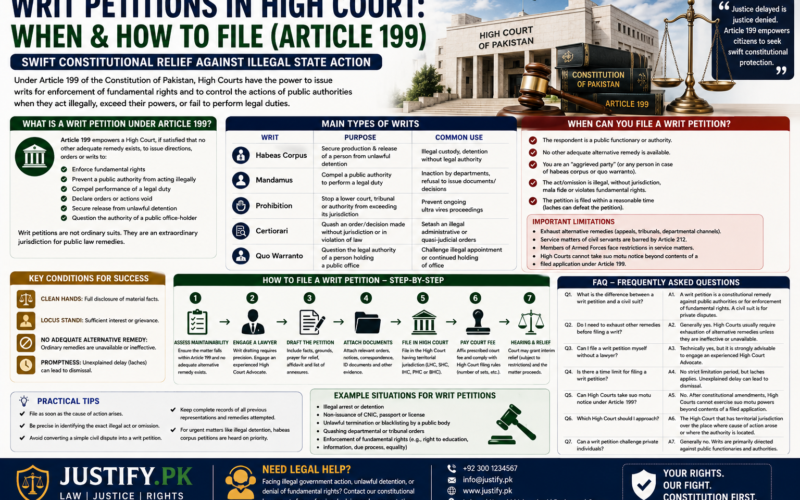
- A High Court’s writ (رٹ) jurisdiction lies under Article 199: prohibition, mandamus, certiorari, habeas corpus and quo warranto.
- Writs are discretionary and generally unavailable where an adequate alternative remedy exists, except habeas corpus.
- The 27th Amendment created the Federal Constitutional Court and omitted Article 184; the old public-importance fundamental-rights jurisdiction now lies with that Court under Article 175E(3), exercisable only on an application.
- Decisions of the apex courts on questions of law bind all courts below; High Court decisions bind subordinate courts (Art. 201).
 guide to fundamental rights.
3. Right to Life (Expanded Meaning)
The Supreme Court has read “life” in Article 9 widely. In Shehla Zia v. WAPDA, PLD 1994 SC 693, it held that life includes the right to a clean and healthy environment, opening the door to environmental litigation in Pakistan.
4. Principles of Policy
Articles 29 to 40 set out goals the State should pursue (such as Islamic way of life, social justice and protection of family). Unlike fundamental rights, they are not directly enforceable in court, though courts use them to interpret laws.
Part B: Types of Writs in Pakistan (Article 199)
5. Writ
Dictionary meaning: a written command issued in the name of a court.
Legal meaning: an order of a High Court under Article 199 directing a person performing functions in connection with the affairs of the Federation, a province or a local authority. The Constitution describes the orders without using the old English names, but lawyers still use those names:
| Writ | Literal meaning | Art. 199 | Purpose |
|---|---|---|---|
| Mandamus | “We command” | (1)(a)(i) | Directs a public functionary to do what the law requires him to do |
| Prohibition | “Forbid” | (1)(a)(i) | Restrains a functionary from doing what the law does not permit |
| Certiorari | “To be informed” | (1)(a)(ii) | Declares an act or proceeding done without lawful authority to be of no legal effect |
| Habeas corpus | “You may have the body” | (1)(b)(i) | Directs that a person in custody be produced so the court may satisfy itself that he is not held unlawfully |
| Quo warranto | “By what authority” | (1)(b)(ii) | Requires a person holding a public office to show under what authority he holds it |
Under Article 199(1)(c), the High Court may also issue directions to enforce any fundamental right. See our guide on writ petitions in the High Court.
6. Aggrieved Person
Except for habeas corpus and quo warranto (which any person may seek), a writ under Article 199(1)(a) is available only on the application of an aggrieved party, meaning someone whose legal right or interest is adversely affected.
7. Adequate Alternative Remedy
Article 199 applies only “if satisfied that no other adequate remedy is provided by law”. So where a statute provides an appeal or revision, the High Court ordinarily declines a writ, unless the impugned order is without jurisdiction, mala fide or void.
8. Laches
Unexplained delay in seeking a writ. There is no fixed limitation period for a writ petition, but because the remedy is discretionary, unreasonable delay can defeat it.
Part C: Courts, Jurisdiction and the Federal Constitutional Court
9. Kinds of Jurisdiction
| Jurisdiction | Meaning | Example |
|---|---|---|
| Original | Power to hear a matter at first instance | Writs under Art. 199; Federal Constitutional Court under Art. 175E |
| Appellate | Power to rehear a decided matter | Supreme Court in civil and criminal appeals |
| Advisory | Opinion on a question of law referred by the President | Formerly Supreme Court under Art. 186; constitutional matters now with the Federal Constitutional Court |
| Review | Power of a court to reconsider its own judgment | Supreme Court under Art. 188 |
10. Locus Standi and Public Interest Litigation
Locus standi (Latin: “place to stand”) is the right to bring a case. In Benazir Bhutto v. Federation of Pakistan, PLD 1988 SC 416, the Supreme Court relaxed the traditional rule for petitions concerning fundamental rights of public importance, so that a person need not be personally aggrieved. This gave birth to public interest litigation. In Darshan Masih, PLD 1990 SC 513, the Court acted on a telegram from bonded brick-kiln labourers and treated it as a petition.
11. Suo Motu
Latin: “on its own motion”. It describes a court taking up a matter without a formal petition. The former Supreme Court practice of suo motu action under Article 184(3) was restricted by the 26th Amendment, and after the 27th Amendment Article 175E(3) provides that the Federal Constitutional Court’s corresponding jurisdiction is exercised only when an application is filed.
12. Federal Constitutional Court
A court created by the 27th Amendment, signed into law on 13 November 2025. It took over constitutional matters, including the public-importance fundamental-rights jurisdiction formerly exercised by the Supreme Court under Article 184(3) (now omitted), and pending matters were transferred to it (Art. 175E(4)). The Supreme Court continues to hear civil and criminal appeals.
13. Constitutional Benches
Benches introduced by the 26th Amendment to hear constitutional petitions, in the Supreme Court (Art. 191A) and in the High Courts. After the 27th Amendment, constitutional matters at the apex level go to the Federal Constitutional Court; practitioners should check the current rules of the relevant High Court for how writs are assigned.
Part D: Legality and Authority
14. Ultra Vires
Latin: “beyond the powers”. An act of a legislature, government or authority that exceeds the power given to it by the Constitution or statute. Such an act is void and may be struck down.
15. Intra Vires
The opposite: within the powers conferred.
16. Binding Precedent
A decision of the Supreme Court on a question of law, or enunciating a principle of law, binds all other courts in Pakistan (Art. 189). After the 27th Amendment, check the current text for how decisions of the Federal Constitutional Court and the Supreme Court bind each other. A High Court’s decisions bind all courts subordinate to it (Art. 201). The binding part is the ratio decidendi (the reason for the decision), not obiter dicta (passing remarks), though obiter of the apex court is highly persuasive.
17. Contempt of Court
Disobeying a court’s order, scandalising the court, or prejudicing a pending case. The Supreme Court and High Courts have power to punish contempt under Article 204. In Baz Muhammad Kakar v. Federation of Pakistan, PLD 2012 SC 923, the Supreme Court struck down the Contempt of Court Act, 2012 as inconsistent with the Constitution.
18. Amendment and Basic Structure
The Constitution is amended by a two-thirds majority of each House (Arts. 238–239). Whether any feature is beyond amendment (the “basic structure”) has been debated in Pakistan for decades and remains a live question after the 26th and 27th Amendments.
Frequently Asked Questions About Constitutional Law Terms
What are the five writs under Article 199?
Mandamus (to do a legal duty), prohibition (to stop an unlawful act), certiorari (to declare an unlawful act of no legal effect), habeas corpus (to produce a person held in custody) and quo warranto (to ask by what authority a public office is held).
Can a writ be filed if an appeal is available?
Ordinarily no. Article 199 applies only where no other adequate remedy is provided by law, though the High Court may intervene where the order is without jurisdiction, mala fide or void.
Who now hears Article 184(3)-type petitions?
After the 27th Amendment (November 2025), Article 184 was omitted and the Federal Constitutional Court exercises the public-importance fundamental-rights jurisdiction under Article 175E(3), only on an application filed before it.
What is locus standi?
The right to bring a case to court. The Supreme Court in Benazir Bhutto v. Federation (PLD 1988 SC 416) relaxed it for public-interest petitions on fundamental rights.
Important Sources
- The Constitution of the Islamic Republic of Pakistan, 1973, as amended up to the 27th Amendment.
- Article 184(3) and its replacement by Article 175E(3) (overview).
- EUAA: Major judicial and constitutional reforms (26th and 27th Amendments).
Conclusion: Closing the Series
Over seven lectures we have defined more than 130 terms, from summons and warrant to writ and precedent. The lesson running through all of them is the same: in law, the precise word leads to the precise remedy. A student who masters the vocabulary has already mastered half the subject. Start again from Part 1, keep this series bookmarked, and return to it whenever a word in a plaint, an FIR or a judgment leaves you uncertain.
Need help with a constitutional petition? Request a free legal consultation with a verified Justify.pk advocate.
Legal Disclaimer: This article provides general legal information only and is not a substitute for advice from a qualified advocate.
Written for Justify.pk. For personalised guidance, get a free consultation at https://justify.pk/free-consultation or WhatsApp 0300-0779014.
Join Justify.pk on WhatsAppGet new legal news, jobs, scholarships and law updates on WhatsApp — free.
Join Channel