Note: This is a law student’s independent analysis, written for educational purposes. It is not legal advice, is not affiliated with the court or parties discussed, and should not be relied on as a substitute for consulting a licensed advocate about your own matter.
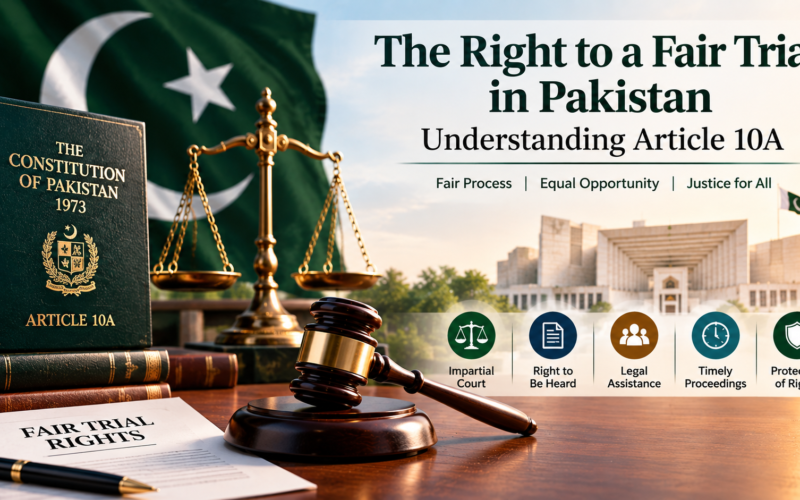
The Right to Fair Trial and Due Process of Law in Pakistan: A Constitutional Guarantee under Article 10A
Introduction
Justice is the foundation of every democratic society, and the right to a fair trial is one of the most essential elements of a just legal system. No individual should be punished, deprived of legal rights, or subjected to an adverse judicial decision without being given a fair opportunity to defend their position before an independent and impartial forum. The concept of a fair trial ensures that justice is administered according to law rather than personal interests, political influence, discrimination, or arbitrary exercise of authority.
In Pakistan, the right to a fair trial is constitutionally protected under Article 10A of the Constitution of the Islamic Republic of Pakistan, 1973. This provision guarantees every person the right to a fair trial and due process for the determination of civil rights and obligations or any criminal charge. It reflects the constitutional commitment to justice, equality, human dignity, and the rule of law.
The importance of this right extends beyond criminal proceedings. It also applies to civil matters and other legal determinations involving a person’s civil rights and obligations. Therefore, Article 10A plays a significant role in protecting individuals against unfair procedures and ensuring that legal authorities exercise their powers within constitutional limits.
Constitutional Foundation of Article 10A
Article 10A was inserted into the Constitution of Pakistan through the Constitution (Eighteenth Amendment) Act, 2010. Before its express inclusion, the principles of fair trial and due process had already received recognition through constitutional interpretation and judicial decisions.
Article 10A provides:
“For the determination of his civil rights and obligations or in any criminal charge against him a person shall be entitled to a fair trial and due process.”
This constitutional provision establishes fair trial and due process as independent fundamental rights. Its protection is not restricted to individuals accused of criminal offences. It also covers people involved in civil proceedings where their legal rights and obligations are being determined.
The constitutional significance of Article 10A is closely connected with Article 4, which guarantees the right of individuals to be dealt with in accordance with law, and Article 9, which protects life and liberty. Article 14 further protects the dignity of individuals, while Article 25 guarantees equality before law and equal protection of law.
Together, these constitutional provisions establish an important framework for the protection of individual rights and the administration of justice in Pakistan.
Meaning of Fair Trial and Due Process
A fair trial means a legal proceeding in which all parties receive a genuine and equal opportunity to present their cases before a competent, independent, and impartial judicial authority.
It requires that decisions must be based on applicable law, reliable evidence, and proper legal procedures rather than personal prejudice, political pressure, or external influence.
Due process of law refers to the requirement that government authorities and judicial institutions must follow lawful and fair procedures before taking actions that affect a person’s rights, liberty, or legal interests.
In simple terms, fair trial means that every person must be heard fairly, while due process means that the law must be followed properly throughout the proceedings.
Both principles are interconnected. A legal system cannot claim to provide justice if its procedures are unfair, discriminatory, or arbitrary.
Essential Elements of the Right to a Fair Trial
The right to a fair trial consists of several important legal principles that protect the interests of all parties involved in judicial proceedings.
1. Right to an Independent and Impartial Court
Every individual is entitled to have their case decided by a competent, independent, and impartial court or tribunal established under law.
A judge must decide a case on the basis of evidence, applicable law, and legal arguments. Personal interests, political pressure, financial influence, or personal bias must not affect judicial decisions.
Judicial independence is essential because courts must be able to protect fundamental rights without improper interference from other institutions or powerful individuals.
2. Right to Be Informed of the Allegations
In criminal proceedings, an accused person must be informed of the nature and details of the allegations against them.
Without knowing the specific accusation, a person cannot prepare an effective defence. Therefore, proper information about the charge is a necessary requirement of procedural fairness.
3. Right to Legal Representation
Every accused person should have a meaningful opportunity to obtain legal assistance and defend themselves through a lawyer.
Legal representation is particularly important when a person faces serious criminal charges or lacks sufficient knowledge of legal procedures.
Access to legal assistance helps ensure that individuals can understand their rights, challenge unlawful actions, and present their cases effectively.
4. Right to Be Heard
One of the most important principles of natural justice is that no person should be condemned without being given an opportunity to be heard.
The court must provide the parties with a reasonable opportunity to present their arguments, explain their positions, and respond to the opposing side.
A decision made without providing a meaningful hearing may violate the principles of fair trial and due process.
5. Right to Present Evidence and Cross-Examine Witnesses
The parties to judicial proceedings must receive a fair opportunity to present relevant evidence supporting their claims or defence.
In criminal cases, the accused must also have an appropriate opportunity to challenge prosecution evidence and cross-examine witnesses, subject to applicable law and procedural safeguards.
This principle helps courts evaluate the reliability of evidence and reduces the possibility of wrongful convictions.
6. Presumption of Innocence
The presumption of innocence is a fundamental principle of criminal justice.
A person accused of committing an offence should not automatically be treated as guilty. The prosecution must establish the accused person’s guilt according to the applicable legal standard.
This principle protects individuals from punishment based merely on suspicion, public opinion, allegations, or personal assumptions.
7. Right to a Reasoned Judgment
A judicial decision should be based on relevant facts, applicable law, and proper consideration of the arguments presented by the parties.
A reasoned judgment explains why the court has reached a particular conclusion. It promotes transparency, judicial accountability, and confidence in the legal system.
8. Right to an Appeal Where Provided by Law
The availability of an appropriate appellate remedy is an important safeguard against judicial errors.
Where the law provides a right of appeal, an affected person should be able to challenge an unlawful or incorrect decision before the competent appellate forum.
The appellate process helps maintain consistency in the interpretation and application of law.
Application of Article 10A in Criminal Proceedings
Article 10A has particular importance in criminal justice because criminal proceedings may result in imprisonment, financial penalties, or other serious legal consequences.
A criminal trial must be conducted according to the requirements of law. The accused must receive information about the charges, an opportunity to defend themselves, access to legal representation, and a fair opportunity to challenge the evidence presented against them.
The prosecution must prove the case through legally admissible and reliable evidence. A conviction should not be based on unsupported allegations, personal hostility, or external pressure.
Similarly, courts must remain impartial and ensure that procedural requirements are respected throughout the proceedings.
These safeguards are necessary to protect innocent individuals and maintain public confidence in criminal justice institutions.
Application of Article 10A in Civil Proceedings
An important feature of Article 10A is that its protection extends beyond criminal cases.
Civil proceedings frequently involve important matters such as property ownership, contractual obligations, inheritance, family disputes, financial claims, and other legal rights.
When a court or competent legal forum determines such matters, the parties must receive a fair opportunity to present their positions.
For example, if a person’s property rights are being determined through civil litigation, the individual should receive proper notice and a reasonable opportunity to present evidence and legal arguments.
Similarly, administrative decisions that determine civil rights and obligations may require procedural fairness according to the Constitution and applicable law.
Therefore, Article 10A is an important constitutional safeguard in both criminal and civil justice.
Judicial Interpretation and Important Case Law
The Supreme Court of Pakistan has played an important role in explaining the scope and significance of the right to fair trial.
1. Muhammad Bashir v. Rukhsar (PLD 2020 SC 334)
This case is cited in Supreme Court jurisprudence concerning the essential ingredients of a fair trial.
The principles discussed in the Court’s subsequent judgments include the importance of an independent and impartial forum, the right to legal representation, the opportunity to know and challenge the case against a person, and the right to present evidence.
The case is significant for understanding the procedural safeguards that contribute to a fair judicial process.
2. Chairman NAB v. Nasrullah (PLD 2022 SC 497)
This decision is referred to in later Supreme Court jurisprudence regarding the constitutional importance of Article 10A.
It reinforces the recognition of fair trial and due process as fundamental constitutional protections that must receive meaningful judicial enforcement.
3. Constitutional Petitions No. 24 of 2023 and connected matters
In its January 2024 proceedings concerning the trials of civilians before military courts, the Supreme Court examined important constitutional questions relating to fair trial, due process, judicial independence, and human dignity.
The judgments and judicial opinions discussed the importance of an independent and impartial decision-maker, meaningful participation in proceedings, and the protection of fundamental rights.
These proceedings demonstrate that Article 10A is not merely a procedural formality. It is a constitutional guarantee that must be considered when determining the legality and fairness of judicial proceedings.
4. Presidential Reference No. 1 of 2011: Zulfikar Ali Bhutto Case
In its opinion delivered on 6 March 2024, the Supreme Court of Pakistan examined whether the proceedings in the trial and appeal of former Prime Minister Zulfikar Ali Bhutto had satisfied the constitutional requirements of fair trial and due process.
The Supreme Court concluded that the proceedings did not meet the requirements of the fundamental right to fair trial and due process.
This opinion is an important reminder of the lasting significance of procedural fairness and the responsibility of judicial institutions to uphold constitutional guarantees.
It also demonstrates that the legitimacy of judicial proceedings depends not only on the final outcome but also on the fairness of the process through which that outcome is reached.
Challenges to the Implementation of the Right to Fair Trial in Pakistan
Although Article 10A provides constitutional protection, its effective implementation continues to face practical challenges.
1. Delay in Judicial Proceedings
One of the major problems in Pakistan’s justice system is the delay in the disposal of cases.
Long periods of litigation can create financial difficulties, emotional pressure, and uncertainty for individuals seeking justice.
Unnecessary delays may weaken the practical value of legal remedies and undermine public confidence in courts.
2. Lack of Access to Legal Assistance
Many individuals cannot afford professional legal representation.
People from economically disadvantaged backgrounds may face difficulties understanding legal procedures, preparing their cases, and protecting their rights.
The availability of effective legal aid is therefore important for making constitutional protections meaningful.
3. Weak Investigation and Evidence Collection
Fair trials depend on lawful investigations and reliable evidence.
Improper investigation, careless evidence collection, inaccurate witness statements, and procedural irregularities may affect the quality of criminal proceedings.
Strengthening investigative institutions and ensuring accountability are essential for improving the justice system.
4. Public and Political Pressure
Judicial institutions must remain independent and impartial.
External pressure, media trials, political influence, and public hostility can create an environment in which the fairness of legal proceedings may be questioned.
Courts must decide cases according to law and evidence rather than public popularity or political considerations.
5. Lack of Legal Awareness
A significant number of individuals are unaware of their fundamental rights and the remedies available to them.
Without legal awareness, people may fail to challenge unlawful actions or may not understand how to seek legal protection.
Public legal education is therefore an important requirement for effective constitutional governance.
Recommendations for Strengthening Article 10A
The constitutional guarantee of fair trial can be strengthened through practical legal and institutional reforms.
First, judicial institutions should take effective measures to reduce unnecessary delays and improve the timely disposal of cases.
Second, affordable legal assistance should be made more accessible, particularly to individuals who cannot afford private lawyers.
Third, police and investigative agencies should receive proper training in lawful investigation, evidence preservation, and respect for fundamental rights.
Fourth, judicial independence must be protected so that courts can make decisions without improper influence or interference.
Fifth, legal awareness programmes should be introduced through educational institutions, universities, media platforms, and public legal assistance organisations.
Sixth, courts and relevant authorities should ensure that procedural safeguards are respected throughout civil, criminal, and administrative proceedings where Article 10A applies.
Finally, legal institutions should promote transparency, accountability, and effective remedies against violations of fundamental rights.
Relationship Between Fair Trial, Human Dignity, and the Rule of Law
The right to a fair trial is closely connected with human dignity and the rule of law.
Article 14 of the Constitution protects the dignity of individuals. Article 10A complements this protection by ensuring that individuals are treated fairly when their civil rights or criminal liability are determined.
The rule of law requires that everyone, including public officials and government institutions, must act within the limits of the Constitution and applicable laws.
A legal system cannot achieve genuine justice if individuals are denied the opportunity to defend themselves or if judicial decisions are influenced by irrelevant considerations.
Fair trial safeguards the relationship between the individual and the State by ensuring that legal authority is exercised through lawful and fair procedures.
Conclusion
The right to a fair trial and due process is one of the most significant constitutional guarantees in Pakistan. Article 10A of the Constitution of 1973 provides an essential foundation for protecting individuals against arbitrary decisions and ensuring fairness in the determination of civil rights, obligations, and criminal charges.
However, the real value of this constitutional right depends on its effective implementation. Constitutional guarantees alone cannot ensure justice unless courts remain independent, legal procedures are followed, investigations are conducted lawfully, and individuals have meaningful access to legal representation.
The challenges of judicial delays, inadequate legal assistance, weak investigations, and limited public awareness must be addressed through consistent institutional reforms and constitutional accountability.
Ultimately, justice is not simply about punishing the guilty or resolving disputes. It is equally about ensuring that every person is treated fairly, lawfully, and with dignity throughout the legal process.
A fair trial is not a privilege granted by the State; it is a fundamental constitutional right. The strength of a justice system is measured not only by the decisions it delivers but also by the fairness of the procedures through which those decisions are reached.