By Justify.pk Editorial Team | Reviewed by Zeshan Haider Advocate
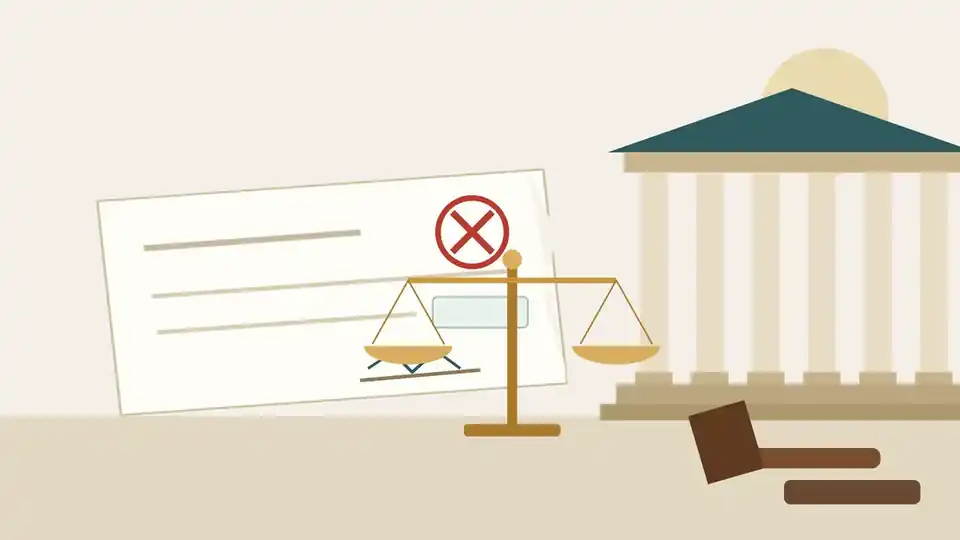
A cheque that “bounces” is one of the most common reasons people in Pakistan walk into a police station. Business partners, landlords, car dealers, shopkeepers and family members all rely on post-dated cheques, and when one comes back unpaid, the first question is usually: can I file an FIR? The answer lies in Section 489-F of the Pakistan Penal Code, 1860 (PPC), the offence of dishonestly issuing a cheque (چیک ڈس آنر).
This guide explains Section 489-F in plain language: what the offence is, what must be proved, how a criminal case moves from the bank’s return memo to trial, how bail works after the latest Supreme Court rulings, the defences available to the person who issued the cheque, and when a civil recovery suit is the better choice. For a shorter overview of timelines, see our cheque bounce procedure guide.
Key Points at a Glance
- Section 489-F PPC makes it an offence to dishonestly issue a cheque for repayment of a loan or fulfilment of an obligation that is then dishonoured.
- Punishment: imprisonment of up to three years, or fine, or both.
- It is listed as a cognizable, non-bailable offence, so the police can register an FIR. But because the maximum sentence is three years, it falls outside the “prohibitory clause” of Section 497 CrPC, and courts treat bail as the rule.
- The Supreme Court has repeatedly said that Section 489-F is not a recovery tool. If your main aim is to get your money back, a civil suit is usually the right route, sometimes alongside the criminal case.
- The person who issued the cheque can escape conviction by proving he had arranged with his bank for the cheque to be honoured and that the bank was at fault.

What Does Section 489-F PPC Say?
Section 489-F was added to the Pakistan Penal Code by the Criminal Law (Amendment) Ordinance, 2002. Its essence is:
Whoever dishonestly issues a cheque towards re-payment of a loan or fulfilment of an obligation which is dishonoured on presentation, shall be punishable with imprisonment which may extend to three years, or with fine, or with both, unless he can establish, for which the burden of proof shall rest on him, that he had made arrangements with his bank to ensure that the cheque would be honoured and that the bank was at fault in not honouring the cheque.
Three phrases do most of the work: “dishonestly”, “re-payment of a loan or fulfilment of an obligation”, and “dishonoured on presentation”. A bounced cheque on its own is not a crime. The law punishes the dishonest use of a cheque to settle a real debt or obligation.
Ingredients of the Offence: What Must Be Proved
Courts, including the Supreme Court in Muhammad Sultan v. The State (2010 SCMR 806), have identified the following ingredients. The prosecution must prove each one:
- Issuance of the cheque by the accused (signature, handwriting and account ownership).
- Dishonest intention at the time the cheque was issued, meaning the accused knew or intended that it would not be paid.
- A loan or obligation: the cheque was given to repay a loan or to fulfil an obligation, such as the price of goods, rent, or a settlement amount.
- Dishonour on presentation: the bank refused payment when the cheque was presented, usually shown by the bank’s return memo stating the reason.
The High Courts have stressed that merely proving the cheque was issued and bounced is not enough. The complainant must also prove the underlying loan or obligation. This is why the story behind the cheque, and the documents supporting it, matter as much as the cheque itself.
Is a “security cheque” covered?
One of the most common disputes is whether a cheque was given as security (ضمانتی چیک) rather than as payment. If a cheque was only held as a guarantee and no amount had yet become due, the accused will argue there was no “loan or obligation” to repay when it was presented. Courts treat this as a factual question to be decided at trial after evidence. For example, the Sindh High Court in Adnan Aziz v. The State (Cr. Bail Application No. 1855 of 2025, decided 15 December 2025) held that whether a cheque was security or for a legally enforceable liability needed evidence, and granted bail.
Punishment and Nature of the Offence
| Point | Position under Section 489-F |
|---|---|
| Maximum punishment | Up to 3 years’ imprisonment, or fine, or both |
| Cognizable? | Yes: police can register an FIR and investigate |
| Bailable? | Listed as non-bailable, but outside the prohibitory clause of Section 497(1) CrPC, so bail is normally granted |
| Compoundable? | Yes: listed under Section 345 CrPC, so the parties can settle (compromise); check with your lawyer whether the court’s permission is needed at your stage |
| Burden of proof | On the prosecution for the ingredients; the special defence (bank’s fault) must be proved by the accused |
Because the offence is compoundable, many cases end in a written compromise once the amount is paid. In March 2025, the Lahore High Court was reported as holding that Section 489-F is among the offences that can be compounded, and that court permission is not needed at the pre-trial bail stage.
Step-by-Step: How a Section 489-F Case Proceeds
- Present the cheque to the bank within its validity period and collect the return memo (cheque return slip), which shows the reason for dishonour, such as “insufficient funds” or “payment stopped by drawer”.
- Collect your evidence: the original cheque, the return memo, the agreement or receipts showing the loan or obligation, messages or emails acknowledging the debt, and details of any witnesses.
- Consider a legal notice. Section 489-F does not require a notice before an FIR, but a written demand gives the issuer a chance to pay and helps show his intention if he ignores it. Our legal draft generator can help prepare a first draft.
- Lodge the FIR at the police station with jurisdiction, usually where the cheque was presented or dishonoured, or where the transaction took place. Give a written complaint attaching copies; keep the originals safe.
- If the police refuse to register the FIR, you can apply to the Ex-Officio Justice of Peace (the Sessions Judge or Additional Sessions Judge) under Sections 22-A and 22-B CrPC for a direction to register the case. Alternatively, a private complaint can be filed before the Magistrate under Section 200 CrPC.
- Investigation: the police record statements, take the original cheque and return memo into possession, and may verify the account with the bank.
- Arrest and bail: the accused may seek pre-arrest (protective) bail before arrest, or post-arrest bail after arrest. See the bail section below.
- Challan and trial: after investigation, the police submit the report under Section 173 CrPC. The case is tried by a Judicial Magistrate, with evidence of the complainant, the bank official and other witnesses.
- Judgment and appeal: the court convicts or acquits. Either side can challenge the decision before the Sessions Court within the time allowed.
- Compromise: at any point, if the parties settle, a compromise application can be filed and the case may be disposed of on that basis.
There is no fixed deadline for lodging an FIR, but delay is costly. Courts often treat an unexplained gap of many months between the cheque bouncing and the FIR as a reason for “further inquiry” and grant bail on that basis.
Bail in Section 489-F Cases: The Supreme Court’s Approach
Bail is where most Section 489-F cases are decided in practice. Two Supreme Court decisions are cited in almost every bail order:
- Abdul Saboor v. The State (2022 SCMR 592): Section 489-F does not fall within the prohibitory clause of Section 497(1) CrPC, so bail should ordinarily be granted. The provision is not meant to be used as a tool for recovering money; recovery belongs in civil proceedings.
- Abdul Rasheed v. The State (2023 SCMR 1948): the Court said Section 489-F “is not a provision which is intended by the Legislature to be used for recovery of an alleged amount”, and that in offences outside the prohibitory clause, “grant of bail … is a rule and refusal is an exception”.
Bail may still be refused in exceptional circumstances, for example where the accused is a habitual offender, is likely to abscond, or has tampered with evidence. Every bail decision is tentative and does not decide the case itself.
For the complainant, the practical lesson is clear: an FIR alone will rarely keep the other side in custody, and the criminal case will not by itself return your money. For the accused, the case is serious and must be defended, but arrest is usually not the end of the matter.
Defences Available to the Person Who Issued the Cheque
- Statutory defence: proof that arrangements had been made with the bank to honour the cheque and that the bank was at fault. The burden of proving this lies on the accused.
- No loan or obligation: the cheque was a gift, a blank cheque, a security cheque, or the debt had already been paid.
- No dishonest intention: for example, funds were available when the cheque was issued, but an account was frozen or attached later for reasons beyond the accused’s control.
- Cheque misused or altered: a signed blank or security cheque was filled in for a higher amount or a later date without consent.
- Procedural and evidential gaps: no original cheque or return memo on record, no bank witness, or contradictions in the complainant’s account.
- Payment or settlement: the amount was paid in full, which supports a compromise.
Keep every record of payments, messages and agreements. A defence often succeeds or fails on paperwork.
Criminal Case or Civil Suit: Which Route Should You Choose?
A Section 489-F case can lead to punishment, but the trial court does not issue a decree for the cheque amount. To recover money, the usual route is a civil suit. For a suit based on a cheque, many lawyers use the summary procedure under Order XXXVII of the Code of Civil Procedure, 1908, where the defendant must first obtain the court’s permission (leave to defend) before contesting the claim. Read our guide on filing a civil suit for recovery of money.
| Criminal case (S. 489-F PPC) | Civil suit (recovery) | |
|---|---|---|
| Main purpose | Punishment for dishonest issuance | Decree for the money owed |
| Starts with | FIR or private complaint | Plaint in the civil court |
| Can you recover the amount? | Not directly; usually only through a voluntary settlement | Yes, through a decree and its execution |
| Standard of proof | Beyond reasonable doubt | Balance of probabilities |
| Time limits | No fixed limit for an FIR, but delay weakens the case | Limitation periods under the Limitation Act, 1908 apply, so file without delay |
Both routes can run at the same time, and many complainants pursue both. Your advocate can advise which combination suits your facts.
Common Mistakes to Avoid
- Handing over the original cheque too early. Give copies with your complaint and produce the original when the police or court formally require it.
- Waiting too long. Months of delay weaken both the criminal case and a later civil claim.
- Relying on the cheque alone. Keep proof of the loan or deal: agreements, receipts, bank transfers and messages.
- Using the FIR as a pressure tactic. Courts recognise this, and it can backfire at the bail stage.
- Signing blank or security cheques without a written agreement. If you must give a security cheque, record its purpose in writing.
- Ignoring a summons. If a case is filed against you, appear and seek bail through a lawyer; non-appearance can lead to a warrant.
Frequently Asked Questions About Section 489-F PPC
Is cheque bounce a criminal offence in Pakistan?
Yes, under Section 489-F PPC, if the cheque was issued dishonestly to repay a loan or fulfil an obligation and was dishonoured. A cheque that bounces without dishonest intention, or that was not for a debt or obligation, does not by itself make out the offence.
What is the punishment under Section 489-F?
Imprisonment of up to three years, or fine, or both. The court decides the sentence on the facts of each case.
Is Section 489-F bailable?
It is listed as non-bailable, but since the maximum punishment is three years it falls outside the prohibitory clause of Section 497 CrPC. Following Abdul Saboor (2022 SCMR 592) and Abdul Rasheed (2023 SCMR 1948), courts treat bail as the rule and refusal as the exception.
Can I get my money back through a 489-F case?
Not directly. The Supreme Court has said Section 489-F is not a recovery provision. To recover the amount, file a civil recovery suit, often under the summary procedure of Order XXXVII CPC, alongside or instead of the criminal case.
Is a security cheque covered by Section 489-F?
It depends on the facts. If no amount had become due when the cheque was presented, the accused can argue there was no loan or obligation. Courts decide this at trial after evidence.
Can a Section 489-F case be settled by compromise?
Yes. The offence is compoundable under Section 345 CrPC, so the parties can settle, usually after payment. Ask your lawyer whether the court’s permission is needed at your stage of the case.
What if the police refuse to register my FIR?
You can apply to the Ex-Officio Justice of Peace (Sessions Judge) under Sections 22-A and 22-B CrPC for a direction, or file a private complaint before the Magistrate under Section 200 CrPC.
Important Sources
- Muhammad Jamil Khan, “Offence of Dishonouring of Cheque”, Khyber Pakhtunkhwa Judicial Academy (text of Section 489-F, ingredients and case law).
- Sindh High Court, Adnan Aziz v. The State (2025), applying Abdul Saboor (2022 SCMR 592) and Abdul Rasheed (2023 SCMR 1948).
Conclusion
Section 489-F PPC protects people who accept cheques in good faith, but it is a criminal provision with a narrow purpose: punishing the dishonest issue of a cheque for a real debt or obligation. It is not a shortcut to recovery, and the Supreme Court has made bail the norm. Whether you received a bounced cheque or are facing an FIR, the outcome usually turns on evidence of the underlying transaction and on choosing the right mix of criminal and civil remedies.
Speak to a qualified advocate before you act. Justify.pk’s Criminal Law practice area connects you with verified advocates, and you can request a free legal consultation in confidence.
Legal Disclaimer: This article provides general legal information only and is not a substitute for advice from a qualified advocate.
Written for Justify.pk. For personalised guidance, get a free consultation at https://justify.pk/free-consultation or WhatsApp 0300-0779014.
Join Justify.pk on WhatsAppGet new legal news, jobs, scholarships and law updates on WhatsApp — free.
Join Channel