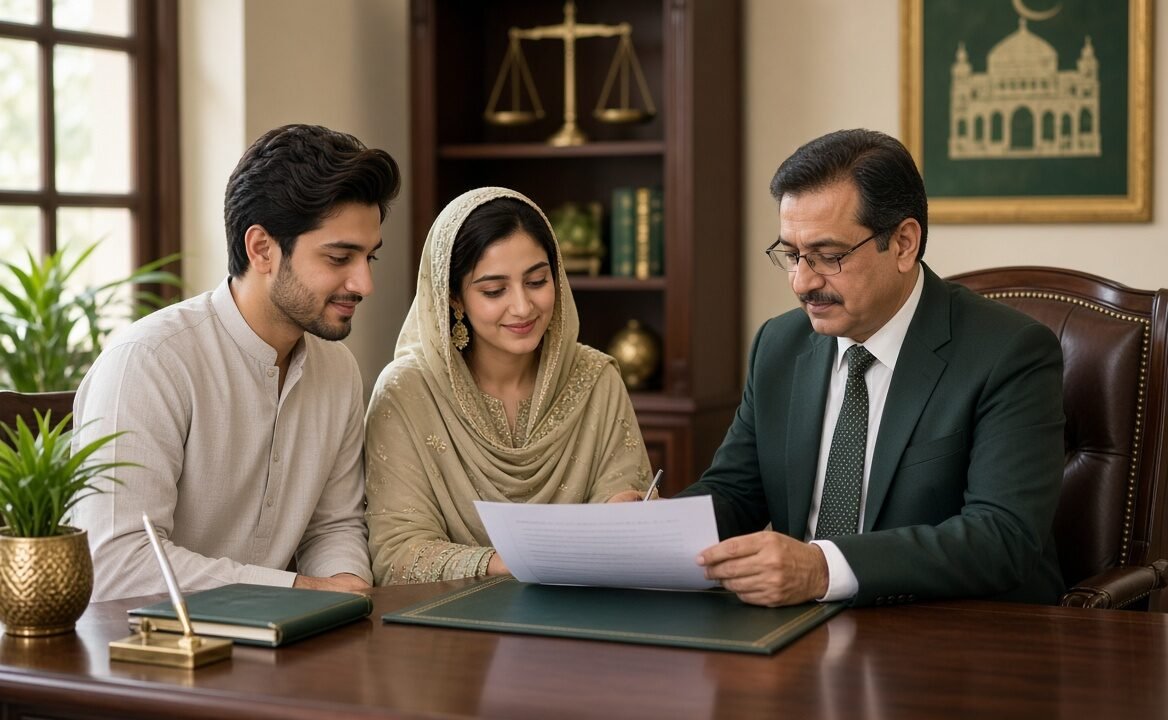
Court marriage in Pakistan generally refers to a properly solemnised and documented Nikah between two eligible adults, followed by official registration with the relevant Union Council and, where applicable, obtaining the NADRA Marriage Registration Certificate (MRC).
There is no separate law called the “Court Marriage Act”. In practice, what is commonly called a court marriage is a legally valid Muslim marriage supported by proper documentation, free consent, witnesses and registration. The process is often facilitated by a licensed Nikah Registrar or family lawyer.
A properly solemnised Muslim marriage can have the same legal validity as other valid Muslim marriages. The important distinction is generally the documentation and registration process rather than a different type of marriage.
For certain non-Muslim or interfaith couples, a different legal framework, including the Special Marriage Act, 1872, may apply. Such cases can involve additional formalities, including notice and an objection period.
What Is Court Marriage in Pakistan?
The expression “court marriage” is commonly used in Pakistan for a marriage where two eligible adults voluntarily marry and complete the required Nikah and registration formalities, often with legal assistance.
For a Muslim couple, the marriage normally involves:
- Free and voluntary consent of both parties
- Offer and acceptance of marriage (Ijab-o-Qubool)
- Two appropriate adult Muslim witnesses
- Agreement and recording of Haq Mehr
- Completion and signing of the Nikahnama
- Registration with the relevant Union Council
Once the applicable legal requirements are fulfilled, the marriage creates the legal rights and obligations associated with marriage under Pakistani law.
Legal Requirements for Court Marriage in Pakistan in 2026
1. Legal Age
Both parties must satisfy the applicable legal minimum age under the law of the relevant province or territory.
Punjab: The applicable child-marriage law should be checked carefully for the current requirements in 2026. A marriage involving a person below the legally prescribed age can result in serious legal consequences, and consent alone does not make an otherwise prohibited child marriage lawful.
Other provinces may have different statutory provisions. Therefore, the applicable provincial law should always be verified before proceeding.
2. Free Consent
Both parties must enter into the marriage voluntarily. Consent obtained through force, coercion, threats or unlawful pressure can create serious legal issues.
3. Legal Capacity
The parties must be legally capable of entering into the marriage and must not fall within prohibited degrees of relationship.
If either party was previously married, appropriate documentation such as a divorce certificate, Khula decree or death certificate of the previous spouse may be required.
4. Witnesses
A Muslim Nikah ordinarily requires appropriate witnesses according to the applicable Islamic and legal requirements. In common practice, two adult Muslim witnesses are present for the Nikah.
5. Haq Mehr
The amount and terms of Haq Mehr (dower) should be agreed between the parties and properly recorded in the Nikahnama.
Documents Required for Court Marriage
The exact documentation may vary depending on the location, circumstances of the couple and requirements of the relevant Nikah Registrar or Union Council.
Documents for Bride and Groom
- Original CNIC
- Passport or NICOP, where applicable
- Recent passport-size photographs
- Free-will / free-consent affidavit, where required
- Divorce certificate or Khula decree, if previously married
- Death certificate of previous spouse, where applicable
- Other proof of age or residence where required
Documents for Witnesses
- CNIC copies of the two adult witnesses
- Other identification documents where required
Court Marriage Documents Checklist
- ✓ Bride’s CNIC
- ✓ Groom’s CNIC
- ✓ Passport-size photographs
- ✓ Witnesses’ CNIC copies
- ✓ Free-consent affidavit, where required
- ✓ Previous marriage documents, if applicable
- ✓ Proof of age/residence, if requested
Step-by-Step Court Marriage Procedure in Pakistan
Step 1: Consultation and Document Preparation
The couple may consult a licensed Nikah Registrar or family lawyer to determine whether they satisfy the applicable legal requirements. Required documents and affidavits should be prepared before the Nikah.
Step 2: Verification of Eligibility
The parties’ identity documents, age, previous marital status and other relevant information should be checked. Any previous marriage should have been legally dissolved or otherwise ended before entering into a new marriage where required by law.
Step 3: Nikah Solemnisation
The Nikah is solemnised in accordance with the applicable Islamic and legal requirements. The bride and groom express their consent and complete Ijab-o-Qubool in the presence of the required witnesses.
The Haq Mehr is agreed and recorded in the Nikahnama.
Step 4: Signing of Nikahnama
The official Nikahnama is completed and signed by the relevant parties, witnesses and Nikah Registrar according to the prescribed procedure.
Both spouses should carefully check their names, CNIC numbers, dates, addresses, Haq Mehr and other important information before signing.
Step 5: Union Council Registration
The Nikahnama is submitted to the relevant Union Council for registration according to the applicable law, including the registration framework under the Muslim Family Laws Ordinance, 1961.
Proper registration is extremely important because it creates an official record of the marriage and helps establish documentary proof of the marital relationship.
Step 6: Obtain the NADRA Marriage Registration Certificate
After completion of the relevant Union Council registration process, the couple may obtain the NADRA Marriage Registration Certificate (MRC), subject to the applicable local procedure.
The certificate is commonly used as documentary proof for matters such as immigration, visa applications, passport-related matters and family records.
How Long Does Court Marriage Take in Pakistan?
The time required depends on the city, availability of the Nikah Registrar, completeness of documents and Union Council procedures.
Where all documents are complete and there are no legal complications, the Nikah and related initial formalities may sometimes be completed on the same day or within a few working days.
Obtaining the NADRA Marriage Registration Certificate may require additional processing time. Local procedures can vary, so couples should confirm the expected timeline with the relevant office or legal representative.
Special Marriage Act Cases
Cases falling under the Special Marriage Act, 1872 can involve a different procedure from an ordinary Muslim Nikah. Formal notice and an objection period may apply, and the timeline can therefore be significantly different.
Legal Validity of Court Marriage
A properly solemnised and registered marriage can establish the legal relationship of husband and wife and create the rights and obligations associated with marriage.
These may include:
- Spousal rights and obligations
- Maintenance rights where applicable
- Inheritance rights under applicable law
- Family and succession-related rights
- Rights arising from the Nikahnama
- Recognition by courts and government departments
Proper documentation can also make it easier to establish the marriage when dealing with immigration, visa, passport and other official matters.
Can Parents Stop an Adult Couple From Marrying?
Where two legally eligible adults freely consent to marriage, family disagreement by itself does not automatically invalidate their marriage.
However, each case should be assessed carefully, particularly where there are allegations of threats, coercion, forced marriage, underage marriage or unlawful interference.
If there is a genuine risk of violence or unlawful interference, the couple should seek appropriate legal protection and professional advice.
Important Practical Tips for Court Marriage
- Verify the current age requirement: Check the law applicable in your province before proceeding.
- Check all CNIC details: Make sure names, CNIC numbers and other information are correct.
- Register the Nikahnama promptly: Do not rely solely on an unregistered or informal Nikah document.
- Obtain the NADRA MRC: Keep the marriage registration certificate safely.
- Use a licensed professional: Avoid unknown or unlicensed intermediaries.
- Keep certified copies: Store copies of the signed Nikahnama and registration documents.
- Seek protection if necessary: If there is a genuine threat of violence or unlawful interference, consult a qualified lawyer regarding available legal remedies.
Court Marriage for Overseas Pakistanis
Overseas Pakistanis may need additional identification and documentation, such as a NICOP or passport. Depending on the circumstances, attested documents or a properly executed Power of Attorney may also be relevant to registration formalities.
Because requirements can vary depending on the person’s country of residence and the authority involved, overseas couples should obtain specific legal advice before preparing documents.
Second Marriage by a Muslim Husband
A Muslim man who wishes to contract another marriage while an existing marriage continues must comply with the applicable requirements, including the provisions of Section 6 of the Muslim Family Laws Ordinance, 1961.
Where required, permission from the relevant Arbitration Council should be obtained before contracting another marriage. Failure to comply can result in legal consequences. See our guide on second marriage rules.
Common Court Marriage Mistakes to Avoid
- Providing incorrect CNIC information
- Using incomplete or outdated documents
- Failing to register the Nikahnama
- Relying only on a verbal or unregistered Nikah
- Ignoring applicable provincial age requirements
- Using forged or false documents
- Failing to properly record Haq Mehr
- Using unlicensed intermediaries
- Not keeping copies of marriage documents
Frequently Asked Questions About Court Marriage in Pakistan
Is Court Marriage Legal in Pakistan?
Yes. A marriage between legally eligible parties that satisfies the applicable requirements of consent, age, capacity, witnesses, solemnisation and registration can be legally recognised in Pakistan.
Is There a Court Marriage Act in Pakistan?
There is no separate statute generally known as the “Court Marriage Act.” The term “court marriage” is commonly used to describe a properly solemnised and documented marriage, often arranged with legal assistance.
Can Parents Stop an Adult Couple From Getting Married?
Family opposition alone does not automatically invalidate the marriage of legally eligible adults who freely consent to marriage. However, cases involving threats, coercion, forced marriage or other unlawful conduct may require legal intervention.
Do We Need a Lawyer for Court Marriage?
A lawyer is not necessarily mandatory in every case. However, professional legal assistance can be particularly useful where there is family opposition, an interfaith issue, a previous marriage, overseas documentation or a risk of unlawful interference.
How Long Does Court Marriage Take?
Where all documents are complete, the Nikah and initial formalities may be completed quickly, sometimes on the same day or within a few working days. Union Council and NADRA documentation may require additional processing time.
Is NADRA Marriage Registration Necessary?
The marriage should be properly registered through the applicable registration system. The NADRA Marriage Registration Certificate is an important practical document and is commonly required or requested for official purposes such as immigration and family records.
Can an Overseas Pakistani Get Married in Pakistan?
Yes, subject to applicable legal requirements and documentation. An overseas Pakistani may need a passport, NICOP and additional attested documents depending on the circumstances.
Need Personalised Help With Court Marriage?
Planning a court marriage in Lahore, Karachi, Islamabad, Gujranwala or anywhere else in Pakistan?
Whether you need help with affidavits, Nikahnama preparation, Union Council registration, NADRA formalities or family opposition, obtaining professional legal guidance can help you understand the process and protect your rights.
The family law team at Justify.pk provides confidential legal guidance and support.
Book a free consultation or contact Justify.pk on WhatsApp/phone at 0300-0779014.
Legal Disclaimer
This article provides general legal information based on Pakistani law and common practice as of 2026. Laws, provincial requirements and local registration procedures may change and can differ depending on the circumstances of a particular case. This information should not be treated as a substitute for advice from a qualified advocate.
Join Justify.pk on WhatsAppGet new legal news, jobs, scholarships and law updates on WhatsApp — free.
Join Channel