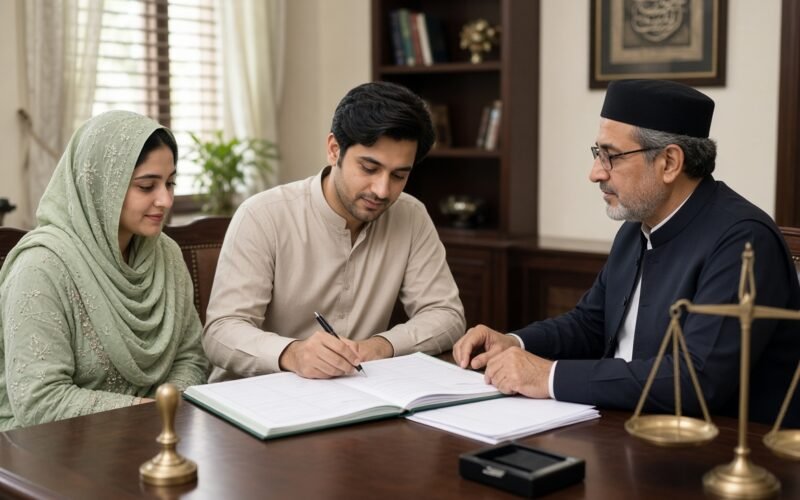
Second Marriage Rules for Muslim Men in Pakistan – Permission & Legal Consequences (2026 Guide)
Introduction
Under Pakistani family law, a Muslim man may contract another marriage during the subsistence of an existing marriage, but Section 6 of the Muslim Family Laws Ordinance, 1961 (MFLO) imposes a statutory procedure that must be followed.
Before contracting another marriage, the husband must obtain previous written permission of the Arbitration Council. The application is submitted to the Chairman of the relevant Union Council, who constitutes the Arbitration Council according to the prescribed procedure.
This guide explains the legal requirements for a second marriage, the permission process, the role of the existing wife or wives, consequences of marrying without permission, and the remedies available under Pakistani law.
Is Permission Required for a Second Marriage?
Yes. Section 6(1) of the Muslim Family Laws Ordinance, 1961 provides that a man who is already married cannot contract another marriage during the subsistence of that marriage without the previous written permission of the Arbitration Council.
The provision also states that a marriage contracted without such permission shall not be registered under the Ordinance. ([pakistancode.gov.pk](https://www.pakistancode.gov.pk/english/sHyuRsF?query=Family+Law&results=10&search=1&start=3&type=or&utm_source=chatgpt.com))
Important: Permission from the Arbitration Council is different from the personal consent of the existing wife. The wife’s views are relevant to the statutory process, but her individual consent is not itself the legal permission issued under Section 6.
Who Grants Permission?
Permission is granted by the Arbitration Council, not simply by the first wife and not merely by the Nikah Registrar.
The husband submits his application to the Chairman of the Union Council concerned. The Chairman then constitutes the Arbitration Council according to the prescribed procedure.
Step-by-Step Process for Permission for a Second Marriage
Step 1: Submit a Written Application
The husband must submit a written application to the Chairman of the relevant Union Council.
Under the West Pakistan Rules under the Muslim Family Laws Ordinance, the application should:
- State whether the consent of the existing wife or wives has been obtained;
- Contain a brief statement of the grounds on which the proposed marriage is claimed to be just and necessary; and
- Bear the applicant’s signature and comply with the prescribed requirements.
The application is considered under the procedure prescribed by Section 6 and the relevant Rules. ([pakistancode.gov.pk](https://pakistancode.gov.pk/pdffiles/administratorcc19213a335396659068c340f4dbe7a9.pdf?utm_source=chatgpt.com))
Step 2: Notice to the Existing Wife or Wives
The Chairman initiates the prescribed Arbitration Council process and gives the existing wife or wives an opportunity to participate through the representatives required by law.
The existing wife can present her position and objections during the proceedings.
Step 3: Constitution of the Arbitration Council
The Arbitration Council is constituted in accordance with the statutory procedure.
The Council considers the application and the circumstances presented by the parties.
Step 4: Consideration of Whether the Marriage Is Just and Necessary
The Arbitration Council may grant permission where it is satisfied that the proposed marriage is just and necessary.
The West Pakistan Rules specifically provide that the Council may consider circumstances including:
- Sterility of an existing wife;
- Physical infirmity;
- Physical unfitness for the conjugal relationship;
- Wilful avoidance of a decree for restitution of conjugal rights;
- Insanity; and
- Other relevant circumstances bearing on whether the proposed marriage is just and necessary.
These circumstances are examples identified in the Rules and should not be treated as an exhaustive statutory list. ([pakistancode.gov.pk](https://pakistancode.gov.pk/pdffiles/administratorcc19213a335396659068c340f4dbe7a9.pdf?utm_source=chatgpt.com))
Step 5: Written Permission
If the Arbitration Council grants permission, the permission should be obtained before the proposed second marriage is contracted.
The husband should retain the written permission because it forms part of the legal record of compliance with Section 6.
Can the First Wife Stop the Second Marriage?
The existing wife has the right to participate in the Arbitration Council proceedings and present her position.
However, the statutory scheme does not make the first wife’s individual consent the same thing as the Arbitration Council’s permission. The Council considers the application and decides whether the proposed marriage is just and necessary under Section 6.
Accordingly, it is inaccurate to state simply that a husband can obtain permission only if his first wife gives consent.
What Happens If a Husband Marries Without Permission?
Section 6(5) provides legal and financial consequences where a man contracts another marriage without the permission required by the Ordinance.
1. Immediate Payment of Dower
The entire amount of dower payable to the existing wife or wives becomes immediately due and payable.
If the amount is not paid, it may be recoverable in the manner provided by Section 6, including as arrears of land revenue. ([pakistancode.gov.pk](https://www.pakistancode.gov.pk/english/sHyuRsF?query=Family+Law&results=10&search=1&start=3&type=or&utm_source=chatgpt.com))
2. Criminal Liability
A husband who contracts another marriage in violation of Section 6 may face criminal proceedings and, upon conviction, imprisonment and a fine according to the applicable law.
The original federal provision provided for simple imprisonment of up to one year, or a fine of up to Rs. 5,000, or both. Provincial amendments have changed the penalty in some jurisdictions.
3. Punjab: Rs. 500,000 Fine
In Punjab, the Punjab Muslim Family Laws (Amendment) Act, 2015 amended Section 6(5)(b). The amended provision provides for simple imprisonment of up to one year and a fine of Rs. 500,000.
Lahore High Court case-law has held that the Rs. 500,000 fine under the Punjab amendment is mandatory upon conviction, although the court retains discretion concerning the length of imprisonment up to the statutory maximum. ([researchcenter.lhc.gov.pk](https://researchcenter.lhc.gov.pk/pdf/CaseLawBulletin/XIII-2-34_merged-min_2e7f.pdf?utm_source=chatgpt.com))
Important: Do not automatically apply Punjab’s Rs. 500,000 penalty to every province. The applicable provincial law should be checked for the place where the proceedings arise.
4. Registration Consequences
Section 6 states that a marriage contracted without the required prior permission shall not be registered under the MFLO.
This creates significant legal and administrative consequences for the parties and should not be confused with a determination that the underlying marriage is automatically void.
Does a Second Marriage Without Permission Become Void?
The statutory consequence of non-compliance is not simply that the second marriage automatically becomes void.
Section 6 primarily imposes a regulatory procedure and provides financial and penal consequences for non-compliance. Questions concerning the validity of the marriage itself may involve separate principles of Muslim personal law and the particular facts of the case.
Therefore, it is more accurate to say that a husband can incur statutory liabilities by contracting another marriage without the required permission rather than stating that the marriage is automatically void.
Right of the Existing Wife to Seek Dissolution
Failure by a husband to comply with the statutory requirements concerning a subsequent marriage can also be relevant to a wife’s right to seek dissolution under the Dissolution of Muslim Marriages Act, 1939.
The applicable statutory ground should be examined carefully in light of the facts and the current wording of the law before filing a case.
Rights of the Existing Wife
The existing wife may have several legal remedies depending on the circumstances, including:
- Participation in the Arbitration Council proceedings;
- Opportunity to present objections to the proposed marriage;
- Claim for payment of dower where Section 6 makes it immediately payable;
- Proceedings arising from violation of Section 6;
- Seeking dissolution of marriage where the statutory requirements are satisfied;
- Claiming maintenance and other matrimonial reliefs available under applicable law; and
- Protecting her separate property and inheritance rights.
Important Practical Points
- Permission must be obtained beforehand: The statutory requirement is for previous written permission.
- First wife’s consent is not the same as Arbitration Council permission: The Council makes the statutory decision.
- Keep the written permission: If permission is granted, retain the official document and related proceedings.
- Do not rely on verbal approval: Section 6 specifically requires permission in writing.
- Provincial amendments matter: Penalties and certain procedural aspects can differ because of provincial amendments.
- Do not assume the second marriage is automatically void: Non-compliance creates statutory consequences, but validity is a separate legal question.
- Seek advice before filing: The correct forum and procedure for a complaint or family remedy can depend on the jurisdiction and facts.
Frequently Asked Questions
Is second marriage completely banned in Pakistan?
No. Pakistani law does not impose an absolute prohibition on a Muslim man contracting another marriage. Section 6 of the MFLO regulates a subsequent marriage during the subsistence of an existing marriage by requiring prior written permission of the Arbitration Council.
Can a husband marry a second wife without the first wife’s consent?
The first wife’s consent is not itself the statutory permission. The husband must follow the Section 6 procedure and obtain prior written permission from the Arbitration Council. The existing wife is entitled to participate in the prescribed proceedings.
What if the husband marries secretly?
If he contracts another marriage without the permission required by Section 6, he may face the statutory consequences, including immediate liability for the dower of the existing wife or wives and criminal liability upon conviction.
Can the first wife claim her dower immediately?
Where Section 6(5) applies because the husband contracted another marriage without the required permission, the entire amount of dower payable to the existing wife or wives becomes immediately payable under the Ordinance.
Does the second wife get punished?
The Section 6(5) penalty is directed at the husband who contracts another marriage in violation of the statutory requirement. The legal position of the second wife is a separate issue and depends on the circumstances.
Can the first wife seek divorce because of an unauthorized second marriage?
Non-compliance with the statutory requirements for another marriage can provide a basis for seeking dissolution under the applicable law. The facts and current statutory requirements should be examined before filing.
Does the fine of Rs. 500,000 apply throughout Pakistan?
Not necessarily. Punjab has specifically amended Section 6(5)(b) to provide a Rs. 500,000 fine. Other jurisdictions may have different amendments or applicable provisions. The law applicable to the particular case should therefore be checked.
Conclusion
Section 6 of the Muslim Family Laws Ordinance, 1961 does not simply prohibit every second marriage. Instead, it establishes a statutory procedure requiring a husband who wishes to contract another marriage during an existing marriage to obtain prior written permission from the Arbitration Council.
The existing wife has a right to participate in the prescribed process and present her position. If a husband contracts another marriage without the required permission, the law provides financial and penal consequences, including immediate payment of the applicable dower and criminal liability.
Because provincial amendments can affect penalties and procedure, anyone dealing with a second-marriage dispute should check the law applicable in the relevant province and obtain appropriate legal advice.
Need Legal Assistance?
If you need assistance with an Arbitration Council application, objection to a proposed second marriage, dower recovery, dissolution proceedings or other family-law matter, Justify.pk can help you understand the applicable legal procedure.
Disclaimer: This article provides general legal information and does not constitute legal advice. Family-law procedures, penalties and available remedies may vary according to the province, jurisdiction and circumstances of the case.