Cybercrime in Pakistan (2025): Laws, Rights, Reporting Process & Legal Remedies
Author: Zeshan Haider, Advocate
Published By: Justify.pk Legal Hub
Pakistan’s digital landscape is growing rapidly. Millions of people now rely on the internet for banking, education, shopping, employment, and communication. While technology has improved convenience, it has also created opportunities for cybercriminals.
Online fraud, identity theft, cyber harassment, hacking, blackmail, fake social media profiles, and unauthorized access to personal information are becoming increasingly common. Many victims are unaware that Pakistani law provides protection and legal remedies against such offences.
This guide explains cybercrime laws in Pakistan, your digital rights, the PECA 2025 amendments, and the steps you should take if you become a victim of online crime.

Cybercrime in Pakistan: Understanding your digital rights and legal protections.
What is Cybercrime?
Cybercrime refers to unlawful activities committed using computers, mobile phones, digital devices, or internet-based platforms. Under Pakistani law, these offences are primarily regulated through the Prevention of Electronic Crimes Act (PECA) 2016, as amended in 2025.
Common cybercrimes include:
- Online financial fraud
- Cyber harassment and cyberstalking
- Blackmail and sextortion
- Identity theft and impersonation
- Unauthorized access to accounts (hacking)
- Data theft
- Fake social media profiles
- Spreading false information online

Pakistani Cybercrime Laws: PECA 2016 & PECA 2025
The Prevention of Electronic Crimes Act (PECA) 2016 established Pakistan’s primary legal framework for addressing cyber offences. The law provides protection against harassment, hacking, identity fraud, unauthorized access to data, and misuse of personal information.
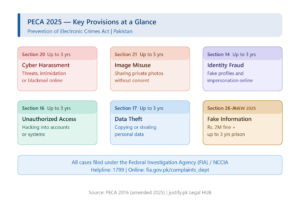
Important PECA Provisions
| Section | Offence |
|---|---|
| Section 20 | Cyber Harassment |
| Section 21 | Misuse of Images & Privacy Violations |
| Section 14 | Identity Fraud & Impersonation |
| Section 16 | Unauthorized Access (Hacking) |
| Section 17 | Data Theft & Unauthorized Copying |
PECA Amendment Act 2025
The PECA Amendment Act 2025 introduced significant changes to Pakistan’s cyber law framework:
- Introduction of Section 26-A regarding intentional dissemination of false information.
- Creation of the Social Media Protection and Regulatory Authority (SMPRA).
- Expansion of enforcement and investigation mechanisms.
- Strengthening of digital governance and complaint procedures.
Key cyber offences and legal consequences under PECA.
Common Cybercrime Problems in Pakistan
1. Online Financial Fraud
Scammers frequently impersonate banks, investment firms, or online businesses to steal money through fake offers, phishing links, or fraudulent payment requests.
2. Blackmail and Sextortion
Victims are threatened with the publication of private information or images unless money is paid. This conduct is punishable under PECA.
3. Cyber Harassment and Stalking
Repeated threats, abusive communication, and online stalking are criminal offences that may result in imprisonment and fines.
4. Identity Theft
Creating fake profiles, impersonating individuals, or misusing CNIC information constitutes identity fraud.
5. Hacking and Data Theft
Unauthorized access to email accounts, social media accounts, business systems, or databases is punishable under Pakistani law.
How to Report Cybercrime in Pakistan
If you become a victim of cybercrime, take immediate action and preserve all evidence.
Step 1: Preserve Evidence
- Screenshots
- Emails
- Transaction records
- URLs
- Phone numbers
- Chat history
Step 2: Contact NCCIA
The National Cyber Crime Investigation Agency (NCCIA) handles cybercrime complaints throughout Pakistan.
- Helpline: 1799
- Email: helpdesk@nr3c.gov.pk
- Online Complaint Portal: https://fia.gov.pk/complaints_dept
Step 3: Register Your Complaint
Provide all supporting evidence and cooperate with investigators during the inquiry process.
Step 4: Obtain Legal Assistance
A lawyer can assist with complaint drafting, legal notices, court proceedings, injunctions, and representation before relevant authorities.
Practical Online Safety Tips
- Use strong passwords for all accounts.
- Enable two-factor authentication (2FA).
- Never share OTPs, PINs, or passwords.
- Review social media privacy settings regularly.
- Verify identities before making payments.
- Avoid suspicious links and unknown downloads.
- Keep software and devices updated.
- Back up important personal and business data.
Your Digital Rights in Pakistan
\
- Right to Privacy – Protected under Article 14 of the Constitution of Pakistan.
- Right to Report – Victims may file complaints with NCCIA.
- Right to Content Removal – Unlawful content may be reported for removal.
- Right to Legal Representation – Victims may engage legal counsel.
- Right to Appeal – Administrative decisions may be challenged through lawful procedures.
Special Protection for Women and Minors
Women and children are particularly vulnerable to cyber harassment, image misuse, blackmail, and online exploitation. Pakistani law provides enhanced protection for such victims.
- Stronger penalties for image misuse offences.
- Priority handling of complaints involving minors.
- Dedicated support mechanisms for gender-based cybercrime.
- Online complaint options for greater accessibility.
Frequently Asked Questions (FAQs)
Is cyber harassment a crime in Pakistan?
Yes. Cyber harassment is punishable under PECA and may result in imprisonment and fines.
How can I report online blackmail?
Save all evidence and immediately contact NCCIA through helpline 1799 or the online complaint portal.
Can fake social media accounts be reported?
Yes. Identity fraud and impersonation are offences under PECA.
What should I do if my account is hacked?
Change passwords, enable 2FA, preserve evidence, and file a complaint with NCCIA.
Is sharing someone’s private photos illegal?
Yes. Unauthorized sharing of private images may constitute a criminal offence under PECA.
Conclusion
Cybercrime affects individuals, businesses, students, professionals, and families throughout Pakistan. The law provides significant protections against online fraud, harassment, hacking, identity theft, and privacy violations.
By understanding your digital rights, taking preventive measures, and reporting offences promptly, you can better protect yourself and your loved ones in the digital world.
If you become a victim of cybercrime, do not remain silent. Preserve evidence, report the matter immediately, and seek legal assistance where necessary.
About the Author
Zeshan Haider, Advocate is the founder of Justify.pk Legal Hub. He provides legal guidance on civil, constitutional, family, consumer, property, and cyber law matters. Through Justify.pk, he aims to make legal knowledge accessible, practical, and understandable for every Pakistani citizen.
Need Legal Help?
Get professional legal guidance for cybercrime, harassment, fraud, family matters, property disputes, and other legal issues.
Email: admin@justify.pk
WhatsApp: 0300-0779014