What Is FIR? Complete Legal Guide in Pakistan (2026 Update)
In Pakistan’s criminal justice system, the First Information Report (FIR) is the foundation of every criminal case. Whether you are a victim, witness, complainant, or accused person, understanding the FIR process is essential to protect your legal rights.
This detailed guide explains the legal meaning of FIR, registration procedure, rights of citizens, legal remedies, and important judicial principles under Pakistani law.
What Is FIR?
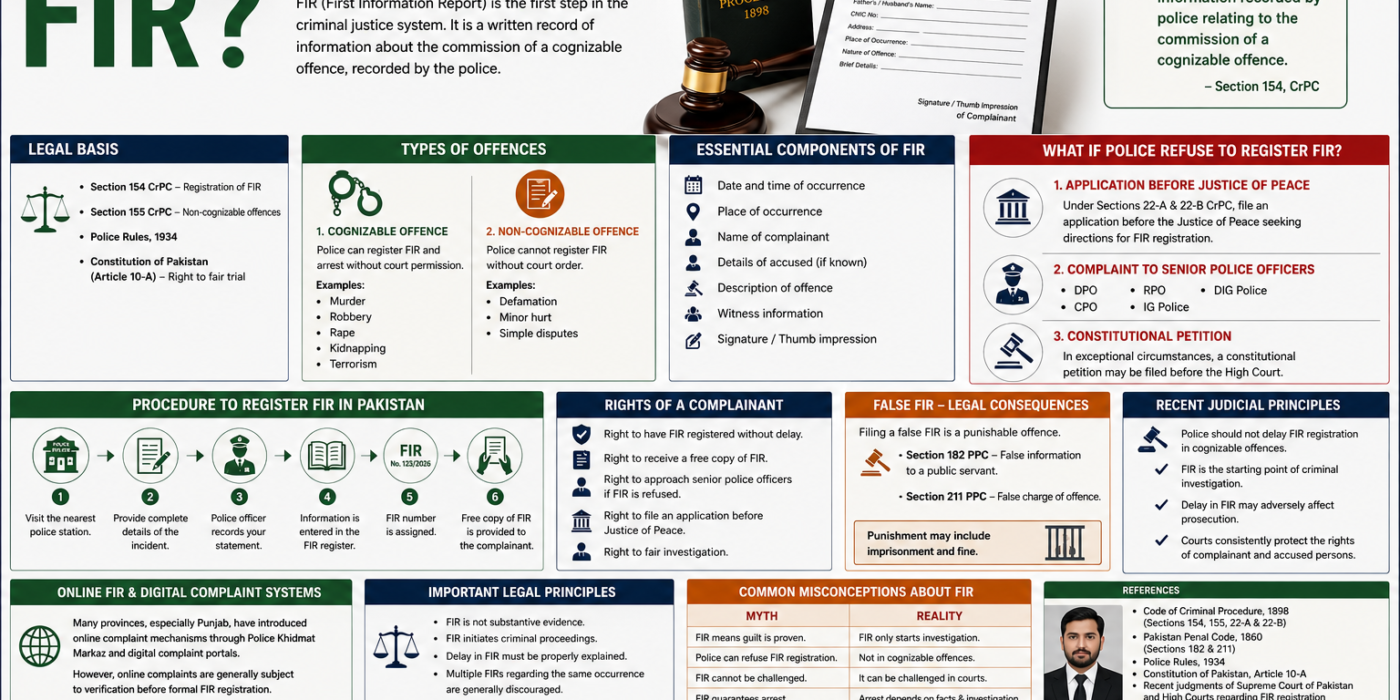
An FIR (First Information Report) is a written document prepared by the police when information regarding a cognizable offence is received.
The FIR is governed by Section 154 of the Code of Criminal Procedure (CrPC), 1898.
Legal Basis of FIR in Pakistan
- Section 154 CrPC – Registration of FIR
- Section 155 CrPC – Non-cognizable offences
- Police Rules, 1934
- Article 10-A of the Constitution of Pakistan – Right to Fair Trial
Types of Offences
1. Cognizable Offence
Police can register an FIR and arrest the accused without obtaining prior permission from a court.
- Murder
- Robbery
- Rape
- Kidnapping
- Terrorism
2. Non-Cognizable Offence
Police generally require court authorization before proceeding.
- Defamation
- Minor hurt cases
- Simple disputes
Essential Components of an FIR
- Date and time of occurrence
- Place of occurrence
- Name of complainant
- Details of accused (if known)
- Description of offence
- Witness information
- Signature or thumb impression
Procedure to Register FIR in Pakistan
- Visit the nearest police station.
- Provide complete details of the incident.
- Police officer records your statement.
- Information is entered into the FIR register.
- FIR number is assigned.
- A free copy of the FIR is provided to the complainant.
Online FIR and Digital Complaint Systems
Several provinces, especially Punjab, have introduced online complaint mechanisms through Police Khidmat Markaz and digital complaint portals.
However, online complaints are generally subject to verification before formal FIR registration.
Rights of a Complainant
- Right to have FIR registered without unnecessary delay.
- Right to receive a free copy of FIR.
- Right to approach senior police officers if FIR is refused.
- Right to file an application before the Justice of Peace.
- Right to fair investigation.
What If Police Refuse to Register FIR?
1. Application Before Justice of Peace
Under Sections 22-A and 22-B CrPC, an aggrieved person may file an application before the Justice of Peace seeking directions for FIR registration.
2. Complaint to Senior Police Officers
- DPO
- CPO
- RPO
- DIG Police
- IG Police
3. Constitutional Petition
In exceptional circumstances, a constitutional petition may be filed before the High Court.
False FIR – Legal Consequences
Filing a false FIR is a punishable offence under Pakistani law.
- Section 182 PPC – False information to a public servant.
- Section 211 PPC – False charge of offence.
Punishment may include imprisonment and fine.
Recent Judicial Principles
- Police should not delay FIR registration in cognizable offences.
- FIR is the starting point of criminal investigation.
- Delay in FIR may adversely affect prosecution.
- Courts consistently protect the rights of complainants and accused persons.
Important Legal Principles
- FIR is not substantive evidence.
- FIR initiates criminal proceedings.
- Delay in FIR must be properly explained.
- Multiple FIRs regarding the same occurrence are generally discouraged.
Common Misconceptions About FIR
| Myth | Reality |
|---|---|
| FIR means guilt is proven. | FIR only starts investigation. |
| Police can refuse FIR registration. | Not in cognizable offences. |
| FIR cannot be challenged. | It can be challenged before competent courts. |
| FIR guarantees arrest. | Arrest depends upon facts and investigation. |
What is FIR in Pakistan, FIR Procedure Pakistan, Section 154 CrPC, How to Register FIR, Justice of Peace Pakistan, Criminal Law Pakistan, FIR Registration Guide
Conclusion
The FIR is one of the most important legal instruments in Pakistan’s criminal justice system. Understanding how FIRs are registered, investigated, and challenged can help citizens protect their rights and seek justice effectively.
If police refuse to perform their legal duty, Pakistani law provides remedies through senior police authorities, Justice of Peace proceedings, and constitutional jurisdiction of the High Courts.
References
- Code of Criminal Procedure, 1898 (Sections 154, 155, 22-A & 22-B)
- Pakistan Penal Code, 1860 (Sections 182 & 211)
- Police Rules, 1934
- Constitution of the Islamic Republic of Pakistan, Article 10-A
- Recent judgments of the Supreme Court of Pakistan and High Courts regarding FIR registration and criminal investigations.
Get Free Consultation please Click