{
“@context”: “https://schema.org”,
“@type”: “Article”,
“headline”: “Labour Laws & Workplace Harassment Protections in Pakistan 2026”,
“description”: “A practical guide to labour laws, employee rights, workplace harassment protections, complaint procedures and legal remedies in Pakistan in 2026.”,
“author”: {
“@type”: “Organization”,
“name”: “Justify.pk”
},
“publisher”: {
“@type”: “Organization”,
“name”: “Justify.pk”
},
“datePublished”: “2026-08-30”,
“dateModified”: “2026-08-30”,
“inLanguage”: “en-PK”
}
{
“@context”: “https://schema.org”,
“@type”: “FAQPage”,
“mainEntity”: [
{
“@type”: “Question”,
“name”: “Does the Harassment Act only protect women?”,
“acceptedAnswer”: {
“@type”: “Answer”,
“text”: “The 2022 amendments expanded the definition of complainant and employee. FOSPAH has stated that aggrieved men, women and transgender persons can approach an Inquiry Committee or FOSPAH for workplace harassment complaints.”
}
},
{
“@type”: “Question”,
“name”: “Can I complain about harassment that happened outside the office?”,
“acceptedAnswer”: {
“@type”: “Answer”,
“text”: “Yes. Conduct occurring outside the physical workplace may fall within the legal framework where it has a sufficient connection with employment or work-related activities.”
}
},
{
“@type”: “Question”,
“name”: “What is FOSPAH?”,
“acceptedAnswer”: {
“@type”: “Answer”,
“text”: “FOSPAH is the Federal Ombudsperson Secretariat for Protection Against Harassment. It is a quasi-judicial forum that handles workplace harassment complaints under the applicable federal law.”
}
},
{
“@type”: “Question”,
“name”: “Do organisations need an Inquiry Committee?”,
“acceptedAnswer”: {
“@type”: “Answer”,
“text”: “Yes. Organisations are required to constitute an Internal Inquiry Committee in accordance with the applicable workplace harassment law and related requirements.”
}
},
{
“@type”: “Question”,
“name”: “What should I do first if I face workplace harassment?”,
“acceptedAnswer”: {
“@type”: “Answer”,
“text”: “Preserve evidence, document dates and incidents, review your organisation’s harassment policy, and consider filing a complaint with the Internal Inquiry Committee or the appropriate Ombudsperson.”
}
},
{
“@type”: “Question”,
“name”: “Are gig workers and freelancers protected?”,
“acceptedAnswer”: {
“@type”: “Answer”,
“text”: “The 2022 amendment expanded the definition of employee to include categories such as gig, temporary, part-time and freelance employees, as well as interns, trainees, apprentices and certain other workers.”
}
},
{
“@type”: “Question”,
“name”: “Can an employer retaliate against a complainant?”,
“acceptedAnswer”: {
“@type”: “Answer”,
“text”: “Retaliation or adverse treatment connected with a harassment complaint may create additional legal issues. A complainant should document any retaliatory conduct and seek appropriate legal advice.”
}
}
]
}
Employment & Labour Law Pakistan | Updated 2026
Labour Laws & Workplace Harassment Protections in Pakistan 2026
Know your workplace rights: Learn about labour laws in Pakistan,
employee protections, workplace harassment complaints, Inquiry Committees,
FOSPAH, provincial labour authorities, and practical legal remedies.
Introduction
Every worker in Pakistan deserves a safe, fair and respectful workplace.
Whether you work in a private office, factory, educational institution,
government department, professional organisation or another workplace,
Pakistani law provides important protections concerning working conditions,
wages, leave, workplace dignity and freedom from harassment.
Labour regulation in Pakistan is largely administered at the provincial level,
while the federal workplace harassment framework provides an important
nationwide legal mechanism. The
Protection Against Harassment of Women at the Workplace Act, 2010,
as amended in 2022, significantly expanded the categories of employees and
complainants covered by the law.
This 2026 guide explains the major labour-law protections, workplace
harassment rules, complaint procedures, employer responsibilities and
practical remedies available to employees in Pakistan.
Labour Laws in Pakistan: Quick Overview
Labour laws in Pakistan regulate matters such as wages,
working hours, leave, occupational safety, social security, industrial
relations and termination of employment. Because labour is substantially
a provincial subject, the exact rules can differ between Punjab, Sindh,
Khyber Pakhtunkhwa, Balochistan and Islamabad.
Workplace harassment is separately addressed through the
Protection Against Harassment of Women at the Workplace Act, 2010,
including amendments introduced in 2022.
Key Labour Law Framework in Pakistan
Pakistan’s employment and labour framework consists of federal and
provincial legislation, depending on the nature of employment and the
jurisdiction involved.
- Provincial Shops and Establishments legislation
- Factories and industrial safety laws
- Minimum wage laws
- Industrial relations legislation
- Payment of wages laws
- Employees’ Old-Age Benefits (EOBI) laws
- Provincial social security legislation
- Occupational health and safety requirements
- Employment and service rules applicable to specific sectors
-
Protection Against Harassment of Women at the Workplace Act, 2010,
as amended
Important: Labour rights and procedures can vary according
to province, sector, employment status and the terms of employment.
Employees should verify the law applicable to their specific situation.
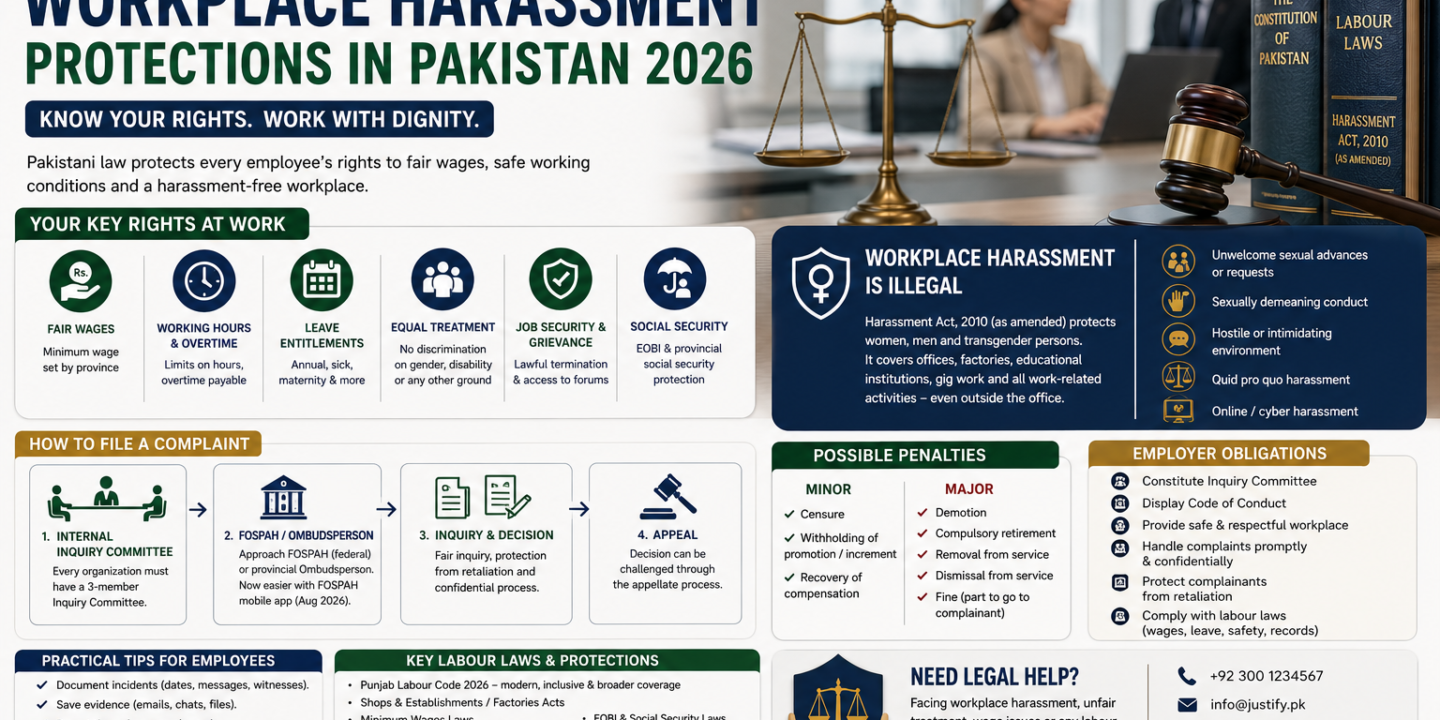
Employee Rights Under Pakistani Labour Laws
Depending on the applicable provincial and federal framework, employees
may have legal protections relating to the following:
1. Minimum Wage
Provincial authorities prescribe minimum wage rates for categories of
workers covered by the relevant legislation. The applicable rate can
change through government notifications, so employees should verify the
latest rate in their province.
2. Working Hours and Overtime
Labour legislation regulates working hours and, where applicable,
overtime. The precise limits and overtime rates depend on the relevant
provincial law and category of employment.
3. Leave Entitlements
Depending on the applicable law, employees may be entitled to annual,
casual, sick, maternity and other forms of statutory leave.
4. Equal Treatment and Non-Discrimination
Employees may have legal protection against unlawful discrimination and
unequal treatment. Workplace harassment law also addresses conduct
involving gender-based discrimination that affects dignity.
5. Lawful Termination and Grievances
Termination of employment may be subject to statutory requirements,
contractual terms and applicable service rules. Employees may have access
to labour courts, tribunals or other competent authorities depending on
the nature of the dispute.
6. Social Security and EOBI
Eligible workers may receive protections through EOBI and provincial
social security institutions, subject to registration and statutory
requirements.
Workplace Harassment Law in Pakistan
The principal federal legislation dealing specifically with workplace
harassment is the
Protection Against Harassment of Women at the Workplace Act, 2010.
The law was amended in 2022 to broaden important definitions, including
the definitions of employee and complainant.
The amended framework covers a significantly wider range of working
arrangements, including regular, contractual, temporary, part-time,
freelance and gig workers, as well as interns, trainees, apprentices and
certain other categories identified by the law.
What Constitutes Workplace Harassment?
Workplace harassment may involve conduct that violates a person’s dignity
or creates an intimidating, hostile or offensive work environment.
Depending on the facts, it may include:
- Unwelcome sexual advances or requests for sexual favours
- Sexually demeaning or inappropriate conduct
- Verbal, written, visual or physical conduct of a sexual nature
- Gender-based discrimination affecting workplace dignity
- Conduct creating an intimidating or hostile work environment
- Quid pro quo conduct involving employment benefits or disadvantages
- Work-related digital or online harassment
- Harassment occurring during work-related activities outside the office
Whether particular conduct legally constitutes harassment depends on the
facts, evidence, employment relationship and applicable law.
Who Is Protected Under the Amended Harassment Law?
The 2022 amendment expanded the statutory definition of
employee. It includes a broad range of employment
arrangements, including:
- Regular employees
- Contractual employees
- Temporary and part-time workers
- Freelancers
- Gig workers
- Interns and trainees
- Apprentices
- Students and certain other workers
- Domestic and home-based workers covered by the statutory definition
- Performers, artists and sportspersons covered by the law
FOSPAH has also stated that aggrieved men, women and transgender persons
can approach an Inquiry Committee or FOSPAH for workplace harassment
redressal. :contentReference[oaicite:1]{index=1}
Does Workplace Harassment Have to Happen Inside the Office?
No. Workplace-related harassment is not necessarily limited to an
employee’s physical office or workplace premises.
Depending on the circumstances, work-related conduct occurring during
official meetings, business trips, professional events, online
communications or other employment-related activities may fall within
the relevant legal framework.
The important question is whether the conduct has a sufficient connection
with the employment or workplace relationship.
How to File a Workplace Harassment Complaint in Pakistan
Employees generally have more than one potential route for seeking
redress, depending on the applicable law and circumstances.
1. Internal Inquiry Committee
Organisations covered by the harassment law are required to constitute
an Internal Inquiry Committee. FOSPAH states that the committee should
consist of three members, including at least one female member, and that
relevant information should be publicly displayed by the organisation.
:contentReference[oaicite:2]{index=2}
2. FOSPAH
The Federal Ombudsperson Secretariat for Protection Against
Harassment (FOSPAH) is a quasi-judicial forum for workplace
harassment complaints under the applicable federal law. FOSPAH provides
complaint management and adjudication services. :contentReference[oaicite:3]{index=3}
3. Digital Complaint Facilities
In August 2026, FOSPAH announced the launch of its
Complaint Management System (CMS), mobile application and new
website as part of its digitalisation efforts. This makes
complaint-related access more convenient for users. :contentReference[oaicite:4]{index=4}
4. Labour Authorities and Courts
Wage disputes, unlawful termination, working-hours issues and other
general employment disputes may fall within the jurisdiction of the
relevant provincial Labour Department, Labour Court, tribunal or another
competent forum.
Step-by-Step Process for a Workplace Harassment Complaint
-
Document the incident:
Record dates, locations, messages, emails, witnesses and other relevant
facts. -
Preserve evidence:
Keep screenshots, emails, recordings where lawfully obtained, notices,
employment records and other supporting material. -
Review workplace policies:
Check the organisation’s Code of Conduct and complaint procedure. -
Submit a written complaint:
Where appropriate, file the complaint before the Internal Inquiry
Committee or the relevant Ombudsperson. -
Keep proof of submission:
Preserve the complaint, acknowledgement, reference number and related
correspondence. -
Seek legal advice:
Professional advice can be particularly important where the case
involves termination, retaliation, discrimination or complicated
evidence.
Employer Obligations Regarding Workplace Harassment
Employers and organisations covered by the applicable harassment law
should take active steps to maintain a workplace free from harassment
and ensure that statutory complaint mechanisms are available.
- Constitute the required Internal Inquiry Committee
- Display the Code of Conduct
- Make relevant committee information accessible to employees
- Provide an appropriate mechanism for receiving complaints
- Handle complaints through the prescribed procedure
- Maintain appropriate confidentiality
- Protect workplace dignity and safety
- Comply with applicable labour and employment requirements
FOSPAH specifically states that organisations, whether public or private,
have responsibilities concerning the Inquiry Committee, competent
authority and display of the Code of Conduct. :contentReference[oaicite:5]{index=5}
Penalties for Workplace Harassment
The applicable law provides a range of penalties depending on the nature
and seriousness of the misconduct and the findings of the competent
authority.
Possible Minor Penalties
- Censure
- Withholding of promotion or increment
- Recovery of compensation
Possible Major Penalties
- Demotion
- Compulsory retirement
- Removal from service
- Dismissal from service
- Other penalties prescribed by the applicable framework
The actual penalty depends on the applicable law, evidence, findings and
circumstances of the particular case.
What to Do If Your Employer Violates Your Labour Rights
Workplace harassment is not the only employment-related problem.
Employees may also face unpaid wages, unlawful deductions, excessive
working hours, unsafe conditions, wrongful termination or other labour
violations.
- Collect your employment agreement and salary records.
- Keep payslips, bank statements and attendance records.
- Document communications with your employer.
- Check the labour law applicable in your province.
- Submit a written grievance where appropriate.
- Approach the relevant Labour Department or competent forum.
- Consult an employment lawyer where the dispute is serious.
Important Workplace Law Developments in 2026
Employment law continues to develop through legislation, provincial
reforms, government notifications and decisions of courts and
specialised forums.
Digital Access to FOSPAH
FOSPAH announced the launch of its CMS, mobile application and new website
on 27 August 2026, representing an important step toward
digital access to workplace harassment complaint services. :contentReference[oaicite:6]{index=6}
Broader Protection After the 2022 Amendment
The 2022 amendment expanded the statutory definition of employee to cover
several modern and non-traditional forms of work, including gig and
freelance arrangements. :contentReference[oaicite:7]{index=7}
Provincial Labour Reforms
Provincial labour frameworks continue to evolve. Employees and employers
should verify the latest provincial legislation, notifications and
implementation status before relying on a specific wage, leave,
employment or compliance requirement.
Practical Tips for Employees
-
Keep written records: Save employment documents,
salary records and important workplace communications. -
Preserve evidence: Do not delete relevant emails,
messages or documents. -
Know your workplace policy: Read the employer’s
harassment and grievance procedures. -
Report serious misconduct promptly: Delays can make
evidence harder to preserve. -
Do not sign documents without understanding them:
Seek advice before signing a resignation, settlement or admission in
a disputed matter. -
Seek professional advice: A lawyer can help identify
the correct legal forum and remedy.
Workplace Harassment Checklist for Employees
| Action | Why It Matters |
|---|---|
| Save messages and emails | Preserves potential evidence |
| Record dates and incidents | Creates a clear chronology |
| Identify witnesses | May support your version of events |
| Review workplace policy | Helps identify the correct internal procedure |
| File a written complaint | Creates a formal record of the grievance |
| Keep acknowledgement/reference number | Helps track the complaint |
| Seek legal advice | Helps protect procedural and legal rights |
Frequently Asked Questions About Labour Laws & Workplace Harassment in Pakistan
1. Does the Harassment Act only protect women?
The 2022 amendments expanded the definitions of employee and complainant.
FOSPAH has stated that aggrieved men, women and transgender persons can
approach an Inquiry Committee or FOSPAH for workplace harassment
complaints. :contentReference[oaicite:8]{index=8}
2. Can I complain about harassment that happened outside the office?
Yes, where the conduct has a sufficient connection with the employment
relationship or work-related activities. The location alone does not
necessarily determine whether conduct falls within the workplace
harassment framework.
3. What is FOSPAH?
FOSPAH stands for the Federal Ombudsperson Secretariat for Protection
Against Harassment. It is a quasi-judicial forum that handles workplace
harassment complaints under the applicable federal framework.
4. Do organisations need an Inquiry Committee?
Yes. FOSPAH states that organisations are required to constitute a
three-member Internal Inquiry Committee, including at least one female
member, and display relevant information about the committee.
:contentReference[oaicite:9]{index=9}
5. What should I do first if I face workplace harassment?
Document the incident, preserve relevant evidence, review your workplace
complaint procedure and consider filing a written complaint with the
Internal Inquiry Committee or the appropriate Ombudsperson.
6. Are gig workers and freelancers protected?
The 2022 amendment expanded the statutory definition of employee to
include gig, temporary, part-time and freelance employees, along with
several other categories of workers. :contentReference[oaicite:10]{index=10}
7. Can an employer retaliate against a complainant?
Retaliatory conduct connected with a harassment complaint can create
additional legal issues. Employees should document any adverse action
and seek appropriate legal advice promptly.
Related Legal Guides
Conclusion
Pakistan’s labour and workplace harassment laws provide important
protections for employees, but the exact remedy depends on the nature of
the problem and the law applicable to the employment relationship.
If you are facing workplace harassment, unpaid wages, discrimination,
unlawful termination or another employment dispute, documenting the facts
and taking timely legal action can significantly strengthen your position.
Employees should also identify the correct forum before filing a complaint
or legal proceeding.
A safe and respectful workplace is not merely a matter of good management;
it is closely connected with legal rights, dignity and accountability.
Need Legal Help With a Workplace Dispute?
Facing workplace harassment, unfair treatment, unpaid wages,
discrimination, wrongful termination or another labour-law issue in
Pakistan?
Contact the experienced employment and labour law team at Justify.pk
for confidential legal guidance, complaint assistance and
representation.