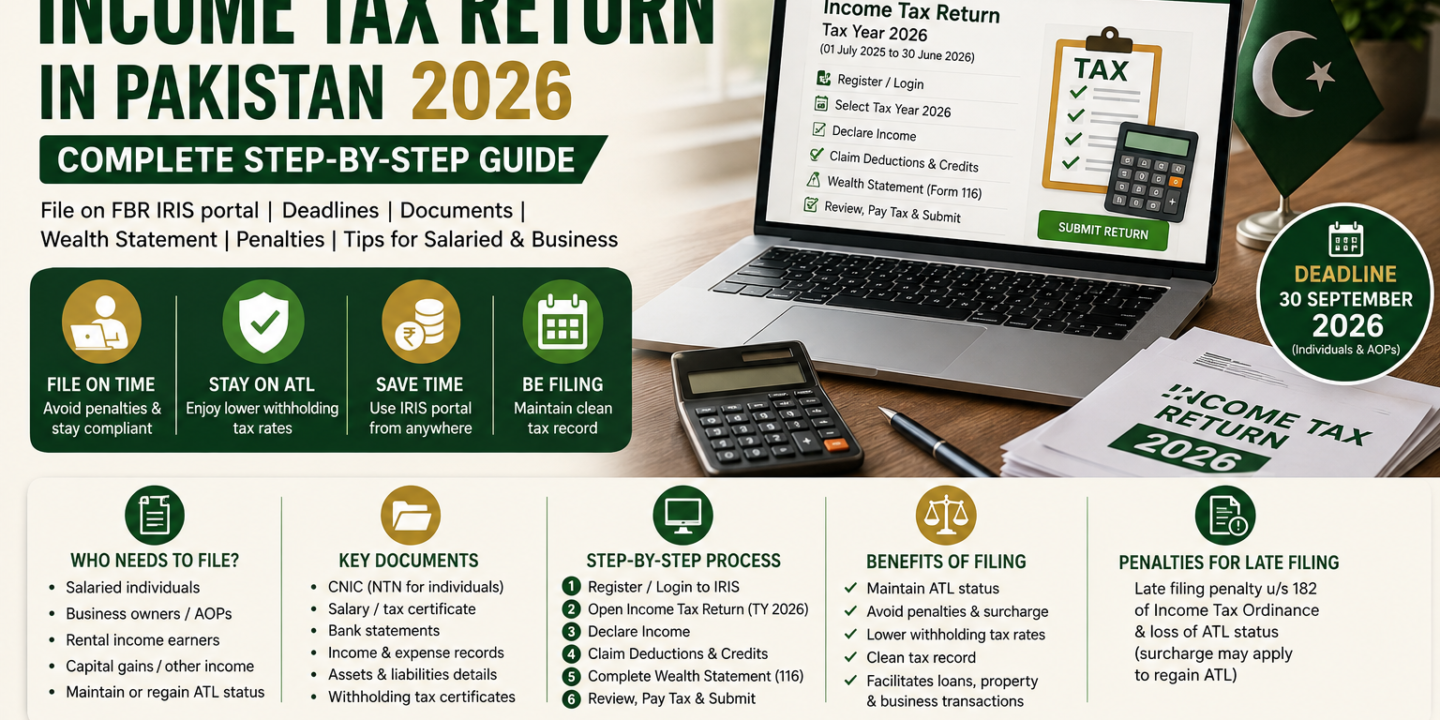
How to File Income Tax Return in Pakistan 2026 – Complete Guide
“`
Filing your income tax return in Pakistan is an important annual obligation for taxpayers. Whether you are a salaried employee in Lahore, a business owner in Karachi, a freelancer, or an Overseas Pakistani, understanding the tax filing process can help you remain compliant and maintain your Active Taxpayer List (ATL) status.
This complete guide explains how to file an income tax return in Pakistan for Tax Year 2026 through the official FBR IRIS portal. It covers important deadlines, required documents, registration, income declaration, the Wealth Statement, tax payment, penalties, and common mistakes to avoid.
Tax Year 2026 generally covers income earned from 1 July 2025 to 30 June 2026.
“`
Who Needs to File an Income Tax Return in Pakistan?
“`
The requirement to file an income tax return depends on your income, employment, business activities, assets, and other circumstances under applicable tax law.
You may need to file an income tax return if:
- You have taxable income above the applicable exemption threshold.
- You are a salaried individual whose tax has been deducted at source.
- You run a business or are a member of an Association of Persons (AOP).
- You receive rental or property income.
- You have capital gains or other taxable sources of income.
- You have foreign income that is relevant to your tax position.
- You want to maintain or regain your Active Taxpayer List (ATL) status.
Even where tax has already been deducted from your income or your final tax liability is zero, filing may still be necessary or beneficial depending on your circumstances and ATL status.
“`
Important Income Tax Filing Deadlines for Tax Year 2026
“`
| Taxpayer Type | Filing Deadline |
|---|---|
| Salaried Individuals | 30 September 2026 |
| Other Individuals & AOPs | 30 September 2026 |
| Companies with June Year-End | 31 December 2026 |
Missing the applicable filing deadline may result in late-filing penalties and may affect your Active Taxpayer List status. Applicable surcharges and other consequences may also arise under the relevant tax rules.
“`
Documents Required to File an Income Tax Return
“`
Preparing your documents before starting the return can make the filing process much easier and reduce the risk of errors.
Documents for Salaried Individuals
- Salary certificate or annual tax certificate from your employer.
- Bank statements covering July 2025 to June 2026.
- Details of rental income, freelancing, dividends, or other income.
- Withholding tax details where applicable.
Documents for Business Owners and Freelancers
- Income and expense records.
- Sales and purchase details.
- Business bank statements.
- Invoices and relevant financial records.
- Details of withholding taxes and other tax payments.
Documents Commonly Required for Individuals
- CNIC details.
- Bank account and IBAN information.
- Details of assets and liabilities.
- Withholding tax certificates and CPR details.
- Property documents where relevant.
- Vehicle and investment details where applicable.
“`
How to File Income Tax Return on the FBR IRIS Portal
“`
Individuals can file their income tax returns electronically through the FBR IRIS portal. The following steps provide a practical overview of the filing process.
Step 1: Register or Log In to FBR IRIS
- Visit the official FBR IRIS portal.
- If you are a new taxpayer, select the registration option for an unregistered person and provide the required information.
- Complete the applicable verification process using your registered mobile number and email.
- Set your IRIS password after completing registration.
- Existing users can log in using their CNIC/NTN credentials and password.
Keep your registered mobile number and email accessible because they may be required for verification and account recovery.
Step 2: Update Your Profile
If IRIS requires a profile update, complete the relevant information before proceeding with the return.
This may include information such as:
- Bank account and IBAN.
- Employer information.
- Business information.
- Utility connections.
- Other information required by the tax system.
Step 3: Open the Income Tax Return
- Log in to the FBR IRIS portal.
- Open the Declaration section.
- Select the applicable Income Tax Return.
- Select Tax Year 2026.
- Select the appropriate return type according to your circumstances.
Step 4: Declare Your Income
Enter income under the appropriate categories. Depending on your circumstances, these may include:
- Salary / Employment Income
- Business / Professional Income
- Property / Rental Income
- Capital Gains
- Other Sources of Income
- Foreign Income, where applicable
Carefully compare any pre-filled withholding tax information with your salary certificate, bank records, withholding certificates, and other available documentation.
Step 5: Enter Deductions, Tax Credits and Adjustable Tax
Where applicable, enter eligible deductions, tax credits, and adjustable tax already paid or deducted during the tax year.
- Zakat and other allowable deductions.
- Eligible donations.
- Applicable tax credits.
- Salary tax already deducted.
- Bank withholding tax.
- Other adjustable tax already paid or withheld.
Only claim deductions and tax credits that are legally available and supported by appropriate records.
Step 6: Complete the Wealth Statement
The Wealth Statement (Form 116) is an important part of individual tax filing. It provides details of your assets, liabilities, income, expenses, and changes in wealth.
Depending on your circumstances, you may need to declare:
- Residential and other property.
- Vehicles.
- Bank balances.
- Investments.
- Business assets.
- Loans and other liabilities.
- Personal and household expenses.
- Other relevant assets and liabilities.
Wealth Reconciliation
Your Wealth Statement should properly reconcile your opening wealth with your income, expenses, and closing wealth. Any unexplained difference can create questions or problems during tax processing.
“`
Step 7: Review, Pay Tax and Submit the Return
“`
- Review all income and tax information carefully.
- Check your Wealth Statement and wealth reconciliation.
- Review the final tax computation.
- If additional tax is payable, generate the applicable PSID (Payment Slip ID).
- Pay the tax through an available authorized banking or payment channel.
- Confirm that the payment has been properly reflected.
- Submit the completed income tax return.
- Download and save your acknowledgement receipt and relevant records.
Keep copies of your return, Wealth Statement, payment records, certificates, and supporting documents for future reference.
“`
Benefits of Filing Your Tax Return on Time
“`
Timely tax filing can help you:
- Maintain your Active Taxpayer List (ATL) status.
- Access applicable filer-related tax benefits.
- Avoid or reduce the risk of late-filing penalties.
- Avoid complications associated with ATL status.
- Maintain an organized tax record.
- Facilitate certain banking, property, investment, and business transactions.
- Demonstrate tax compliance when documentation is required.
“`
Common Mistakes to Avoid When Filing a Tax Return
“`
Small mistakes can result in incorrect tax calculations, reconciliation problems, or unnecessary delays. Avoid the following common errors:
- Selecting the wrong tax year.
- Selecting the wrong return type.
- Failing to complete the Wealth Statement properly.
- Entering incorrect asset values.
- Failing to reconcile opening and closing wealth.
- Ignoring pre-filled withholding tax information.
- Failing to declare relevant income sources.
- Waiting until the final days before the deadline.
- Using unofficial websites or unauthorized tax agents.
- Failing to keep copies of submitted documents and payment records.
“`
Income Tax Penalties for Late Filing
“`
Late filing may attract penalties under the applicable provisions of the Income Tax Ordinance, 2001, including Section 182 where applicable.
In addition to a late-filing penalty, failure to file within the prescribed time may affect your Active Taxpayer List (ATL) status. Applicable surcharge or other consequences may arise under the tax rules in force at the relevant time.
Because tax penalties and ATL rules can change through legislation, notifications, or Finance Acts, taxpayers should check the latest FBR requirements for the relevant tax year.
“`
Special Notes for Overseas Pakistanis
“`
Overseas Pakistanis may also need to file a Pakistani income tax return depending on their residential status, Pakistani-source income, assets, and other applicable tax obligations.
Individuals living abroad should carefully determine whether they are considered residents or non-residents for Pakistani tax purposes before preparing their return.
Overseas Pakistanis with Pakistani-source income may have tax obligations relating to property, rental income, investments, business income, capital gains, or other sources.
Dual nationals and non-residents with complex income or asset structures should consider obtaining professional tax advice before filing.
“`
How to Stay on the Active Taxpayer List (ATL)
“`
The Active Taxpayer List is important for taxpayers because ATL status can affect applicable withholding tax rates and other tax consequences.
To maintain your tax compliance:
- File your return within the applicable deadline.
- Ensure your return is properly submitted.
- Complete the required Wealth Statement.
- Pay any tax due within the applicable time.
- Check your ATL status after filing where appropriate.
- Keep your FBR profile and contact information updated.
“`
Frequently Asked Questions About Income Tax Return in Pakistan
“`
1. What is the last date to file the Tax Year 2026 return?
According to the filing schedule stated in this guide, the deadline for individuals and AOPs is 30 September 2026, while the deadline stated for companies with a June year-end is 31 December 2026. Taxpayers should check the latest FBR notifications for any extension or change.
2. Do I need to file a return if tax was already deducted from my salary?
In many cases, salaried individuals still need to file a return even where tax has already been deducted at source. Filing can also be important for maintaining ATL status and completing the required tax declarations.
3. Can I file a revised income tax return?
A revised return may be possible subject to the conditions, procedure, and applicable timelines under Pakistani tax law. If you discover an error after filing, review the applicable FBR rules before submitting a revision.
4. What if I forget my IRIS password?
Use the Forgot Password option available on the IRIS login page and follow the verification procedure using your registered contact information.
5. Is the Wealth Statement compulsory?
Individuals required to submit a Wealth Statement should complete it along with their income tax return. The Wealth Statement should accurately reflect assets, liabilities, income, expenses, and wealth reconciliation.
6. How do I pay tax if there is a balance due?
If tax is payable, generate the applicable PSID through the IRIS system and make payment through an authorized banking or payment channel. Keep the payment record for your files.
7. What happens if I miss the tax filing deadline?
Late filing may result in penalties and may affect your ATL status. Depending on the applicable rules, a surcharge or other consequences may apply. It is advisable to file as soon as possible rather than continuing to delay.
“`
Related Legal & Tax Guides
“`
Explore more practical legal and tax guides on Justify.pk:
-
NADRA & Immigration Issues for Overseas Pakistanis 2026
-
Property Dispute Resolution in Pakistan: Common Cases & Solutions
-
Illegal Eviction by Landlord: Tenant Rights in Pakistan
“`
Conclusion
“`
Filing an income tax return in Pakistan for Tax Year 2026 can be straightforward when your documents are prepared in advance and the correct information is entered into the FBR IRIS portal.
Whether you are a salaried employee, freelancer, business owner, investor, or Overseas Pakistani, timely filing can help you maintain your tax record, protect your ATL status, and avoid unnecessary penalties and complications.
Before submitting your return, carefully review your income, withholding tax, deductions, assets, liabilities, expenses, and Wealth Statement reconciliation. If your tax affairs are complex, professional tax advice can help ensure accurate and compliant filing.
“`
Need Help Filing Your Income Tax Return?
“`
Facing difficulty with FBR IRIS, income tax return filing, Wealth Statement, tax calculations, ATL status, or other tax matters in Pakistan?
The experienced tax and legal team at Justify.pk assists individuals, businesses, freelancers, and Overseas Pakistanis with tax return preparation, IRIS-related matters, documentation, and other tax-related legal issues.
Contact Justify.pk for Tax & Legal Assistance
“`