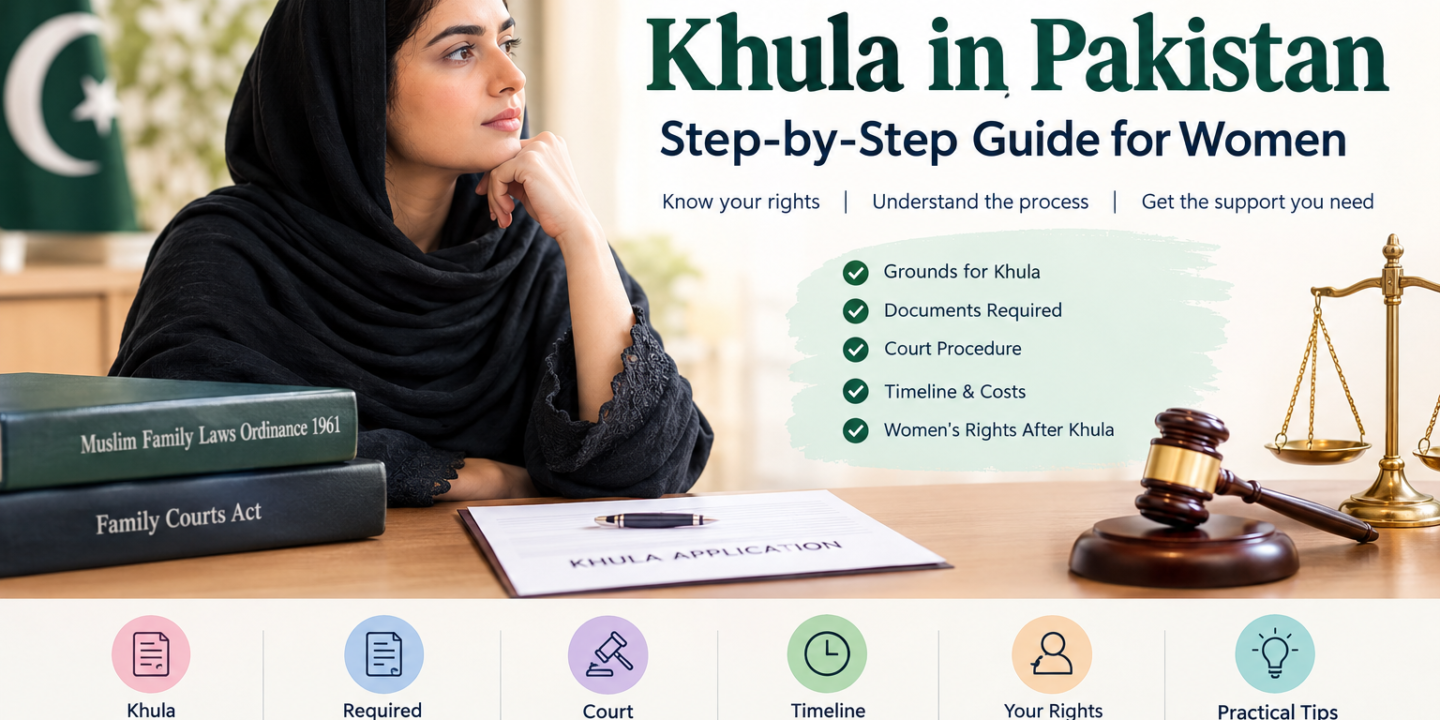
How to File for Khula in Pakistan 2026 – Complete Step-by-Step Guide for Women
Khula is a legal mechanism through which a Muslim woman can seek
dissolution of her marriage through the Family Court in Pakistan. If a marriage
has become difficult or impossible to continue, a woman may approach the court
and request a decree of Khula.
The procedure generally involves filing a suit for dissolution of marriage,
service of notice on the husband, attempts at reconciliation, and, where
reconciliation fails, proceedings leading to a decree. The exact procedure,
documentation and practical requirements may vary depending on the applicable
provincial family law and the circumstances of the case.
Women should understand that seeking Khula does not mean they have to remain
trapped in an unhappy marriage. Legal assistance can make the process easier to
understand and help protect important rights relating to dower, children,
maintenance and personal belongings.
Need personalised guidance?
Book a free consultation with a family law advocate at
Justify.pk.
What Is Khula?
Khula is a form of dissolution of marriage sought by the wife. In Pakistan,
a woman can approach the Family Court when she no longer wishes to continue
the marital relationship and seeks dissolution of the marriage according to
applicable family law.
Khula should be distinguished from Talaq, which is ordinarily initiated by
the husband, and other forms of judicial dissolution of marriage based on
specific legal grounds.
Khula vs Talaq vs Judicial Dissolution
| Type | Who Initiates It? | General Meaning |
|---|---|---|
| Talaq | Husband |
Divorce pronounced by the husband subject to the applicable legal requirements and procedure. |
| Khula | Wife | Wife seeks dissolution of marriage through the Family Court. |
| Judicial Dissolution / Faskh | Wife through court |
Marriage may be dissolved by the court on legally recognised grounds, such as those provided under applicable Muslim family law. |
The legal framework may involve the Muslim Family Laws Ordinance,
1961, the applicable Family Courts legislation,
and other relevant family laws. The exact legal route depends on the facts
of the case.
Grounds for Filing Khula in Pakistan
A woman may seek dissolution of marriage where continuation of the marital
relationship has become difficult or impossible. Common circumstances
considered in family cases include:
-
Failure to Maintain: The husband fails to provide
reasonable maintenance according to his legal obligations. -
Cruelty: Physical, mental, emotional or other forms of
abusive treatment may be relevant depending on the facts and legal basis
of the claim. -
Desertion or Prolonged Absence: The husband has abandoned
the wife or remained absent for a prolonged period. -
Impotency or Inability to Consummate: Certain medical or
legal circumstances relating to inability to consummate the marriage may
provide a basis for judicial dissolution. -
Imprisonment: A husband’s imprisonment for the legally
prescribed period may constitute a ground for judicial dissolution. -
Breakdown of the Marriage: Where the relationship has
irretrievably broken down and the parties cannot reasonably continue
living together, the circumstances may support dissolution through Khula. -
Other Circumstances: Depending on the facts, other
circumstances may demonstrate that the marital relationship cannot
reasonably continue.
Important: The legal grounds and evidentiary requirements
can differ between Khula and a suit for dissolution on specific statutory
grounds. A family lawyer can advise which legal claim is most appropriate
for a particular case.
Step-by-Step Procedure to File for Khula in Pakistan
Step 1: Consider Reconciliation
Family law proceedings generally provide opportunities for reconciliation
between the parties. Depending on the applicable procedure, reconciliation
may be attempted before or during the court proceedings.
If reconciliation is unsuccessful, the case can proceed according to the
applicable Family Court procedure.
Step 2: Prepare the Khula Application / Suit
The wife, normally through herself or her authorised lawyer, files a suit
for dissolution of marriage before the competent Family Court.
The plaint generally identifies the parties, marriage details, relevant
circumstances, children if any, and the relief being requested from the
court.
The question of which Family Court has jurisdiction depends on the
applicable law and facts, including the residence of the wife and other
jurisdictional requirements.
Step 3: Prepare the Required Documents
The documents commonly required for a Khula case may include:
- Copy of the wife’s CNIC
- Copy of Nikah Nama / marriage certificate
- Recent photographs, where required
- Proof of residence, where required
- Relevant evidence supporting the case, if available
- Details of children, if applicable
- Previous court orders, if any
- Any other documents requested by the relevant Family Court
Khula Documents Checklist
Before filing, make sure your lawyer checks:
- CNIC copy
- Nikah Nama
- Proof of address/residence
- Children’s details, if applicable
- Supporting evidence, if available
- Previous court documents, if applicable
Step 4: File the Suit in Family Court
After preparation of the plaint and supporting documents, the suit is filed
before the competent Family Court.
The court registers the case according to its procedure and issues notice
or summons to the husband. The husband is given an opportunity to appear
and respond to the proceedings.
Step 5: Court Proceedings
The exact sequence can vary depending on the case, but proceedings may
include:
- Filing and registration of the case
- Service of notice on the husband
- Appearance and response of the husband
- Attempts at reconciliation
- Recording of evidence where required
- Final arguments
- Pronouncement of judgment and decree
If the husband does not appear despite proper service, the court may proceed
according to the applicable law and procedural requirements.
Step 6: Decree of Khula
If the Family Court grants the dissolution, it issues a decree according
to the court’s decision.
One important issue in Khula cases is Haq Mehr (dower).
Whether and to what extent dower is to be returned depends on the legal
basis of the case, the evidence, the terms of the marriage and the court’s
determination.
Therefore, women should not assume that every Khula case automatically
requires exactly the same treatment of Haq Mehr.
How Long Does Khula Take in Pakistan?
The duration of a Khula case varies from one case to another. A relatively
straightforward case may be completed within several months, while a
contested matter or a case involving service difficulties, evidence,
adjournments or related disputes may take considerably longer.
As a general practical estimate, a Khula case may take approximately
3 to 8 months, but this should not be treated as a guaranteed
timeline.
Factors That Can Delay a Khula Case
- Difficulty serving notice on the husband
- Husband living abroad or having an unknown address
- Repeated adjournments
- Contested proceedings
- Evidence and witness requirements
- Related disputes concerning children or property
- Court workload
How Much Does Khula Cost in Pakistan?
The total cost depends on the court, province, lawyer, complexity of the
case and other expenses involved.
Possible expenses include:
- Court and filing-related charges
- Lawyer’s professional fee
- Documentation and photocopying expenses
- Service and process-related expenses
- Other case-specific expenses
Lawyer fees are not fixed nationwide and can vary significantly. If cost is
a concern, ask about legal-aid services or whether a free initial
consultation is available.
Need guidance about your specific situation?
Visit
Justify.pk
for family-law assistance.
Rights of a Wife After Khula
Obtaining a Khula decree does not automatically end all legal issues between
the former spouses. Depending on the circumstances, a woman may have
important rights concerning:
1. Maintenance During Iddat
Questions concerning maintenance during the Iddat period depend on the
applicable law, facts of the case and the court’s determination.
2. Child Custody
Khula does not automatically determine custody of children. Custody is
considered separately under the applicable family law, with the welfare
and best interests of the child being important considerations.
3. Child Maintenance
A father’s legal responsibility toward the maintenance of his children
generally continues after the dissolution of marriage, subject to the
applicable law and circumstances.
4. Right to Remarry
After the legally required Iddat period and completion of the relevant
legal requirements, a woman may remarry.
5. Personal Belongings and Other Claims
A woman may have claims relating to personal belongings, dowry articles,
dower or other property depending on the circumstances and applicable law.
These claims should be assessed separately rather than assuming that they
automatically disappear because Khula has been granted.
Common Mistakes Women Should Avoid When Filing Khula
-
Filing in the wrong court: Jurisdiction should be checked
before filing. -
Incomplete documentation: Missing documents can create
unnecessary delays. -
Ignoring court dates: Attend hearings or ensure your
lawyer is properly representing you. -
Signing documents without understanding them: Read and
understand any settlement, statement or undertaking before signing. -
Ignoring children’s rights: Custody and maintenance
issues should be addressed separately where necessary. -
Accepting unfair terms without legal advice: Before
agreeing to terms concerning dower, children, property or belongings,
obtain appropriate legal advice.
Frequently Asked Questions About Khula in Pakistan
Can I File Khula Without a Lawyer?
Yes, a woman may be able to pursue a Family Court case without privately
hiring a lawyer, depending on the applicable procedure. However, family
litigation involves legal pleadings, jurisdiction, evidence and procedural
requirements. Professional legal advice can therefore be useful,
particularly where the case is contested or involves children, maintenance
or property.
Do I Have to Return the Haq Mehr in Khula?
The treatment of Haq Mehr depends on the circumstances and legal basis of
the case. Return of dower is commonly associated with Khula, but the exact
amount and whether any reduction, adjustment or exception applies should
be determined according to the applicable law and the facts of the case.
Can the Husband Refuse Khula?
A husband cannot simply prevent a Family Court from hearing a properly
instituted case by refusing to cooperate. The court follows its legal
procedure, including opportunities for reconciliation and the husband’s
right to respond. If reconciliation fails, the court may decide the matter
according to the applicable law.
What If the Husband Is Abroad?
A husband living abroad does not necessarily prevent a woman from pursuing
Khula in Pakistan. However, service of court documents and other procedural
requirements may become more complicated. The appropriate procedure depends
on the husband’s location and the circumstances of the case.
Is Khula Possible If We Have Children?
Yes. Having children does not by itself prevent a woman from seeking
dissolution of marriage through Khula. However, custody, visitation and
child maintenance may need to be addressed separately.
How Long After Khula Can I Remarry?
A woman generally needs to observe the applicable Iddat period after the
marriage has legally ended. She should confirm the exact requirements
applicable to her circumstances before contracting another marriage.
Khula in Pakistan: Important Practical Tips
- Keep copies of all court documents.
- Keep your Nikah Nama and identity documents safely.
- Maintain records of relevant communications and evidence.
- Do not sign a settlement without understanding its legal effect.
- Discuss children’s custody and maintenance separately with your lawyer.
- Ask your lawyer about the treatment of Haq Mehr in your particular case.
- Always attend hearings or remain in contact with your legal representative.
Conclusion: Know Your Legal Options
Khula provides a legal route for Muslim women in Pakistan who seek
dissolution of a marriage that they no longer wish or are unable to
continue. The process generally involves filing a case before the competent
Family Court, notice to the husband, reconciliation efforts and, where
reconciliation fails, a judicial decision.
The exact procedure, timeline, costs and treatment of issues such as
Haq Mehr, maintenance, custody and personal belongings
depend on the facts of each case and the applicable provincial law.
Women should not make important legal decisions based solely on general
information available online. If your situation involves domestic abuse,
children, property, dower or a husband living abroad, professional legal
advice can help you understand your options.
Need Help With Khula?
Facing difficulty in your marriage? Get a free, confidential consultation
with an experienced family law advocate at
Justify.pk
.
We help women across Pakistan understand and navigate the Khula process
with dignity and clarity.