Cybercrime & Online Blackmail in Pakistan: Legal Remedies Under PECA
“`
Facing online blackmail, cyber harassment, sextortion, or threats involving private photos and videos? Pakistani law provides criminal remedies for several forms of online abuse through the Prevention of Electronic Crimes Act, 2016 (PECA), as amended in 2025, along with relevant provisions of the Pakistan Penal Code (PPC).
“`
Introduction: Online Blackmail Is a Serious Cybercrime
“`
Online blackmail, sometimes referred to as cyber blackmail or sextortion, is one of the most distressing forms of digital abuse in Pakistan. A victim may be threatened with the publication or distribution of private photographs, videos, conversations, personal information, or manipulated content unless the victim pays money, continues a relationship, provides additional material, or complies with another demand.
These threats may occur through WhatsApp, Facebook, Instagram, TikTok, Snapchat, email, dating applications, or other online platforms. The perpetrator may also use fake accounts, stolen photographs, manipulated images, or deepfake technology.
Depending on the facts, such conduct may attract provisions of the Prevention of Electronic Crimes Act, 2016 (PECA), including provisions concerning dignity, modesty, cyberstalking and other electronic offences. Relevant offences under the Pakistan Penal Code, including criminal intimidation and extortion, may also become applicable.
“`
What Is Online Blackmail Under Pakistani Law?
“`
There is no single offence called “online blackmail” that covers every possible form of digital abuse. Instead, different acts may fall under different provisions of PECA and, where applicable, the PPC.
Examples of conduct that may raise criminal issues include:
- Threatening to publish private or intimate photographs or videos.
- Threatening to distribute sexually explicit material to family members, friends, colleagues, or the public.
- Using manipulated or digitally altered photographs to threaten or humiliate a person.
- Using private chats or personal information to intimidate or extort someone.
- Repeatedly contacting, monitoring, following, or threatening a person through electronic means.
- Creating fake accounts to harass, impersonate, or damage a person’s reputation.
- Demanding money or another benefit in exchange for not publishing private material.
In appropriate circumstances, these acts may involve offences under Sections 20, 21 and 24 of PECA, together with relevant provisions of the PPC.
“`
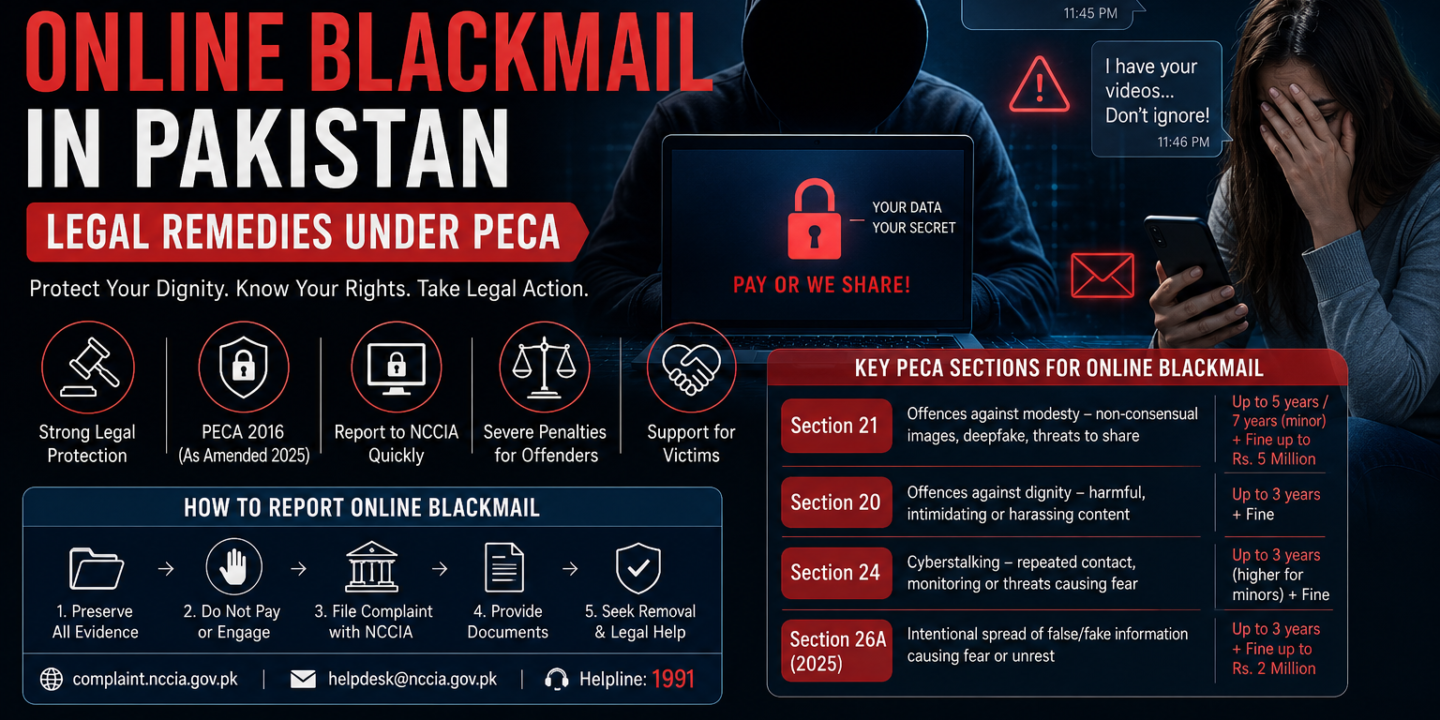
Important PECA Sections for Online Blackmail in Pakistan
“`
| PECA Section | Relevant Conduct | Potential Consequence |
|---|---|---|
| Section 20 | Offences concerning the dignity of a natural person, including certain harmful or intimidating electronic communications. | Imprisonment and/or fine as provided by the statute. |
| Section 21 | Offences against modesty, including certain sexually explicit images/videos, manipulated sexual content, threats involving such material, revenge and blackmail. | Up to 5 years’ imprisonment and/or fine up to Rs. 5 million; enhanced imprisonment applies where the offence concerns a minor. |
| Section 24 | Cyberstalking, including certain forms of repeated unwanted contact, monitoring or threatening conduct through an information system. | Punishment depends on the applicable subsection and circumstances. |
| Section 26A | Intentional dissemination of false or fake information through an information system where the statutory requirements concerning fear, panic, disorder or unrest are met. | Up to 3 years’ imprisonment, fine up to Rs. 2 million, or both. |
Section 21 is especially important in cases involving intimate images, sexually explicit material, manipulated sexual content and threats made to blackmail or take revenge. The statutory text provides imprisonment of up to five years and a fine of up to Rs. 5 million, with imprisonment increasing to up to seven years where the offence is committed in respect of a minor.
Section 26A, introduced through the 2025 PECA amendments, concerns intentional dissemination of false or fake information likely to create or cause fear, panic, disorder or unrest in the general public or society. Its punishment may extend to three years’ imprisonment, a fine of up to Rs. 2 million, or both.
“`
Section 21 PECA and Photo or Video Blackmail
“`
Section 21 of PECA can be particularly important where a person uses sexually explicit photographs or videos, manipulated sexual images, or threats involving such material to harm another person’s reputation, take revenge, create hatred, or blackmail the person.
The provision also covers certain conduct involving the superimposition of a person’s face over sexually explicit material. This makes Section 21 potentially relevant to some forms of deepfake sexual content and image-based abuse, depending on the facts.
Where the victim is a minor, the law provides enhanced punishment. Cases involving children may also raise additional legal and child-protection considerations beyond the provisions discussed in this article.
“`
Can the Pakistan Penal Code Also Apply?
“`
Yes. PECA does not necessarily exclude other criminal laws. Depending on the facts, conduct surrounding online blackmail may also attract relevant provisions of the Pakistan Penal Code (PPC).
For example:
- Criminal intimidation: Threatening a person with injury to reputation, person, property, or other legally recognized interests may raise issues under Sections 503 and 506 PPC.
- Extortion: Where threats are used to dishonestly induce a person to deliver property or valuable security, Section 384 PPC and related provisions may become relevant.
The exact PPC provisions depend on the facts and the nature of the demand or threat. A lawyer should assess the complete circumstances before deciding which provisions should be included in a complaint.
“`
How to Report Online Blackmail in Pakistan
“`
If you are being blackmailed online, do not remain silent simply because the perpetrator is threatening you. Preserve evidence and consider reporting the matter promptly.
Step 1: Preserve Digital Evidence
Before blocking or deleting the account, preserve as much relevant evidence as possible.
- Take screenshots of threatening messages.
- Save photographs, videos, audio messages and other relevant files.
- Record usernames, profile URLs and account information.
- Preserve phone numbers, email addresses and other identifiers.
- Keep payment demands and transaction information.
- Record dates and times of important communications.
- Do not edit or manipulate the original evidence.
Where possible, preserve the original device and files because digital evidence may later be relevant to forensic examination.
Step 2: Do Not Pay the Blackmailer
Paying money does not guarantee that the perpetrator will delete the material or stop making demands. In many cases, payment may lead to additional demands.
Avoid negotiating alone with the perpetrator. Instead, preserve the communications and seek appropriate legal assistance.
Step 3: Report the Matter to NCCIA
Following the 2025 PECA amendments, the National Cyber Crime Investigation Agency (NCCIA) is the relevant law-enforcement agency for inquiries, investigations and prosecutions under PECA.
The official NCCIA website currently provides an online complaint form and lists Cybercrime Reporting Centres in various cities, including Lahore, Gujranwala, Faisalabad, Islamabad and other locations.
Official NCCIA Complaint Portal:
complaint.nccia.gov.pk
The NCCIA also lists helpline 1799 and its official contact email on its website.
According to NCCIA’s official FAQ, a complaint may be submitted through the NCCIA complaint form, Pakistan Citizen Portal, email, or by visiting the nearest Cybercrime Reporting Centre. The FAQ also lists a written application, CNIC copy and evidence among the documents required for complaint registration.
Step 4: Consider Content Removal or Blocking
Criminal investigation and content removal are separate aspects of a cybercrime case. Depending on the nature of the material and the applicable legal procedure, a victim may also seek removal or blocking of unlawful online content through the relevant regulatory mechanism.
The 2025 amendments created the Social Media Protection and Regulatory Authority (SMPRA) and expanded the statutory framework concerning online content regulation and removal. The appropriate legal route depends on the type of content and circumstances.
Step 5: Consult a Cybercrime Lawyer
A lawyer can help identify the appropriate PECA and PPC provisions, organize digital evidence, prepare a complaint, communicate with investigators, and advise on possible court proceedings or protective remedies.
“`
What Documents and Evidence Should a Victim Keep?
“`
Strong and organized evidence can make a cybercrime complaint easier to understand and investigate. Consider preserving:
- Copies of the threatening messages.
- Screenshots showing the account name and profile information.
- Profile links and post URLs.
- Original photographs or videos relevant to the complaint.
- Voice notes and call records where legally and technically available.
- Payment receipts or bank transaction details if money was demanded or transferred.
- Emails and email headers where relevant.
- A written timeline explaining what happened and when.
Do not publicly repost intimate or sensitive material merely to prove your case. Share sensitive evidence with the relevant investigating authorities and your lawyer through appropriate channels.
“`
What If the Blackmailer Is Anonymous?
“`
An anonymous social-media account does not necessarily mean that the perpetrator cannot be investigated. Digital investigations may involve account information, device data, communications records, payment trails, IP-related information and other forensic evidence, subject to applicable law and technical availability.
Victims should therefore report the matter even when they do not know the real identity of the perpetrator. Preserve the account link, username, phone number and every relevant communication before the account disappears.
NCCIA states that it provides cyber investigation and digital-forensics services for identifying and prosecuting cybercriminals.
“`
Special Protection for Minors
“`
Cases involving minors require particular care. Section 21 of PECA provides enhanced punishment where the offence is committed in respect of a minor, and other child-protection laws may also become relevant depending on the conduct.
Parents or guardians should avoid blaming or threatening the child. Instead, preserve the evidence, limit further contact with the perpetrator, and seek appropriate legal and protective assistance as quickly as possible.
If the material involves a child, do not forward or redistribute the material unnecessarily. Preserve relevant information and provide it directly to the appropriate investigating authority or legal counsel.
“`
Practical Examples of Online Blackmail
“`
Example 1: Threat to Publish Private Photographs
A person threatens to publish another person’s intimate photographs unless money is paid. The victim preserves the messages, profile information and payment demands and reports the matter. Depending on the nature of the material and threats, Section 21 PECA and potentially relevant PPC provisions may be considered.
Example 2: Deepfake or Manipulated Sexual Images
A person’s face is digitally placed onto sexually explicit material and the manipulated content is then used to threaten or humiliate the person. Depending on the precise conduct and evidence, Section 21 may become relevant.
Example 3: Repeated Digital Harassment
Following a relationship dispute, an individual repeatedly contacts, monitors and threatens another person through online accounts despite being asked to stop. Depending on the circumstances, cyberstalking provisions under Section 24 and other applicable laws may be considered.
These examples are illustrative only. The applicable criminal charges depend on the actual facts and evidence in each case.
“`
Common Mistakes Victims Should Avoid
“`
- Do not pay automatically: Payment may not end the blackmail.
- Do not delete evidence: Preserve messages, account information and files.
- Do not publicly expose intimate material: Avoid creating further circulation of the harmful content.
- Do not confront the perpetrator alone: Seek legal guidance where the situation is serious or threatening.
- Do not delay unnecessarily: Early preservation and reporting can be important.
- Do not give the perpetrator additional photographs or information: This may increase the risk of further exploitation.
- Secure your accounts: Change passwords, enable two-factor authentication and review logged-in devices.
“`
How to Protect Yourself From Future Cyber Blackmail
“`
- Use strong and unique passwords.
- Enable two-factor authentication on important accounts.
- Review social-media privacy settings.
- Avoid sharing sensitive photographs with unknown or untrusted persons.
- Do not open suspicious links or files.
- Review which applications have access to your photographs, camera and microphone.
- Keep your phone and applications updated.
- Be careful when communicating with newly created or anonymous accounts.
The NCCIA itself advises citizens to secure social-media accounts and remain cautious about suspicious online communications.
“`
Frequently Asked Questions About Online Blackmail in Pakistan
“`
1. Is online blackmail a crime in Pakistan?
Yes. Depending on the conduct, online blackmail may constitute offences under PECA, including provisions such as Sections 20, 21 and 24, and may also involve relevant offences under the Pakistan Penal Code.
2. Where can I report cyber blackmail in Pakistan?
Cybercrime complaints can be reported to the National Cyber Crime Investigation Agency (NCCIA). The official NCCIA website provides an online complaint portal and information about Cybercrime Reporting Centres.
3. What is the official NCCIA complaint website?
The official online complaint portal is
complaint.nccia.gov.pk.
4. Should I pay an online blackmailer?
Generally, do not pay or continue negotiating with the blackmailer without obtaining appropriate advice. Payment does not guarantee that the threats will stop and may result in further demands.
5. What if the blackmailer has deleted the account?
Report the matter anyway. Preserve whatever evidence remains, including screenshots, usernames, profile links, phone numbers, emails and previous communications. Digital investigations may still be possible depending on the available evidence and technical records.
6. Does Section 21 PECA cover deepfake images?
Section 21 expressly addresses certain sexually explicit manipulated material, including conduct involving the superimposition of a person’s face over sexually explicit content. Whether Section 21 applies to a particular deepfake depends on the content and circumstances of the case.
7. Is Section 21 PECA bailable or non-bailable?
The question of bail depends on the specific offence, statutory classification and circumstances. A person should not assume that every allegation under Section 21 automatically results in arrest or denial of bail. A lawyer should examine the applicable provision and current law in the particular case.
8. Can online blackmail also be an offence under the PPC?
Yes. Depending on the facts, conduct involving threats or demands may also attract provisions of the Pakistan Penal Code, including criminal intimidation or extortion.
9. Do I need a lawyer to file a cybercrime complaint?
A lawyer is not necessarily required for every complaint, but professional legal assistance can be valuable in serious blackmail, sextortion, deepfake, harassment or extortion cases, particularly where court proceedings or multiple criminal provisions are involved.
10. Can harmful online content be removed?
Depending on the nature of the content and applicable procedure, victims may have avenues for requesting removal or blocking in addition to pursuing a criminal complaint. The appropriate mechanism should be identified according to the type of content and the current legal framework.
“`
What Should You Do Right Now If You Are Being Blackmailed?
“`
- Stay calm and do not panic.
- Do not pay immediately.
- Save screenshots and original evidence.
- Record the perpetrator’s username, phone number and profile links.
- Secure your social-media and email accounts.
- Report the matter to NCCIA.
- Consult a qualified lawyer if the threats are serious or continuing.
- If there is an immediate physical safety threat, contact the appropriate local emergency or law-enforcement service.
“`
Conclusion
“`
Online blackmail and cyber harassment are serious issues in Pakistan. PECA 2016, as amended in 2025, provides a legal framework for dealing with several forms of electronic abuse, including conduct involving dignity, modesty, cyberstalking and certain forms of sexually explicit or manipulated material.
The most important first steps are to preserve digital evidence, avoid unnecessary engagement with the perpetrator, secure your accounts, report the matter to NCCIA, and obtain appropriate legal advice where necessary.
Victims should not feel ashamed or believe that an online blackmailer has complete control over their situation. The law provides mechanisms for investigation and prosecution, while the available remedies depend on the facts and evidence of each individual case.
Do not delete the evidence. Do not panic. Take lawful action promptly.
“`
Need Legal Help With Online Blackmail or Cybercrime?
“`
Facing online blackmail, sextortion, cyber harassment, deepfake abuse, fake accounts, threats, or another PECA-related issue?
Justify.pk provides legal information and professional guidance for individuals dealing with cybercrime and digital-law issues across Pakistan, including Lahore, Karachi, Islamabad, Gujranwala and other cities.
Get Legal Guidance from Justify.pk
“`