body {
font-family: Arial, Helvetica, sans-serif;
line-height: 1.7;
color: #222;
max-width: 1000px;
margin: auto;
padding: 20px;
background: #ffffff;
}
h1, h2, h3 {
color: #102a43;
line-height: 1.3;
}
h1 {
font-size: 36px;
margin-bottom: 15px;
}
h2 {
font-size: 28px;
margin-top: 35px;
border-bottom: 2px solid #ddd;
padding-bottom: 8px;
}
h3 {
font-size: 22px;
margin-top: 25px;
}
p {
font-size: 17px;
}
ul, ol {
padding-left: 25px;
}
li {
margin-bottom: 8px;
}
.intro-box {
background: #f4f7fa;
border-left: 5px solid #102a43;
padding: 20px;
margin: 25px 0;
}
.important {
background: #fff8e1;
border-left: 5px solid #d39e00;
padding: 18px;
margin: 20px 0;
}
.legal-box {
background: #eef7f1;
border-left: 5px solid #198754;
padding: 18px;
margin: 20px 0;
}
.faq {
background: #f8f9fa;
padding: 18px;
margin: 15px 0;
border-radius: 5px;
}
.cta {
background: #102a43;
color: white;
padding: 25px;
margin-top: 40px;
border-radius: 6px;
}
.cta h2 {
color: white;
border: none;
}
.author {
margin-top: 30px;
font-size: 14px;
color: #666;
}
Press Freedom & Journalist Rights Under New Cyber Laws in Pakistan
Complete guide to press freedom and journalist rights under PECA 2025 amendments in Pakistan. Understand Section 26A, NCCIA powers, legal protections, risks, and remedies for media professionals. Expert advice from Justify.pk.
Introduction
Freedom of the press is a fundamental right protected under
Article 19 of the Constitution of Pakistan. It allows citizens and journalists to express opinions, report facts, and hold power to account, subject only to reasonable restrictions.
In recent years, the Prevention of Electronic Crimes Act (PECA) 2016, particularly after the 2025 amendments, has become one of the most important and contested legal frameworks affecting online journalism, digital commentary, and press freedom in Pakistan.
This article explains the key changes under the new cyber laws, their practical impact on journalists, the rights and remedies available, and steps media professionals can take to protect themselves while continuing public-interest reporting.
Constitutional Protection: Article 19
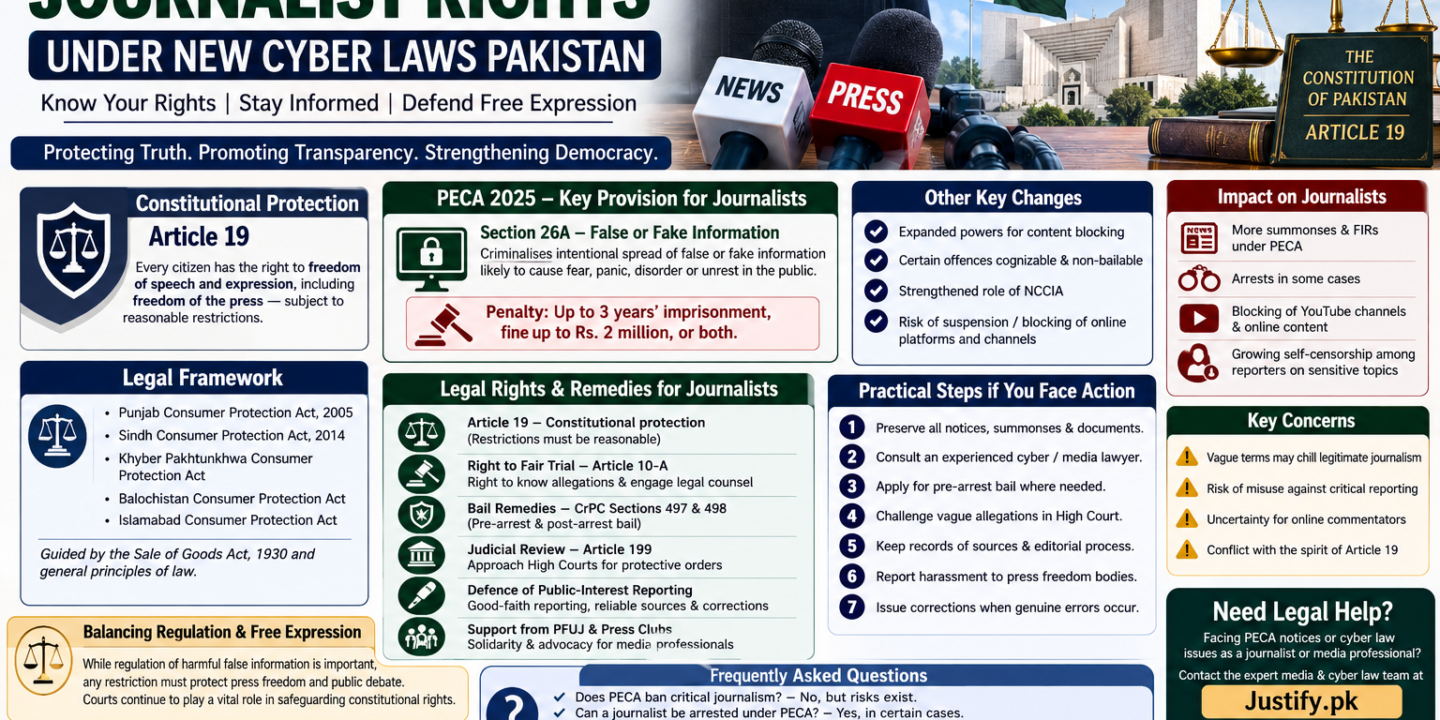
Article 19 guarantees freedom of speech and expression, including freedom of the press. Any restriction must be reasonable and fall within the constitutionally permitted grounds, including sovereignty and integrity of Pakistan, public order, decency, morality, and contempt of court.
Courts examine whether cyber laws are applied in a manner consistent with this constitutional guarantee. Therefore, journalists facing legal action should understand both the relevant cybercrime provisions and their constitutional protections.
Key Provisions of the PECA 2025 Amendments Affecting Journalists
Section 26A – False or Fake Information
The 2025 amendments introduced Section 26A, which makes it an offence to intentionally disseminate, publicly exhibit, or transmit information through an information system that a person knows or has reason to believe is false or fake and is likely to cause or create a sense of fear, panic, disorder, or unrest in the general public or society.
The broad and undefined terms “false or fake” and “likely to cause” unrest have drawn strong criticism from journalists’ unions, human rights organisations, and media watchdogs. Critics argue that the provision may create uncertainty and risk chilling legitimate public-interest reporting.
Other Relevant Changes
- Expanded powers for content blocking and removal.
- Reclassification of certain offences as cognizable and non-bailable.
- Strengthened role of the National Cyber Crime Investigation Agency (NCCIA).
- Regulatory mechanisms that can lead to suspension or blocking of digital platforms and channels.
Impact on Journalists and Press Freedom
Reports by media freedom organisations have documented legal actions against journalists under PECA-related provisions following the 2025 amendments.
These actions may include:
- Summonses and call-up notices from the NCCIA.
- FIRs and investigations.
- Arrests in some cases.
- Orders for blocking YouTube channels or online content.
- Increased self-censorship among reporters covering sensitive topics.
Journalist bodies such as the Pakistan Federal Union of Journalists (PFUJ) have described the amendments as a significant challenge to media independence and have called for review of laws that may conflict with Article 19.
Courts, including the Islamabad High Court, have in various proceedings examined the application of the amended law and the process for determining what constitutes “fake news.”
Legal Rights and Remedies Available to Journalists
Despite the expanded cyber framework, journalists continue to enjoy important legal protections.
-
Article 19 Constitutional Right:
Restrictions on speech must comply with constitutional requirements of reasonableness. -
Right to Fair Trial – Article 10-A:
Journalists have the right to know the specific allegations, engage legal counsel, and challenge unlawful investigation or detention. -
Bail Remedies:
Pre-arrest and post-arrest bail under Sections 497 and 498 of the CrPC may be available depending on the nature and classification of the offence. -
Judicial Review:
High Courts may be approached under Article 199 for protective orders, quashing of FIRs, or interim relief against unlawful harassment. -
Public-Interest Reporting:
Good-faith reporting, reliance on credible sources, prompt corrections, and the public-interest nature of reporting may be relevant when responding to allegations of intentional falsehood. -
Professional Support:
Press clubs, PFUJ, and other journalist organisations can provide documentation, solidarity, and advocacy support.
Practical Steps if You Face PECA-Related Action
- Immediately preserve all notices, summonses, FIRs, and related documents.
- Consult a lawyer experienced in cyber and media law without delay.
- Apply for pre-arrest bail or other protective orders where appropriate.
- Challenge vague or overbroad allegations through constitutional petitions where legally appropriate.
- Maintain careful records of sources and editorial processes.
- Protect confidential sources to the extent legally possible.
- Report threats or harassment to relevant press freedom organisations.
- Issue corrections promptly when genuine errors occur.
Balancing Regulation and Free Expression
Supporters of the PECA amendments argue that regulating false information capable of causing public panic is necessary in the digital age.
Critics, including journalist organisations and human rights groups, contend that vague criminal provisions may suppress legitimate journalism and public debate.
Courts continue to play a vital role in interpreting the scope of these laws and protecting constitutional rights while balancing legitimate cyber regulation with freedom of expression.
PECA 2025 Amendments: New Rules on Fake News, Disinformation & Social Media
Frequently Asked Questions
1. Does PECA ban critical journalism?
No. Legitimate public-interest reporting remains protected under Article 19, but broad provisions may create practical legal risks that require careful handling.
2. What is Section 26A of PECA?
Section 26A criminalises the intentional spread of information known or believed to be false or fake that is likely to cause fear, panic, disorder, or unrest. The stated penalty is up to three years’ imprisonment, a fine of up to Rs. 2 million, or both.
3. Can a journalist be arrested under PECA?
Yes, depending on the specific provision involved and whether the offence is classified as cognizable and non-bailable. Bail and other legal remedies may remain available.
4. What should I do if I receive an NCCIA notice?
Do not ignore the notice. Consult a lawyer immediately and consider appropriate protective legal measures based on the facts of the case.
5. Can social media accounts or YouTube channels be blocked?
Authorities may seek or obtain blocking orders in appropriate cases. Such orders may be challenged before the competent court where legal grounds exist.
6. Is there legal protection for confidential sources?
Source confidentiality is an important professional principle. Its legal protection in a particular case should be assessed with qualified legal counsel.
7. Are the PECA amendments being challenged in court?
Yes. Journalists’ bodies and individuals have challenged aspects of the amendments, and courts continue to examine their application and constitutional implications.
Conclusion
The PECA 2025 amendments have significantly altered the legal landscape for online expression and journalism in Pakistan. While the stated goal is to address harmful false information, the broad wording of provisions such as Section 26A has raised serious concerns about press freedom and potential overreach.
Journalists retain important constitutional protections and access to judicial remedies. Awareness of rights, careful documentation, and timely professional legal support remain effective practical safeguards.
A free and responsible press is essential for accountability and informed public discourse. Balancing legitimate cyber regulation with robust protection for freedom of expression remains one of the important legal and democratic challenges facing Pakistan.
Need Legal Help?
Facing PECA notices, NCCIA investigations, or legal threats as a journalist or media professional in Pakistan? Need advice on press freedom rights, bail applications, or constitutional remedies?
Contact the experienced media and cyber law team at Justify.pk for confidential and professional legal support.
{
“@context”: “https://schema.org”,
“@type”: “FAQPage”,
“mainEntity”: [
{
“@type”: “Question”,
“name”: “Does PECA ban critical journalism?”,
“acceptedAnswer”: {
“@type”: “Answer”,
“text”: “No. Legitimate public-interest reporting remains protected under Article 19, but broad provisions may create practical legal risks that require careful handling.”
}
},
{
“@type”: “Question”,
“name”: “What is Section 26A of PECA?”,
“acceptedAnswer”: {
“@type”: “Answer”,
“text”: “Section 26A criminalises the intentional spread of information known or believed to be false or fake that is likely to cause fear, panic, disorder, or unrest. The stated penalty is up to three years’ imprisonment, a fine of up to Rs. 2 million, or both.”
}
},
{
“@type”: “Question”,
“name”: “Can a journalist be arrested under PECA?”,
“acceptedAnswer”: {
“@type”: “Answer”,
“text”: “Yes, depending on the specific provision involved and whether the offence is classified as cognizable and non-bailable. Bail and other legal remedies may remain available.”
}
},
{
“@type”: “Question”,
“name”: “What should I do if I receive an NCCIA notice?”,
“acceptedAnswer”: {
“@type”: “Answer”,
“text”: “Do not ignore the notice. Consult a lawyer immediately and consider appropriate protective legal measures based on the facts of the case.”
}
},
{
“@type”: “Question”,
“name”: “Can social media accounts or YouTube channels be blocked?”,
“acceptedAnswer”: {
“@type”: “Answer”,
“text”: “Authorities may seek or obtain blocking orders in appropriate cases. Such orders may be challenged before the competent court where legal grounds exist.”
}
},
{
“@type”: “Question”,
“name”: “Is there legal protection for confidential sources?”,
“acceptedAnswer”: {
“@type”: “Answer”,
“text”: “Source confidentiality is an important professional principle. Its legal protection in a particular case should be assessed with qualified legal counsel.”
}
},
{
“@type”: “Question”,
“name”: “Are the PECA amendments being challenged in court?”,
“acceptedAnswer”: {
“@type”: “Answer”,
“text”: “Yes. Journalists’ bodies and individuals have challenged aspects of the amendments, and courts continue to examine their application and constitutional implications.”
}
}
]
}