{
“@context”: “https://schema.org”,
“@type”: “Article”,
“headline”: “Consumer Rights Against Fraud & Defective Products in Pakistan”,
“description”: “A practical guide to consumer rights, defective products, fraud, refunds, replacements and compensation under Pakistani consumer protection laws.”,
“author”: {
“@type”: “Organization”,
“name”: “Justify.pk”
},
“publisher”: {
“@type”: “Organization”,
“name”: “Justify.pk”
},
“datePublished”: “2026-08-30”,
“dateModified”: “2026-08-30”
}
Consumer Rights Against Fraud & Defective Products in Pakistan
Meta Description:
Know your consumer rights against fraud and defective products in Pakistan.
Learn how to claim refunds, replacements, and compensation under provincial
Consumer Protection Acts. Step-by-step guide from Justify.pk.
Introduction
Every consumer in Pakistan has the right to receive goods and services that are
safe, of acceptable quality, and as advertised. Whether you bought a faulty
mobile phone in Lahore, a defective appliance in Karachi, or received
substandard service in Islamabad, provincial consumer protection laws provide
important remedies against fraud, defective products, and deficient services.
This guide explains your key consumer rights, the relevant laws, practical steps
to claim a refund, replacement, or compensation, and how Consumer Courts work
across Pakistan.
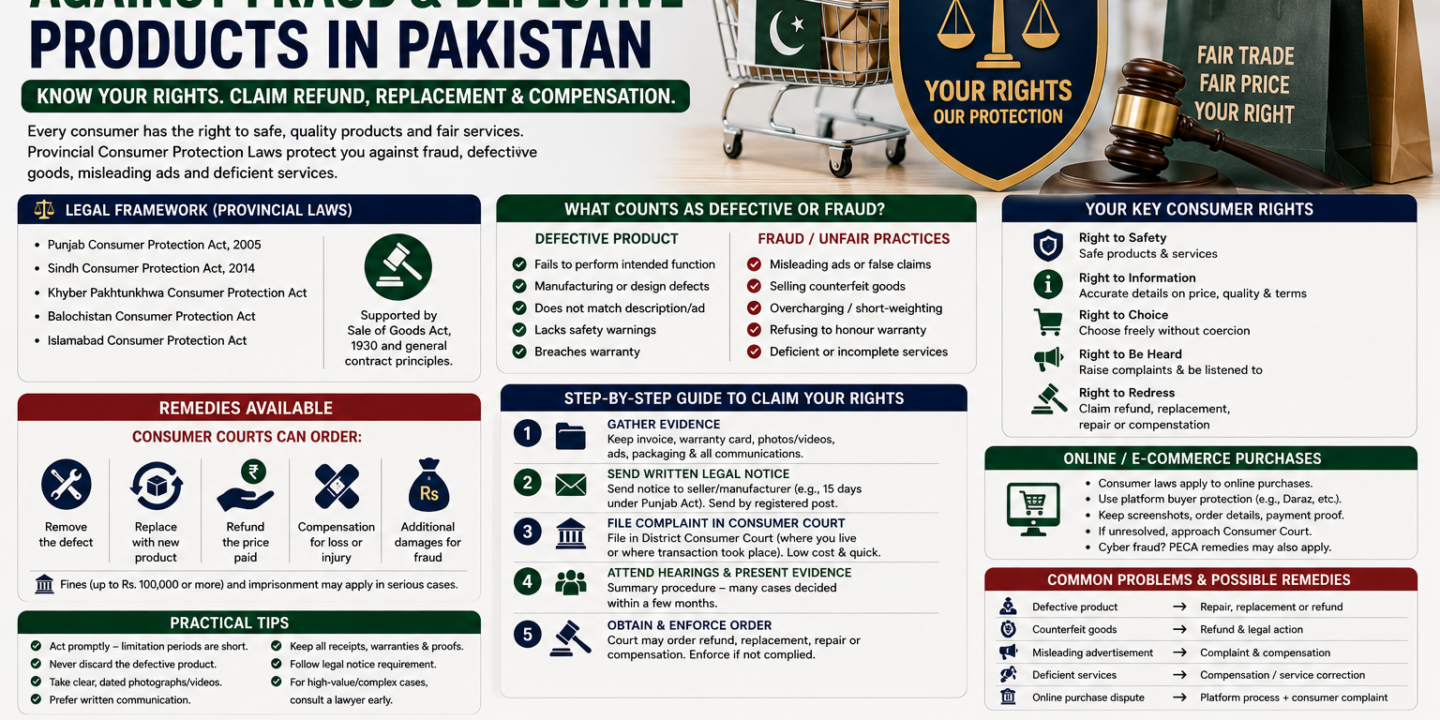
Legal Framework for Consumer Protection in Pakistan
Consumer protection is primarily a provincial subject.
There is no single federal consumer protection statute applicable throughout
Pakistan. The main provincial laws include:
- Punjab Consumer Protection Act, 2005
- Sindh Consumer Protection Act, 2014
- Khyber Pakhtunkhwa Consumer Protection Act
- Balochistan Consumer Protection Act
- Islamabad Consumer Protection Act
These laws are supported by the Sale of Goods Act, 1930,
including principles relating to implied conditions of quality and fitness
for purpose, as well as general principles of contract law.
Consumer protection laws are designed to safeguard consumers from unscrupulous,
deceptive, and unfair business practices, including problems arising from
modern e-commerce transactions.
What Counts as a Defective Product or Consumer Fraud?
A product may generally be considered defective where it does not perform
according to the standard, description, warranty, or purpose represented by
the seller or manufacturer.
Examples of Defective Products
- Failure to perform the intended function
- Manufacturing or design defects
- Product does not match its description or sample
- Missing or inadequate safety warnings
- Breach of an express warranty
Examples of Fraud or Unfair Practices
- Misleading advertisements or false claims
- Selling counterfeit or substandard goods
- Overcharging or short-weighting
- Refusing to honour a valid warranty
- Providing deficient, incomplete, or poor-quality services
Your Key Consumer Rights in Pakistan
Depending on the applicable provincial law, consumers generally have important
rights including:
- Right to Safety: Protection against unsafe goods and services.
- Right to Information: Accurate information about price, quality, and terms.
- Right to Choice: Freedom to choose goods and services without unfair coercion.
- Right to Be Heard: The ability to raise complaints against sellers and service providers.
- Right to Redress: Access to remedies such as repair, replacement, refund, or compensation.
Remedies Available to Consumers
Depending on the facts and applicable law, a Consumer Court may order a seller,
manufacturer, or service provider to:
- Remove or correct the defect
- Replace the defective product
- Refund all or part of the price paid
- Repair the defective product
- Pay compensation for loss or injury caused by the defect
- Pay additional damages where legally justified
In serious cases, applicable provincial legislation may also provide for
fines or imprisonment for violations.
Step-by-Step Guide to Claiming Your Consumer Rights
Step 1: Gather Evidence
Keep all documents and evidence connected with the transaction, including:
- Receipt or invoice
- Warranty card
- Product packaging
- Photographs or videos showing the defect
- Advertisement or online product description
- WhatsApp messages, emails, or other communications with the seller
- Proof of payment
Step 2: Send a Written Legal Notice
Where required by the applicable provincial consumer protection law, send a
written notice to the seller or manufacturer and give them an opportunity
to resolve the complaint.
In Punjab, the applicable procedure may require a prescribed notice period.
Always check the current law and applicable limitation requirements before filing.
Step 3: File a Complaint Before the Consumer Court
If the seller or manufacturer fails to resolve the matter, the consumer may
approach the relevant Consumer Court or equivalent forum having jurisdiction
under the applicable provincial law.
Step 4: Present Your Evidence
Submit the relevant documents, receipts, photographs, warranty information,
notices, and communications supporting your claim.
Step 5: Obtain and Enforce the Court Order
If the Consumer Court grants relief, the consumer should follow the prescribed
enforcement procedure if the seller or manufacturer does not comply voluntarily.
Consumer Protection for Online and E-Commerce Purchases
Online purchases can also raise consumer protection issues. Consumers should
preserve screenshots of product descriptions, advertisements, order details,
payment records, delivery information, and communications with the seller.
E-commerce platforms may provide their own buyer-protection or dispute-resolution
mechanisms. Consumers should normally use those mechanisms where available,
while also considering remedies under the applicable consumer protection law.
Where an online transaction involves deliberate deception, identity misuse,
or other cyber-related conduct, additional legal remedies may potentially
apply depending on the circumstances.
Practical Tips to Strengthen Your Consumer Case
- Act promptly after discovering the defect or fraud.
- Keep the original receipt and proof of payment.
- Do not throw away the defective product.
- Take clear and dated photographs or videos.
- Keep all communication with the seller in written form.
- Save online advertisements and product descriptions.
- Follow the applicable statutory notice procedure.
- Check the limitation period before filing a complaint.
- Seek legal advice for high-value or complicated disputes.
Common Consumer Problems and Possible Remedies
| Consumer Problem | Possible Remedy |
|---|---|
| Defective mobile phone | Repair, replacement, refund, or compensation where legally available |
| Faulty home appliance | Warranty enforcement, repair, replacement, or refund |
| Counterfeit product | Refund and appropriate legal complaint |
| Misleading advertisement | Consumer complaint and applicable statutory remedies |
| Deficient service | Compensation or other relief under applicable law |
| Online purchase dispute | Platform dispute process and applicable consumer remedies |
Frequently Asked Questions
1. Can I get a refund for a defective product in Pakistan?
Yes. Depending on the applicable provincial law and facts of the case,
a Consumer Court may order a refund, replacement, repair, or compensation.
2. Do I need a lawyer to file a consumer complaint?
Not necessarily. Consumers may be able to file and pursue complaints themselves.
However, legal assistance can be useful for drafting notices, preparing evidence,
and handling high-value or contested claims.
3. How long do I have to file a consumer complaint?
Limitation periods vary according to the applicable provincial law. In Punjab,
specific statutory time limits may apply from the date the consumer became aware
of the defect. Consumers should act promptly and verify the current limitation
requirements.
4. What if the seller has a “no return” policy?
A seller’s private return policy does not necessarily remove statutory consumer
rights relating to defective goods, misleading representations, or other
violations of applicable law.
5. Are online purchases covered by consumer protection laws?
Online transactions can fall within applicable consumer protection frameworks.
Platform policies may provide an additional dispute-resolution mechanism.
6. Can I claim compensation for loss or consequential harm?
Depending on the applicable law and evidence, a Consumer Court may award
compensation for legally recognised loss, injury, or other appropriate harm.
7. Where should I file a consumer complaint?
A complaint should be filed before the Consumer Court or equivalent forum
having jurisdiction under the applicable provincial consumer protection law.
Jurisdiction can depend on factors such as the place of transaction and
residence of the consumer.
Related Article
Read also:
Cybercrime & Online Blackmail: Legal Remedies Under PECA
Conclusion
Consumers in Pakistan have important legal protections against defective
products, fraudulent sellers, misleading advertisements, and deficient services.
Provincial Consumer Protection Acts provide remedies including repair, replacement,
refund, and compensation through specialised consumer forums.
The most important steps are to preserve evidence, act within the applicable
limitation period, follow the required notice procedure, and approach the
competent Consumer Court when the dispute cannot be resolved.
Knowing your consumer rights is the first step toward protecting your money
and obtaining effective legal redress.
Need Legal Assistance?
Bought a defective product or faced fraud by a seller or service provider in
Pakistan? Need help drafting a legal notice, filing a consumer complaint,
or recovering your money?
Contact the experienced consumer protection team at Justify.pk for practical
legal guidance and representation.