“`html
Company Registration & Compliance for Small Businesses in Pakistan 2026
Starting a small business in Pakistan is exciting, but choosing the right legal structure and staying compliant is essential for long-term success. Many entrepreneurs in Lahore, Karachi, Islamabad, and other cities begin as sole proprietors, only to later face limitations in banking, contracts, liability protection, and business growth.
Registering a formal company with the Securities and Exchange Commission of Pakistan (SECP) can provide limited liability, greater business credibility, and a stronger foundation for accessing finance and entering commercial contracts.
This guide explains the main business structures available to small businesses, the SECP company registration process, post-incorporation requirements, and ongoing compliance obligations under the Companies Act, 2017 and applicable FBR rules.
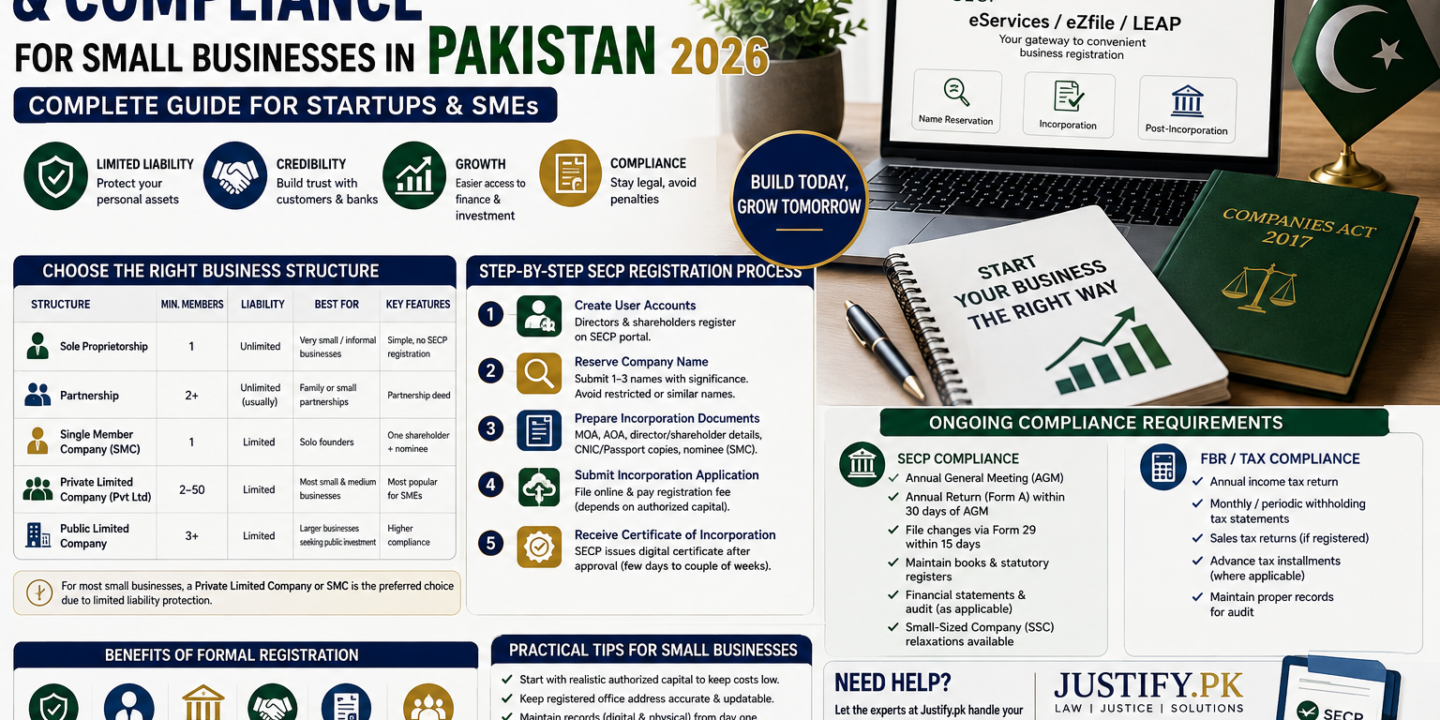
Choosing the Right Business Structure in Pakistan
Before registering a business, it is important to choose a structure that suits your ownership, liability, and growth plans.
| Business Structure | Minimum Members | Liability | Best For | Key Features |
|---|---|---|---|---|
| Sole Proprietorship | 1 | Unlimited | Very small or informal businesses | Simple structure; no SECP company incorporation |
| Partnership | 2+ | Generally unlimited | Family or small partnerships | Partnership deed and shared ownership |
| Single Member Company (SMC) | 1 | Limited | Solo founders | One shareholder with nominee arrangements |
| Private Limited Company | 2–50 | Limited | Small and medium-sized businesses | Separate legal entity and limited liability |
| Public Limited Company | 3+ | Limited | Larger businesses seeking public investment | Higher regulatory and compliance requirements |
For many small businesses, a Private Limited Company or Single Member Company (SMC) can be an attractive structure because it provides limited liability and creates a separate legal identity for the business.
Step-by-Step Company Registration with SECP
Company incorporation in Pakistan is primarily handled online through the SECP’s digital incorporation system. The exact process, fees, and requirements may vary depending on the company type and circumstances.
1. Create User Accounts
Proposed directors and shareholders may need individual accounts on the relevant SECP online system. Identification may involve CNIC, NICOP, or passport details, depending on the applicant.
2. Reserve the Company Name
Submit proposed company names through the SECP system. Names should comply with applicable legal requirements and should not be identical, deceptively similar, prohibited, or otherwise restricted.
Choosing an appropriate and distinctive name at the beginning can help avoid unnecessary delays in the incorporation process.
3. Prepare Incorporation Documents
The incorporation application generally requires information and documents relating to the proposed company, including:
- Memorandum of Association
- Articles of Association
- Details of directors and shareholders
- Registered office information
- Share capital details
- CNIC, NICOP, or passport documents where applicable
- Nominee information and consent for an SMC, where required
4. Submit the Incorporation Application
Submit the incorporation application through the applicable SECP online system and pay the prescribed government and registration fees. Fees may depend on factors such as company type and capital structure.
5. Receive the Certificate of Incorporation
After approval, SECP issues the company’s Certificate of Incorporation, generally in digital form. Processing time depends on the completeness of the application and any queries raised by the regulator.
Post-Incorporation Requirements
Registration is only the first step. After incorporation, a company should complete the necessary tax, banking, licensing, and corporate compliance requirements.
- Obtain or confirm the company’s National Tax Number (NTN) with FBR.
- Open a corporate bank account in the company’s name.
- Deposit subscribed share capital where applicable.
- Register for sales tax where required by law.
- Obtain sector-specific licences or registrations where applicable.
- Maintain statutory records and corporate registers.
- Complete required filings with SECP and FBR.
Ongoing SECP Compliance for Small Companies
Company registration does not end the legal responsibilities of the business. Companies must continue to comply with applicable corporate laws and filing requirements.
Important SECP Compliance Requirements
- Hold an Annual General Meeting (AGM) where required.
- File the applicable annual return within the prescribed period.
- Report changes in directors, CEO, registered office, or other particulars through the required forms.
- Maintain proper books of account.
- Maintain statutory registers and corporate records.
- Prepare and file financial statements where required.
- Meet applicable audit requirements.
Small companies may qualify for certain regulatory relaxations depending on their size, capital, turnover, and other statutory conditions. Businesses should check the latest SECP requirements before relying on any exemption.
FBR and Tax Compliance
Companies also have continuing tax obligations. Depending on the nature and size of the business, these may include:
- Annual income tax return filing
- Withholding tax compliance
- Sales tax registration and return filing where applicable
- Advance tax payments where applicable
- Maintenance of financial and tax records
- Compliance with FBR notices and audit requirements
Proper tax records should be maintained from the beginning rather than waiting until the end of the financial year.
Benefits of Registering a Company in Pakistan
Formal company registration can provide several important advantages for entrepreneurs and growing businesses.
- Limited liability: Helps separate the company’s liabilities from those of its owners, subject to applicable law.
- Separate legal entity: A company has its own legal identity separate from its shareholders.
- Business credibility: Formal registration can increase confidence among customers, suppliers, banks, and investors.
- Access to finance: A formal structure can make certain banking and financing arrangements easier.
- Commercial contracts: The company can enter contracts in its own name.
- Investment opportunities: A structured corporate entity can make bringing in investors easier.
- Succession and ownership: Shareholding provides a clearer framework for ownership and transfer.
Practical Tips for Small Business Owners
- Choose your business structure according to your actual business needs.
- Use a distinctive and legally acceptable company name.
- Keep your registered office information accurate and updated.
- Maintain digital and physical copies of important corporate documents.
- Set reminders for annual corporate and tax deadlines.
- Keep company and personal finances properly separated.
- Maintain accurate accounting records from the beginning.
- Check SECP and FBR portals regularly for regulatory updates.
- Consider professional legal and tax assistance during incorporation and the first year of compliance.
Common Company Registration Mistakes to Avoid
- Choosing the wrong legal structure
- Using a company name that does not meet SECP requirements
- Providing incomplete or inconsistent documents
- Ignoring post-incorporation tax registration
- Mixing personal and company finances
- Missing annual SECP filings
- Ignoring FBR tax deadlines
- Failing to maintain proper corporate records
How Long Does Company Registration Take?
Straightforward online incorporation applications may be processed within a few working days, although the actual time can vary depending on the type of company, completeness of documents, name approval, regulatory queries, and SECP workload.
Submitting accurate information and responding promptly to SECP queries can help reduce unnecessary delays.
Internal Link
Read also: How to File Income Tax Return in Pakistan 2026 – Complete Guide
Frequently Asked Questions (FAQs)
1. How long does SECP company registration take?
Simple online applications may be completed within a few working days, but processing time can vary depending on the application, documents, regulatory queries, and workload.
2. What is the minimum capital required to register a private limited company?
There is generally no broad minimum paid-up capital requirement applicable to every private company in the same manner, but the company must declare its share capital in accordance with applicable requirements. Registration fees may depend on the capital structure.
3. Can one person form a company in Pakistan?
Yes. A person can establish a Single Member Company (SMC), subject to the requirements of the Companies Act and SECP regulations.
4. Is audit mandatory for small companies?
Audit requirements depend on the company’s size, capital, applicable legal category, and current regulatory rules. Certain small companies may qualify for exemptions or relaxed requirements.
5. Do I need a company secretary for a small private company?
Most small private companies do not generally require a full-time company secretary, although specific circumstances and regulatory requirements should be checked.
6. What happens if I miss annual company filings?
Late or missed filings can result in penalties, additional fees, regulatory notices, and other consequences depending on the nature and duration of the non-compliance.
7. Can foreigners become directors or shareholders in a Pakistani company?
Foreign nationals may be able to become directors or shareholders subject to applicable Pakistani laws, documentation requirements, investment rules, and any required regulatory or security clearances.
Conclusion
Registering a company with SECP can transform a small business from an informal venture into a more structured, credible, and scalable enterprise. However, incorporation is only the beginning. Maintaining proper SECP filings, tax compliance, accounting records, and corporate documents is essential for long-term business stability.
For entrepreneurs in Pakistan, choosing the right structure and establishing proper compliance procedures from the beginning can save significant time, expense, and legal complications in the future.
Need Help With Company Registration or Compliance?
Planning to register a Private Limited Company, Single Member Company (SMC), or need assistance with SECP compliance and tax filings?
Contact the corporate and business law team at Justify.pk. We provide company registration, corporate documentation, SECP compliance, tax coordination, and ongoing legal support for businesses across Pakistan.
Written by the Legal Team at Justify.pk
“`