Property Dispute Resolution in Pakistan: Common Cases & Legal Solutions 2026
“`
Facing a property dispute in Pakistan? Whether the dispute concerns inheritance, illegal possession, land boundaries, ownership documents, family property, or a fraudulent transfer, understanding the correct legal remedy is essential.
“`
Introduction: Understanding Property Disputes in Pakistan
“`
Property disputes are among the most common and complicated civil-law problems in Pakistan. Disagreements may arise between family members, co-owners, neighbours, landlords and tenants, buyers and sellers, or property developers and purchasers.
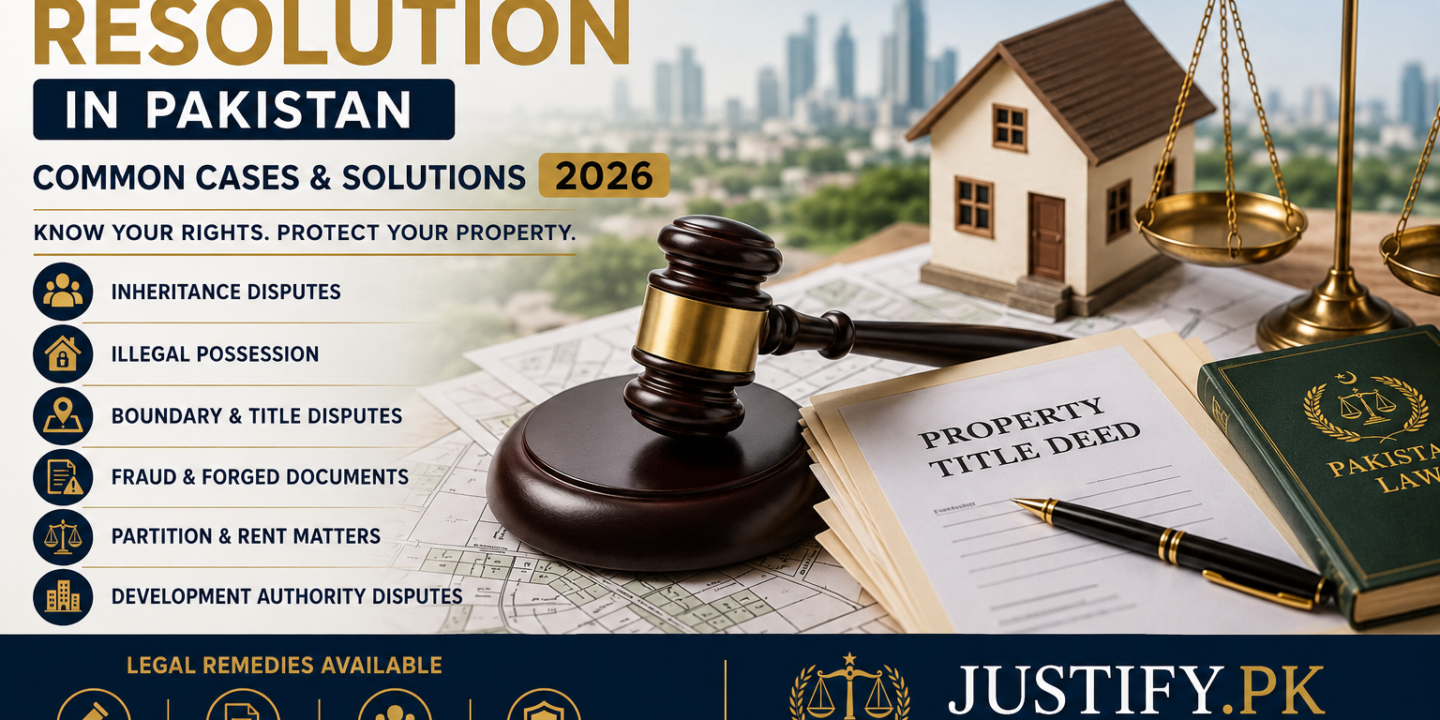
Common disputes involve inheritance shares, illegal possession, encroachment, ownership and title, boundary lines, forged documents, fraudulent transfers, partition of jointly owned property, tenancy, and housing-society or development-authority matters.
A property dispute can become expensive and time-consuming if the wrong legal forum or remedy is chosen. Depending on the circumstances, a matter may involve a civil court, revenue authority, rent tribunal, development authority, housing society, or another specialized forum.
This guide explains the major types of property disputes in Pakistan, important laws, available legal remedies, the general litigation process, and practical steps property owners and heirs can take to protect their rights.
“`
Common Types of Property Disputes in Pakistan
“`
1. Inheritance and Succession Disputes
Inheritance disputes frequently arise when legal heirs disagree about their shares in the estate of a deceased person. Problems may include non-disclosure of property, incorrect mutation, exclusion of female heirs, disputed wills, unauthorized transfers, or attempts to deprive an heir of their lawful share.
The applicable succession rules depend on the personal law governing the deceased and the nature of the property. Muslim inheritance matters are generally governed by Muslim personal law, while different rules may apply to other communities.
A person claiming an inheritance share should obtain the relevant death certificate, succession documentation where applicable, title documents, and revenue or property records before deciding which legal remedy to pursue.
2. Illegal Possession and Encroachment
An illegal possession dispute arises when a person occupies or retains possession of property without a lawful right to do so. Encroachment may also occur when someone extends construction onto another person’s land or interferes with their lawful possession.
Depending on the circumstances, the owner or person entitled to possession may seek recovery of possession, declaration of rights, injunction, or other appropriate relief.
3. Ownership, Title and Boundary Disputes
Property disputes often arise because parties rely on conflicting documents or disagree about the precise boundaries of land.
Examples include:
- Overlapping sale documents.
- Conflicting revenue records.
- Disputes over survey numbers or khasra numbers.
- Incorrect or disputed site plans.
- Boundary encroachment.
- Competing claims to ownership.
- Double allotment or conflicting allotment records.
A survey, demarcation, local commission, revenue record, site plan, or other documentary evidence may become important depending on the nature of the dispute.
4. Fraudulent Transfers and Forged Property Documents
Property fraud can involve forged sale deeds, fake powers of attorney, impersonation, fraudulent mutations, unauthorized transfers, fabricated documents, or misuse of genuine documents.
Where a document is alleged to be forged or unlawfully obtained, the affected party may need to seek appropriate civil relief, such as cancellation or declaration, while criminal proceedings may also be considered where the facts disclose a criminal offence.
5. Landlord-Tenant and Rent Disputes
Rent disputes can involve non-payment of rent, eviction, unauthorized subletting, misuse of rented premises, restoration of possession, or other violations of the applicable tenancy law.
Rent matters are often governed by provincial rent-control or tenancy legislation, so the appropriate forum and procedure depend on the province and type of property.
6. Partition of Joint Property
When several people jointly own property, disagreements may arise over possession, use, sale, construction, or division of the property.
A person with a lawful share may seek partition so that the respective interests of the co-owners can be separated according to the applicable law and the nature of the property.
7. Housing Society and Development Authority Disputes
Property disputes may also arise between purchasers and development authorities, housing societies, builders, or private schemes. Examples include:
- Cancellation of allotment.
- Delay in possession.
- Disputed ownership or allotment.
- Transfer restrictions.
- Development or approval issues.
- Conflicting allotment letters.
- Disputes regarding possession or charges.
The correct legal forum depends on the authority involved, the governing regulations, the contractual documents, and the relief being sought.
“`
Important Laws Governing Property Disputes in Pakistan
“`
There is no single law that governs every property dispute in Pakistan. Several statutes and legal principles may apply depending on the facts.
- Transfer of Property Act, 1882: Governs various transfers of immovable property, including sales, mortgages, leases and gifts, subject to applicable law.
- Registration Act, 1908: Provides the legal framework for registration of documents and transactions requiring registration.
- Specific Relief Act, 1877: Provides important civil remedies including certain forms of possession, declaration, cancellation and injunction.
- Civil Procedure Code, 1908: Governs the procedure followed by civil courts in civil litigation, subject to amendments and special laws.
- Provincial Land Revenue Laws: Govern many aspects of land records, mutations, revenue administration and partition of certain types of land.
- Muslim Personal Law: Relevant to inheritance and succession questions involving Muslims, subject to the applicable statutory framework.
- Provincial Rent and Tenancy Laws: Apply to many landlord-tenant and eviction disputes.
- Special Development and Housing Laws: May apply to property administered by development authorities, housing societies and special regulatory bodies.
Because property law is highly fact-specific, a lawyer should identify the applicable law and forum before filing proceedings.
“`
Legal Remedies for Property Disputes in Pakistan
“`
1. Suit for Declaration
Where a person’s legal character or right to property is disputed, a declaratory suit may be appropriate in circumstances recognized by law.
The purpose is generally to obtain a judicial declaration regarding the claimant’s legal right or status. A declaration alone may not always provide complete relief if the claimant also needs possession, cancellation or another remedy.
2. Suit for Recovery of Possession
If a person is unlawfully deprived of possession of property, an appropriate suit for possession may be available depending on the circumstances and applicable law.
The claimant must establish the legal basis of the claim and satisfy the requirements of the particular remedy being sought.
3. Suit for Partition
Where property is jointly owned, a co-owner may seek partition according to the applicable law. The exact procedure can differ depending on whether the property is urban or agricultural and whether revenue authorities have jurisdiction over particular aspects of the partition.
4. Temporary and Permanent Injunctions
An injunction can be extremely important where there is a risk that the opposing party may sell, transfer, construct upon, damage, encroach upon, or otherwise alter the disputed property.
A court may grant temporary relief during the proceedings where the legal requirements are satisfied. Permanent or perpetual injunctive relief may be considered at the final stage where legally justified.
5. Cancellation of Forged or Fraudulent Documents
Where a registered or other legally significant document adversely affects a person’s rights and is alleged to be void or voidable, an appropriate action for cancellation or declaration may be available depending on the facts.
Forgery or fraud may also raise criminal-law issues, but civil proceedings may still be necessary to resolve the legal effect of a disputed property document.
6. Revenue Proceedings
Revenue authorities can play an important role in matters concerning mutation, land records, demarcation, revenue partition, and other revenue functions.
However, a mutation entry should not automatically be treated as conclusive proof of title. The legal effect of revenue entries depends on the applicable law and the circumstances of the case.
7. Criminal Remedies in Cases of Fraud or Forgery
Not every property dispute is a criminal case. A simple disagreement over ownership, possession or contractual rights is ordinarily addressed through appropriate civil remedies.
However, where the facts disclose offences such as forgery, cheating, criminal trespass, impersonation, or fraudulent conduct, criminal proceedings may also be possible under the applicable provisions of law.
Criminal proceedings should not be used merely as a substitute for proving a civil title dispute. The facts should be carefully assessed before pursuing parallel remedies.
“`
What Is Mutation (Intiqal) and Why Is It Important?
“`
Mutation, commonly called intiqal, is an entry made in the relevant revenue record to reflect a change such as inheritance, sale, gift or another legally recognized transaction.
Mutation is important for maintaining updated revenue records and can be highly relevant in practical property dealings. However, mutation by itself does not necessarily create or extinguish title. The question of title may depend upon the underlying transaction, registered documents, succession rights, court decrees and other applicable legal principles.
Therefore, a person should not rely solely on a mutation entry when purchasing or claiming ownership of valuable property.
“`
Step-by-Step: How to Resolve a Property Dispute in Pakistan
“`
Step 1: Collect All Property Documents
Gather every document connected with the property and dispute, including:
- Sale deed or conveyance deed.
- Registry and registration documents.
- Mutation or intiqal records.
- Allotment and transfer letters.
- Power of attorney documents.
- Inheritance and succession documents.
- Tax and property records.
- Approved site plans and maps.
- Agreements and receipts.
- Photographs and evidence of possession.
- Relevant correspondence or notices.
Step 2: Verify the Title and Property History
Before filing a case—or purchasing disputed property—verify the ownership history and available records through the relevant Sub-Registrar, revenue department, development authority, housing society, or other competent record-keeping body.
A proper title search can identify previous transfers, mortgages, competing claims, encumbrances and other potential problems.
Step 3: Send a Legal Notice Where Appropriate
A well-drafted legal notice can sometimes resolve a dispute without immediate litigation. It can identify the claimant’s legal position, demand corrective action, and create a documented record of the dispute.
A legal notice is not appropriate or sufficient for every dispute, so the proposed remedy should be assessed before relying on it.
Step 4: Choose the Correct Forum
One of the most important decisions is identifying the forum with jurisdiction over the dispute.
Depending on the circumstances, the appropriate forum may include:
- A civil court.
- A revenue authority.
- A rent tribunal or rent controller.
- A development authority or housing authority.
- A specialized tribunal.
- Another forum prescribed by applicable law.
Step 5: Seek Interim Protection
If there is an immediate risk of illegal construction, sale, transfer, demolition, encroachment or alteration of the property, discuss temporary injunctive relief with your lawyer.
Step 6: Consider Negotiation or Mediation
Property disputes between family members and co-owners can sometimes be resolved more efficiently through negotiation or mediation, particularly where the parties want to preserve family relationships.
Settlement should be properly documented and, where necessary, formalized through the appropriate legal instrument or court proceedings.
Step 7: Follow Through With Execution
Obtaining a judgment or decree does not always mean the practical dispute is immediately over. Where a decree requires possession, payment, transfer, mutation or another act, the successful party may need to take appropriate execution proceedings.
“`
Property Dispute Examples
“`
Inheritance Dispute
Several heirs discover that one family member has obtained mutation of inherited property without properly accounting for the shares of the other legal heirs. The affected heirs may need to challenge the relevant record or transaction and pursue the appropriate succession, declaration, partition or other remedy.
Illegal Occupation
An owner discovers that another person has occupied part of the property and started construction. Depending on the evidence and circumstances, the owner may seek appropriate possession and injunctive relief while also addressing any separate criminal conduct if established.
Boundary Dispute
Two neighbouring owners disagree about the boundary between their properties. Revenue records, title documents, approved plans, demarcation and other evidence may be examined to determine the correct boundary.
Forged Power of Attorney
An owner discovers that property was allegedly transferred using a forged power of attorney. The owner may need to pursue appropriate civil proceedings concerning the disputed transfer and may also consider criminal proceedings if the facts establish forgery or another criminal offence.
“`
Women’s Inheritance Rights in Pakistan
“`
Women are entitled to their lawful inheritance shares under the applicable personal and statutory law. Attempts to deprive a female heir of property through coercion, deception, unauthorized transfers or manipulation of records can give rise to legal remedies.
If a daughter, sister, widow, mother or another female heir believes that her inheritance rights have been denied, she should obtain the relevant succession and property records and seek advice regarding the appropriate civil, revenue or other legal remedy.
For more information, see our related guide:
Women’s Right to Matrimonial Property – Latest Islamabad High Court Judgment.
“`
How to Prevent Property Disputes
“`
Prevention is often much easier and less expensive than litigation. Before purchasing, transferring or inheriting property, consider the following precautions:
- Verify the seller’s identity and ownership.
- Check the complete chain of title.
- Verify registration and revenue records.
- Check for mortgages, charges, litigation or competing claims where applicable.
- Use properly executed and registered documents where required by law.
- Complete mutation or other record updates promptly where applicable.
- Keep original documents in a secure location.
- Avoid relying solely on oral property arrangements.
- Obtain independent legal advice before high-value transactions.
- Verify housing-society or development-authority records before purchasing a plot.
“`
Frequently Asked Questions About Property Disputes in Pakistan
“`
1. How long do property cases take in Pakistan?
There is no fixed period for every property case. The duration depends on the nature of the dispute, evidence, number of parties, court workload, interim applications, appeals and other procedural factors. Some disputes may take years to reach final resolution.
2. Can I recover my property from an illegal occupant?
Potentially yes. The appropriate remedy depends on the nature of your right, possession, title and the circumstances of the occupation. A suit for possession and/or other appropriate relief may be available under the applicable law.
3. Does mutation prove ownership?
Not necessarily. Mutation is an important revenue record, but it should not automatically be treated as conclusive proof of title. Ownership depends on the underlying legal rights and documents applicable to the property.
4. Can a woman claim her inheritance share?
Yes. A female heir can claim her lawful inheritance share under the applicable personal and statutory law. If her rights have been denied, the appropriate legal remedy should be determined from the property and succession records.
5. Can I file a criminal case in a property dispute?
A purely civil dispute over title, possession or contractual rights does not automatically become a criminal case. However, where the facts establish offences such as forgery, cheating, impersonation or criminal trespass, criminal proceedings may also be available.
6. Is mediation useful in property disputes?
Yes. Mediation can be particularly useful in family and co-owner disputes where the parties want a practical settlement without prolonged litigation. However, the settlement should be properly documented and legally enforceable.
7. What documents do I need for a property case?
Depending on the dispute, relevant documents may include title deeds, registered instruments, mutation records, allotment letters, site plans, tax records, inheritance documents, agreements, powers of attorney and evidence of possession.
8. Can I stop someone from selling disputed property?
If there is a genuine legal basis and an immediate risk of transfer or other harm, you may be able to seek temporary injunctive relief from the competent court. The court will consider the applicable legal requirements and facts.
9. What should I do if someone has forged my property documents?
Preserve the original and disputed documents, obtain certified records where possible, and consult a property lawyer promptly. Depending on the circumstances, civil proceedings concerning declaration or cancellation and criminal proceedings relating to forgery may both need to be considered.
10. When should I consult a property lawyer?
Ideally, before purchasing high-value property or signing important documents. If a dispute has already arisen, obtain legal advice as early as possible so that limitation, jurisdiction, evidence and interim-protection issues can be assessed.
“`
Conclusion: How to Resolve a Property Dispute in Pakistan
“`
Property disputes in Pakistan can be complicated, but the right legal strategy can significantly improve the chances of protecting your rights. The first step is to identify the exact nature of the dispute—whether it concerns inheritance, title, possession, partition, boundaries, forged documents, tenancy, or a development authority.
Strong documentary evidence, proper title verification, the correct legal forum, timely interim protection, and appropriate litigation or settlement strategy can all play an important role.
At the same time, property owners should remember that prevention is often better than litigation. Proper due diligence, verified title documents, registration where required, updated records and professional legal advice can prevent many disputes before they begin.
Whether you are dealing with inherited property, illegal possession, a boundary dispute, a disputed sale deed, or a family partition matter, obtaining professional legal advice early can help you choose the correct remedy and avoid unnecessary delay and expense.
“`
Need Help With a Property Dispute in Pakistan?
“`
Facing an inheritance dispute, illegal possession, boundary conflict, forged property documents, partition matter, tenancy dispute, or title problem?
Justify.pk provides legal information and professional guidance regarding property and civil-law matters across Pakistan, including Lahore, Karachi, Islamabad, Gujranwala and other cities.
Get Property Legal Guidance from Justify.pk
“`